

Spring situation
During April, May and June, the wind regime measured on board the
ship, was characterized by light and very fluctuating winds with E-SE directions. So, in April 14-15 and 28-29, May 26-27, June 9-10 and 23-24, the
current speed was controlled by tide during the whole night and at all
depths. As an example of this situation the June 23-24 cruise was selected.
The river discharge measured in April 1998 is bigger than the twelve-year
averaged discharge shown in figure 2. The wind direction measured at
night onboard the ship was E-SE wilh a very light speed of 1- 3.5 m.s '.
During these days, was blowing a NNW wind on the shelf.
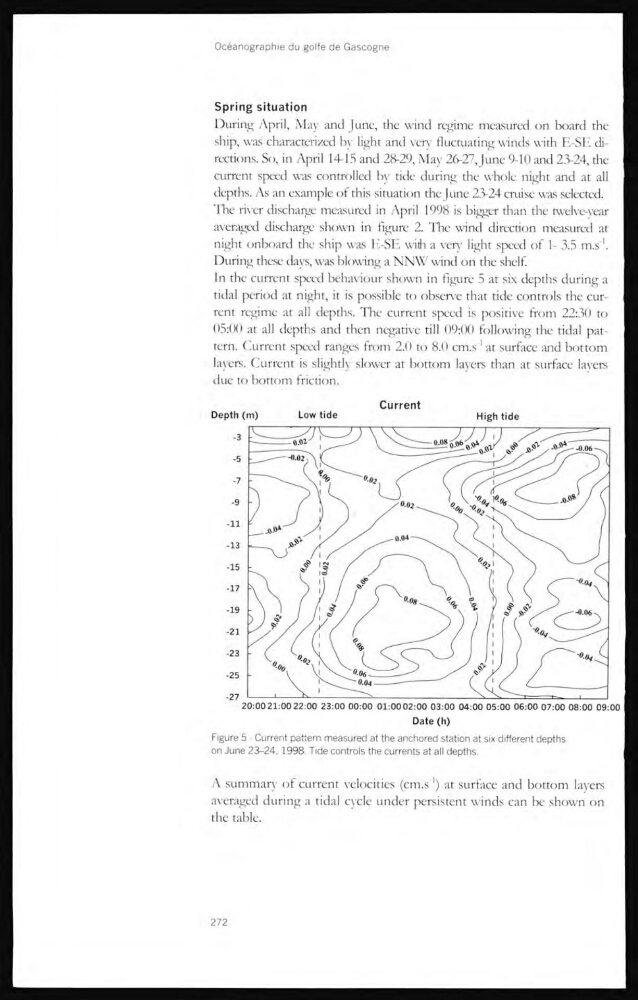
In the current speed behat iour shown in figure 5 at six depths during a
tidal period at night, it is possible to obsene that tide controls the current regime at all depths. The current speed is positive from 22:30 to
05:00 at all depths and then negative till 09:00 following the tidal pattern. Current speed ranges from 2.0 to 8.0 cm.s -1 at surface and bottom
layers. Current is slightly slower at bottom lavers than at surface lavers
due to bottom friction.
Figure 5 ■ Current pattern measured at the anchored station at six different depths
on June 23-24, 1998. Tide controls the currents at all depths.
A summary of current velocities (cm.s - 1 ) at surface and bottom layers
averaged during a tidal cycle under persistent winds can be shown on
the table.
272
During April, May and June, the wind regime measured on board the
ship, was characterized by light and very fluctuating winds with E-SE directions. So, in April 14-15 and 28-29, May 26-27, June 9-10 and 23-24, the
current speed was controlled by tide during the whole night and at all
depths. As an example of this situation the June 23-24 cruise was selected.
The river discharge measured in April 1998 is bigger than the twelve-year
averaged discharge shown in figure 2. The wind direction measured at
night onboard the ship was E-SE wilh a very light speed of 1- 3.5 m.s '.
During these days, was blowing a NNW wind on the shelf.
In the current speed behat iour shown in figure 5 at six depths during a
tidal period at night, it is possible to obsene that tide controls the current regime at all depths. The current speed is positive from 22:30 to
05:00 at all depths and then negative till 09:00 following the tidal pattern. Current speed ranges from 2.0 to 8.0 cm.s -1 at surface and bottom
layers. Current is slightly slower at bottom lavers than at surface lavers
due to bottom friction.
Figure 5 ■ Current pattern measured at the anchored station at six different depths
on June 23-24, 1998. Tide controls the currents at all depths.
A summary of current velocities (cm.s - 1 ) at surface and bottom layers
averaged during a tidal cycle under persistent winds can be shown on
the table.
272