

CoastGIS'99: geomatics and coastal environment
analysis method entity. All values are linked to a parameter described
by a code and a full name, accompanied by the measurement unit,
matrix and substrate.
To incorporate information on the quality of the analysis method, three
different aspects have to be introduced: QUASIMEME intercomparison
exercise codes (Topping, 1998), control chart information and intercalibration exercises. For a given service measuring a given parameter
with a given analysis method, one or more scores can be obtained during
intercomparison exercise(s), and similarly for information on control
chart(s) ancl intercalibration exercises.
Conceptual datamodel
Following the data semantics, a conceptual datamodel was developed
for seawater. The DB-MAIN case tool was used for the design of the model
(Hick et al., 1999). Twenty-one entities and twenty-nine relations
compose this model.
Some entities are linked together by more than one relation such as
“project” with “person” because there is one co-ordinator for a project
and many other people working on that project. The cardinalities are
used to express these constraints (e.g., one and only one person is coordinator for a project, but a person can supervise from zero to N projects).
To avoid mistakes and inconsistency, the first three normal forms of the
database conception rules were checked and some modifications were
made to satisfy them (Kroenke & Dolan, 1988). With respect to the
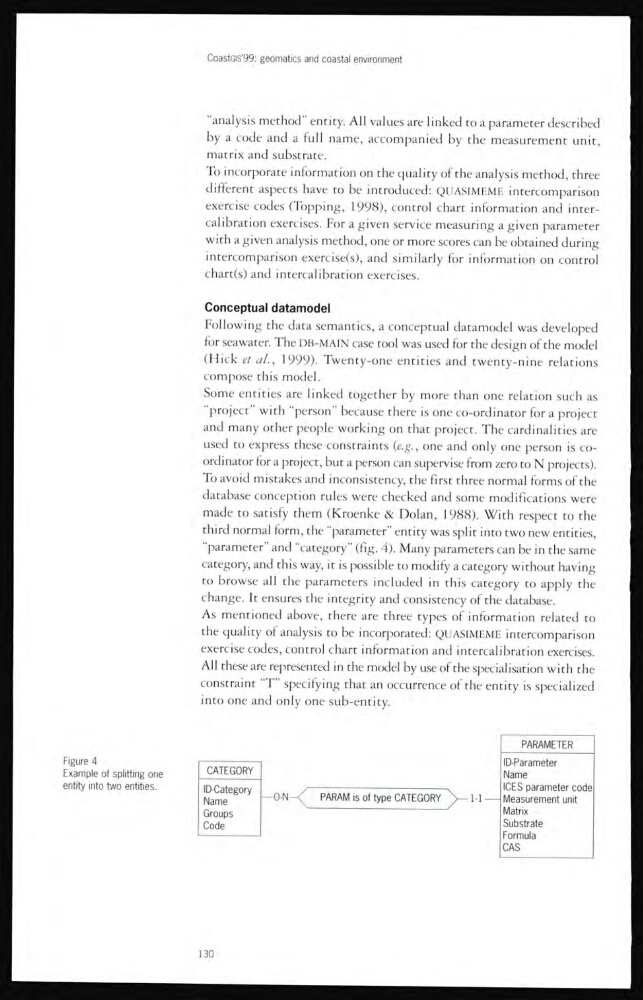
third normal form, the “parameter” entity was split into two new entities,
parameter” and “category” (fig. 4). Many parameters can be in the same
category, and this way, it is possible to modify a category without having
to browse all the parameters included in this category to apply the
change. It ensures the integrity and consistency of the database.
As mentioned above, there are three types of information related to
the quality of analysis to be incorporated: QUASIMEME intercomparison
exercise codes, control chart information and intercalibration exercises.
All these are represented m the model by use of the specialisation with the
constraint “T" specifying that an occurrence of the entity is specialized
into one and only one sub-entity.
Figure 4
Example of splltting one
entity into two entities.
130
analysis method entity. All values are linked to a parameter described
by a code and a full name, accompanied by the measurement unit,
matrix and substrate.
To incorporate information on the quality of the analysis method, three
different aspects have to be introduced: QUASIMEME intercomparison
exercise codes (Topping, 1998), control chart information and intercalibration exercises. For a given service measuring a given parameter
with a given analysis method, one or more scores can be obtained during
intercomparison exercise(s), and similarly for information on control
chart(s) ancl intercalibration exercises.
Conceptual datamodel
Following the data semantics, a conceptual datamodel was developed
for seawater. The DB-MAIN case tool was used for the design of the model
(Hick et al., 1999). Twenty-one entities and twenty-nine relations
compose this model.
Some entities are linked together by more than one relation such as
“project” with “person” because there is one co-ordinator for a project
and many other people working on that project. The cardinalities are
used to express these constraints (e.g., one and only one person is coordinator for a project, but a person can supervise from zero to N projects).
To avoid mistakes and inconsistency, the first three normal forms of the
database conception rules were checked and some modifications were
made to satisfy them (Kroenke & Dolan, 1988). With respect to the
third normal form, the “parameter” entity was split into two new entities,
parameter” and “category” (fig. 4). Many parameters can be in the same
category, and this way, it is possible to modify a category without having
to browse all the parameters included in this category to apply the
change. It ensures the integrity and consistency of the database.
As mentioned above, there are three types of information related to
the quality of analysis to be incorporated: QUASIMEME intercomparison
exercise codes, control chart information and intercalibration exercises.
All these are represented m the model by use of the specialisation with the
constraint “T" specifying that an occurrence of the entity is specialized
into one and only one sub-entity.
Figure 4
Example of splltting one
entity into two entities.
130