

System design and organization, access to data
Design of the IDOD database prototype
Data semantics
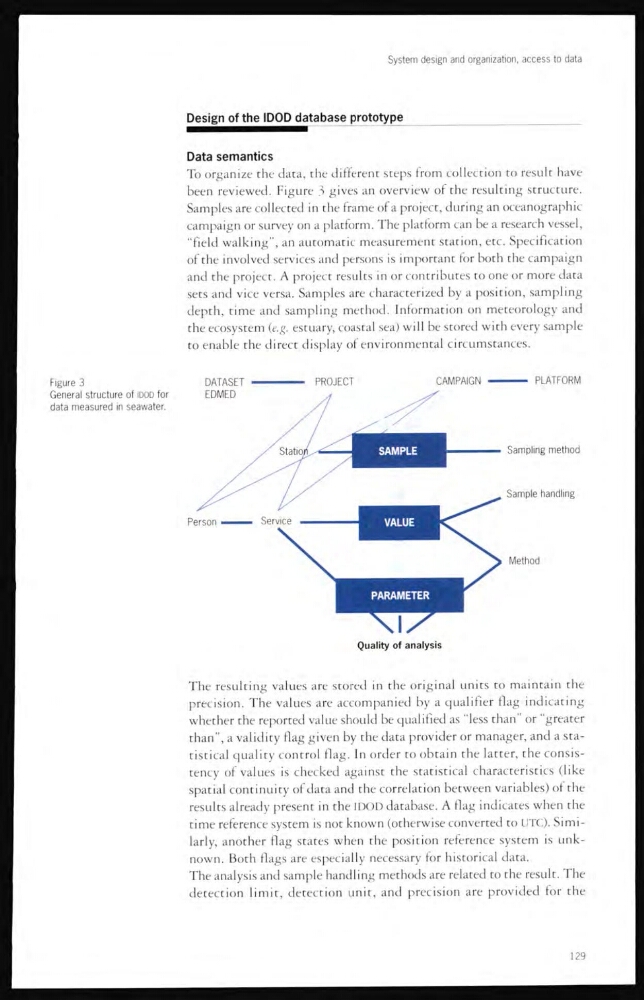
To organize the data, the different steps from collection to result have
been reviewed. Figure 3 gives an overview of the resulting structure.
Samples are collected in the frame of a project, during an oceanographic
campaign or survey on a platform. The platform can be a research vessel,
“field walking”, an automatic measurement station, etc. Specification
of the involved services and persons is important for both the campaign
and the project. A project results in or contributes to one or more data
sets and vice versa. Samples are characterized by a position, sampling
depth, time and sampling method. Information on meteorology and
the ecosystem (e.g. estuary, coastal sea) will be stored with every sample
to enable the direct display of environmental circumstances.
Figure 3
General structure of IDOD for
data measured in seawater.
The resulting values are stored in the original units to maintain the
precision. The values are accompanied by a qualifier flag indicating
whether the reported value should be qualified as “less than” or “greater
than”, a validity flag given by the data provider or manager, and a statistical quality control flag. In order to obtain the latter, the consistency of values is checked against the statistical characteristics (like
spatial continuity of data and the correlation between variables) of the
results already present in the IDOD database. A flag indicates when the
time reference system is not known (otherwise converted to UTC). Similarly, another flag states when the position reference system is unknown. Both flags are especially necessary for historical data.
The analysis and sample handling methods are related to the result. The
detection limit, detection unit, and precision are provided for the
129
Design of the IDOD database prototype
Data semantics
To organize the data, the different steps from collection to result have
been reviewed. Figure 3 gives an overview of the resulting structure.
Samples are collected in the frame of a project, during an oceanographic
campaign or survey on a platform. The platform can be a research vessel,
“field walking”, an automatic measurement station, etc. Specification
of the involved services and persons is important for both the campaign
and the project. A project results in or contributes to one or more data
sets and vice versa. Samples are characterized by a position, sampling
depth, time and sampling method. Information on meteorology and
the ecosystem (e.g. estuary, coastal sea) will be stored with every sample
to enable the direct display of environmental circumstances.
Figure 3
General structure of IDOD for
data measured in seawater.
The resulting values are stored in the original units to maintain the
precision. The values are accompanied by a qualifier flag indicating
whether the reported value should be qualified as “less than” or “greater
than”, a validity flag given by the data provider or manager, and a statistical quality control flag. In order to obtain the latter, the consistency of values is checked against the statistical characteristics (like
spatial continuity of data and the correlation between variables) of the
results already present in the IDOD database. A flag indicates when the
time reference system is not known (otherwise converted to UTC). Similarly, another flag states when the position reference system is unknown. Both flags are especially necessary for historical data.
The analysis and sample handling methods are related to the result. The
detection limit, detection unit, and precision are provided for the
129