

CoastGIS'99: geomatics and coastal environment
Entity
The entity represents a set of objects of the same type that are abstract
or concrete. It is a group of attributes and represents only one semantic
concept. The entity determines a type, a class or a group where all the
elements are called the entity occurrences. To refer directly to one
occurrence of an entity, the entity requires a special attribute called an
idmtifier orprimary key. One value of this identifier corresponds to one
and only one occurrence of the entity. It must be invariable and can never
be changed or modified until the occurrence is deleted.
Relation
The relation is a group of associations of the same type between two
or more occurrences of entities of same or different types. The relation
translates the words of the natural language. For example, in the figure
above, the relation “works at” between the entities Service and Person
is the translation of the sentence "person X works at service Y”. Contrary
to an entity, a relation has no real existence. The relation is simply
expressed by the implied entities. The minimum number of entities
involved in a relation is two. The dimension of a relation is the number
of participating entities. Like an entity, a relation can also contain some
attributes.
Cardinality
For each entity-relation pair, the cardinalities are the minimum and
maximum numbers of occurrences of the relation that can exist for one
occurrence of the corresponding entity. The cardinality values are
indicated above or on the link between the entity and the relation.
Logical datamodel
The logical level is the second step in the database design. The entities
are converted into tables for a relational database. There are three kinds
of relations to be considered: one to one, one to many, many to many.
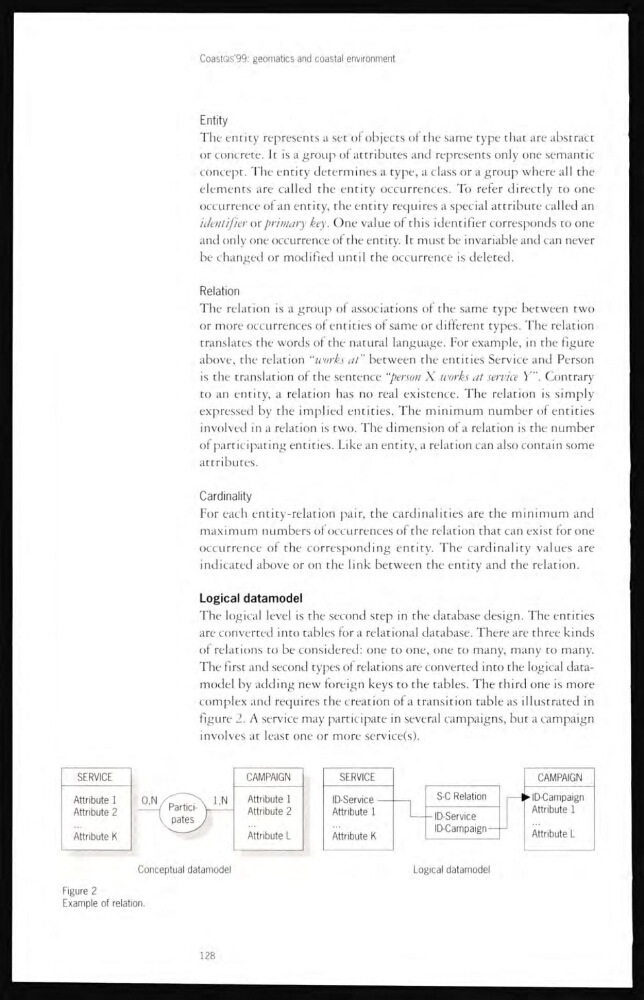
The first and second types of relations are converted into the logical datamodel by adding new foreign keys to the tables. The third one is more
complex and requires the creation of a transition table as illustrated in
figure 2. A service may participate in several campaigns, but a campaign
involves at least one or more service(s).
Figure 2
Example of relation.
128
Entity
The entity represents a set of objects of the same type that are abstract
or concrete. It is a group of attributes and represents only one semantic
concept. The entity determines a type, a class or a group where all the
elements are called the entity occurrences. To refer directly to one
occurrence of an entity, the entity requires a special attribute called an
idmtifier orprimary key. One value of this identifier corresponds to one
and only one occurrence of the entity. It must be invariable and can never
be changed or modified until the occurrence is deleted.
Relation
The relation is a group of associations of the same type between two
or more occurrences of entities of same or different types. The relation
translates the words of the natural language. For example, in the figure
above, the relation “works at” between the entities Service and Person
is the translation of the sentence "person X works at service Y”. Contrary
to an entity, a relation has no real existence. The relation is simply
expressed by the implied entities. The minimum number of entities
involved in a relation is two. The dimension of a relation is the number
of participating entities. Like an entity, a relation can also contain some
attributes.
Cardinality
For each entity-relation pair, the cardinalities are the minimum and
maximum numbers of occurrences of the relation that can exist for one
occurrence of the corresponding entity. The cardinality values are
indicated above or on the link between the entity and the relation.
Logical datamodel
The logical level is the second step in the database design. The entities
are converted into tables for a relational database. There are three kinds
of relations to be considered: one to one, one to many, many to many.
The first and second types of relations are converted into the logical datamodel by adding new foreign keys to the tables. The third one is more
complex and requires the creation of a transition table as illustrated in
figure 2. A service may participate in several campaigns, but a campaign
involves at least one or more service(s).
Figure 2
Example of relation.
128