

526
M. V. L. BENNETT
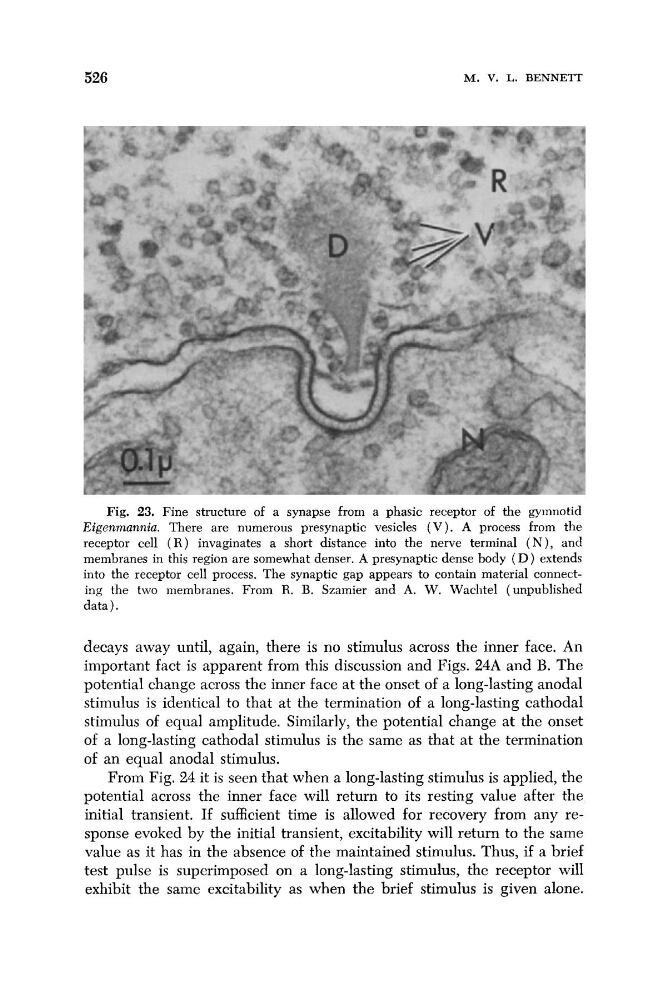
Fig. 23. Fine structure of a synapse from a phasic receptor of the gymnotid
Eigenmannia. There are numerous presynaptic vesicles ( V ) . A process from the
receptor cell ( R ) invaginates a short distance into the nerve terminal ( N ) , and
membranes in this region are somewhat denser. A presynaptic dense body ( D ) extends
into the receptor cell process. The synaptic gap appears to contain material connecting the two membranes. From R. B. Szamier and A. W. Wachtel (unpublished
data).
decays away until, again, there is no stimulus across the inner face. An
important fact is apparent from this discussion and Figs. 24A and B. The
potential change across the inner face at the onset of a long-lasting anodal
stimulus is identical to that at the termination of a long-lasting cathodal
stimulus of equal amplitude. Similarly, the potential change at the onset
of a long-lasting cathodal stimulus is the same as that at the termination
of an equal anodal stimulus.
From Fig. 24 it is seen that when a long-lasting stimulus is applied, the
potential across the inner face will return to its resting value after the
initial transient. If sufficient time is allowed for recovery from any response evoked by the initial transient, excitability will return to the same
value as it has in the absence of the maintained stimulus. Thus, if a brief
test pulse is superimposed on a long-lasting stimulus, the receptor will
exhibit the same excitability as when the brief stimulus is given alone.
M. V. L. BENNETT
Fig. 23. Fine structure of a synapse from a phasic receptor of the gymnotid
Eigenmannia. There are numerous presynaptic vesicles ( V ) . A process from the
receptor cell ( R ) invaginates a short distance into the nerve terminal ( N ) , and
membranes in this region are somewhat denser. A presynaptic dense body ( D ) extends
into the receptor cell process. The synaptic gap appears to contain material connecting the two membranes. From R. B. Szamier and A. W. Wachtel (unpublished
data).
decays away until, again, there is no stimulus across the inner face. An
important fact is apparent from this discussion and Figs. 24A and B. The
potential change across the inner face at the onset of a long-lasting anodal
stimulus is identical to that at the termination of a long-lasting cathodal
stimulus of equal amplitude. Similarly, the potential change at the onset
of a long-lasting cathodal stimulus is the same as that at the termination
of an equal anodal stimulus.
From Fig. 24 it is seen that when a long-lasting stimulus is applied, the
potential across the inner face will return to its resting value after the
initial transient. If sufficient time is allowed for recovery from any response evoked by the initial transient, excitability will return to the same
value as it has in the absence of the maintained stimulus. Thus, if a brief
test pulse is superimposed on a long-lasting stimulus, the receptor will
exhibit the same excitability as when the brief stimulus is given alone.