

11. ELECTRORECEPTION
527
V
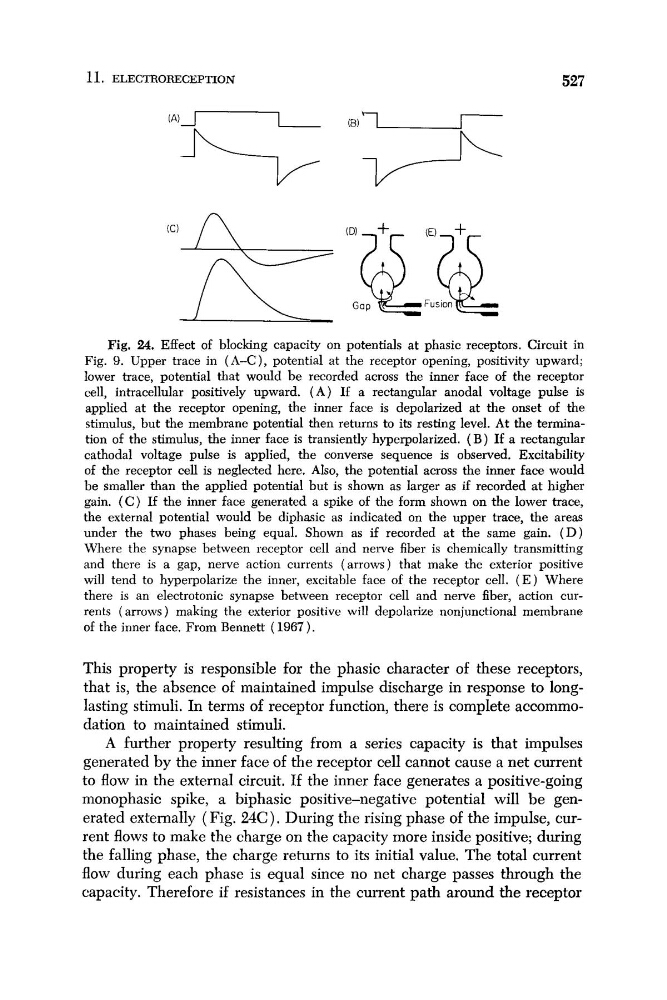
Fig. 24. Effect of blocking capacity on potentials at phasic receptors. Circuit in
Fig. 9. Upper trace in (A-C), potential at the receptor opening, positivity upward;
lower trace, potential that would be recorded across the inner face of the receptor
cell, intracellular positively upward. ( A ) If a rectangular anodal voltage pulse is
applied at the receptor opening, the inner face is depolarized at the onset of the
stimulus, but the membrane potential then returns to its resting level. At the tennination of the stimulus, the inner face is transiently hyperpolarized. ( B ) If a rectangular
cathodal voltage pulse is applied, the converse sequence is observed. Excitability
of the receptor cell is neglected here. Also, the potential across the inner face would
be smaller than the applied potential but is shown as larger as if recorded at higher
gain. ( C ) If the inner face generated a spike of the form shown on the lower trace,
the external potential would be diphasic as indicated on the upper trace, the areas
under the two phases being equal. Shown as if recorded at the same gain. ( D )
Where the synapse between receptor cell and nerve fiber is chemically transmitting
and there is a gap, nerve action currents (arrows) that make the exterior positive
will tend to hyperpolarize the inner, excitable face of the receptor cell. ( E ) Where
there is an electrotonic synapse between receptor cell and nerve fiber, action currents ( arrows ) making the exterior positive will depolarize nonjunctional membrane
of the inner face. From Bennett ( 1967 ) .
This property is responsible for the phasic character of these receptors,
that is, the absence of maintained impulse discharge in response to longlasting stimuli. In terms of receptor function, there is complete accommodation to maintained stimuli.
A further property resulting from a series capacity is that impulses
generated by the inner face of the receptor cell cannot cause a net current
to flow in the external circuit. If the inner face generates a positive-going
monophasic spike, a biphasic positive-negative potential will be generated externally ( Fig. 24C). During the rising phase of the impulse, current flows to make the charge on the capacity more inside positive; during
the falling phase, the charge returns to its initial value. The total current
flow during each phase is equal since no net charge passes through the
capacity. Therefore if resistances in the current path around the receptor
527
V
Fig. 24. Effect of blocking capacity on potentials at phasic receptors. Circuit in
Fig. 9. Upper trace in (A-C), potential at the receptor opening, positivity upward;
lower trace, potential that would be recorded across the inner face of the receptor
cell, intracellular positively upward. ( A ) If a rectangular anodal voltage pulse is
applied at the receptor opening, the inner face is depolarized at the onset of the
stimulus, but the membrane potential then returns to its resting level. At the tennination of the stimulus, the inner face is transiently hyperpolarized. ( B ) If a rectangular
cathodal voltage pulse is applied, the converse sequence is observed. Excitability
of the receptor cell is neglected here. Also, the potential across the inner face would
be smaller than the applied potential but is shown as larger as if recorded at higher
gain. ( C ) If the inner face generated a spike of the form shown on the lower trace,
the external potential would be diphasic as indicated on the upper trace, the areas
under the two phases being equal. Shown as if recorded at the same gain. ( D )
Where the synapse between receptor cell and nerve fiber is chemically transmitting
and there is a gap, nerve action currents (arrows) that make the exterior positive
will tend to hyperpolarize the inner, excitable face of the receptor cell. ( E ) Where
there is an electrotonic synapse between receptor cell and nerve fiber, action currents ( arrows ) making the exterior positive will depolarize nonjunctional membrane
of the inner face. From Bennett ( 1967 ) .
This property is responsible for the phasic character of these receptors,
that is, the absence of maintained impulse discharge in response to longlasting stimuli. In terms of receptor function, there is complete accommodation to maintained stimuli.
A further property resulting from a series capacity is that impulses
generated by the inner face of the receptor cell cannot cause a net current
to flow in the external circuit. If the inner face generates a positive-going
monophasic spike, a biphasic positive-negative potential will be generated externally ( Fig. 24C). During the rising phase of the impulse, current flows to make the charge on the capacity more inside positive; during
the falling phase, the charge returns to its initial value. The total current
flow during each phase is equal since no net charge passes through the
capacity. Therefore if resistances in the current path around the receptor