

10. ELECTRIC ORGANS
447
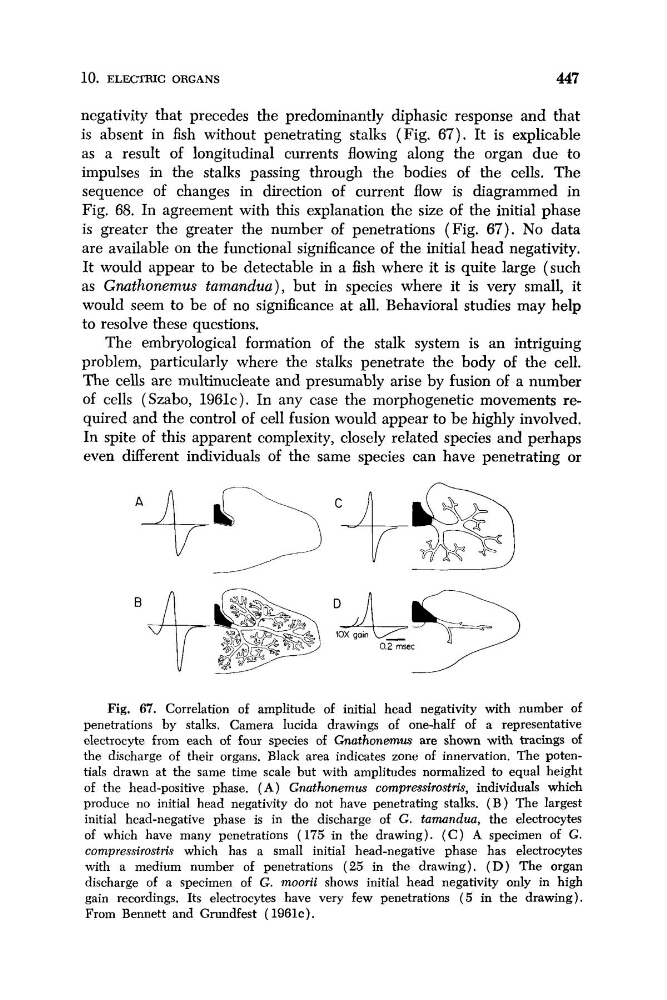
negativity that precedes the predominantly diphasic response and that
is absent in fish without penetrating stalks (Fig. 67). It is explicable
as a result of longitudinal currents flowing along the organ due to
impulses in the stalks passing through the bodies of the cells. The
sequence of changes in direction of current flow is diagrammed in
Fig. 68. In agreement with this explanation the size of the initial phase
is greater the greater the number of penetrations (Fig. 67). No data
are available on the functional significance of the initial head negativity.
It would appear to be detectable in a fish where it is quite large (such
as Gnathonernus tamandua), but in species where it is very small, it
would seem to be of no significance at all. Behavioral studies may help
to resolve these questions.
The embryological formation of the stalk system is an intriguing
problem, particularly where the stalks penetrate the body of the cell.
The cells are multinucleate and presumably arise by fusion of a number
of cells (Szabo, 1961~). In any case the morphogenetic movements required and the control of cell fusion would appear to be highly involved.
In spite of this apparent complexity, closely related species and perhaps
even different individuals of the same species can have penetrating or
0.2 msec
Fig. 67. Correlation of amplitude of initial head negativity with number of
penetrations by stalks. Camera lucida drawings of one-half of a representative
electrocyte from each of four species of Gnathonmus are shown with tracings of
the discharge of their organs. Black area indicates zone of innervation. The potentials drawn at the same time scale but with amplitudes normalized to equal height
of the head-positive phase. ( A ) Gnathonemus compressirostris, individuals which
produce no initial head negativity do not have penetrating stalks. ( B ) The largest
initial head-negative phase is in the discharge of G. tamundua, the electrocytes
of which have many penetrations (175 in the drawing). ( C ) A specimen of G .
compressirostris which has a small initial head-negative phase has electrocytes
with a medium number of penetrations (25 in the drawing). ( D ) The organ
discharge of a specimen of G. moorii shows initial head negativity only in high
gain recordings. Its electrocytes have very few penetrations ( 5 in the drawing).
From Bennett and Grundfest ( 1 9 6 1 ~ ) .
447
negativity that precedes the predominantly diphasic response and that
is absent in fish without penetrating stalks (Fig. 67). It is explicable
as a result of longitudinal currents flowing along the organ due to
impulses in the stalks passing through the bodies of the cells. The
sequence of changes in direction of current flow is diagrammed in
Fig. 68. In agreement with this explanation the size of the initial phase
is greater the greater the number of penetrations (Fig. 67). No data
are available on the functional significance of the initial head negativity.
It would appear to be detectable in a fish where it is quite large (such
as Gnathonernus tamandua), but in species where it is very small, it
would seem to be of no significance at all. Behavioral studies may help
to resolve these questions.
The embryological formation of the stalk system is an intriguing
problem, particularly where the stalks penetrate the body of the cell.
The cells are multinucleate and presumably arise by fusion of a number
of cells (Szabo, 1961~). In any case the morphogenetic movements required and the control of cell fusion would appear to be highly involved.
In spite of this apparent complexity, closely related species and perhaps
even different individuals of the same species can have penetrating or
0.2 msec
Fig. 67. Correlation of amplitude of initial head negativity with number of
penetrations by stalks. Camera lucida drawings of one-half of a representative
electrocyte from each of four species of Gnathonmus are shown with tracings of
the discharge of their organs. Black area indicates zone of innervation. The potentials drawn at the same time scale but with amplitudes normalized to equal height
of the head-positive phase. ( A ) Gnathonemus compressirostris, individuals which
produce no initial head negativity do not have penetrating stalks. ( B ) The largest
initial head-negative phase is in the discharge of G. tamundua, the electrocytes
of which have many penetrations (175 in the drawing). ( C ) A specimen of G .
compressirostris which has a small initial head-negative phase has electrocytes
with a medium number of penetrations (25 in the drawing). ( D ) The organ
discharge of a specimen of G. moorii shows initial head negativity only in high
gain recordings. Its electrocytes have very few penetrations ( 5 in the drawing).
From Bennett and Grundfest ( 1 9 6 1 ~ ) .