

448
M. V. L. BENNETT
-
-
-
B
............. . . TJ
;
* \ : +
;
. ;
;-. . . . . . . . . . . . . . . . . . . . . . . .
............... " .......
+
+
+
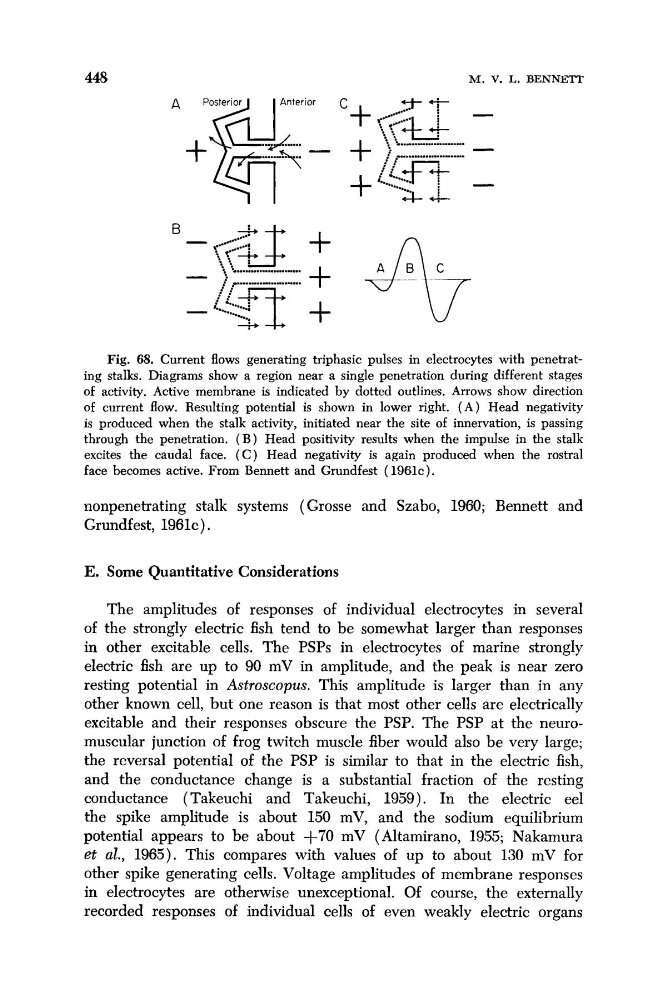
Fig. 68. Current flows generating triphasic pulses in electrocytes with penetrating stalks. Diagrams show a region near a single penetration during different stages
of activity. Active membrane is indicated by dotted outlines. Arrows show direction
of current flow. Resulting potential is shown in lower right. (A) Head negativity
is produced when the stalk activity, initiated near the site of innervation, is passing
through the penetration. ( B ) Head positivity results when the impulse in the stalk
excites the caudal face. ( C ) Head negativity is again produced when the rostra1
face becomes active. From Bennett and Grundfest ( 1 9 6 1 ~ ) .
nonpenetrating stalk systems (Grosse and Szabo, 19600; Bennett and
Grundfest, 1961~).
E. Some Quantitative Considerations
The amplitudes of responses of individual electrocytes in several
of the strongly electric fish tend to be somewhat larger than responses
in other excitable cells. The PSPs in electrocytes of marine strongly
electric fish are up to 90 mV in amplitude, and the peak is near zero
resting potential in Astroscopus. This amplitude is larger than in any
other known cell, but one reason is that most other cells are electrically
excitable and their responses obscure the PSP. The PSP at the neuromuscular junction of frog twitch muscle fiber would also be very large;
the reversal potential of the PSP is similar to that in the electric fish,
and the conductance change is a substantial fraction of the resting
conductance (Takeuchi and Takeuchi, 1959). In the electric eel
the spike amplitude is about 150 mV, and the sodium equilibrium
potential appears to be about +70 mV (Altamirano, 1955; Nakamura
et uZ., 1965). This compares with values of up to about 130 mV for
other spike generating cells. Voltage amplitudes of membrane responses
in electrocytes are otherwise unexceptional. Of course, the externally
recorded responses of individual cells of even weakly electric organs
M. V. L. BENNETT
-
-
-
B
............. . . TJ
;
* \ : +
;
. ;
;-. . . . . . . . . . . . . . . . . . . . . . . .
............... " .......
+
+
+
Fig. 68. Current flows generating triphasic pulses in electrocytes with penetrating stalks. Diagrams show a region near a single penetration during different stages
of activity. Active membrane is indicated by dotted outlines. Arrows show direction
of current flow. Resulting potential is shown in lower right. (A) Head negativity
is produced when the stalk activity, initiated near the site of innervation, is passing
through the penetration. ( B ) Head positivity results when the impulse in the stalk
excites the caudal face. ( C ) Head negativity is again produced when the rostra1
face becomes active. From Bennett and Grundfest ( 1 9 6 1 ~ ) .
nonpenetrating stalk systems (Grosse and Szabo, 19600; Bennett and
Grundfest, 1961~).
E. Some Quantitative Considerations
The amplitudes of responses of individual electrocytes in several
of the strongly electric fish tend to be somewhat larger than responses
in other excitable cells. The PSPs in electrocytes of marine strongly
electric fish are up to 90 mV in amplitude, and the peak is near zero
resting potential in Astroscopus. This amplitude is larger than in any
other known cell, but one reason is that most other cells are electrically
excitable and their responses obscure the PSP. The PSP at the neuromuscular junction of frog twitch muscle fiber would also be very large;
the reversal potential of the PSP is similar to that in the electric fish,
and the conductance change is a substantial fraction of the resting
conductance (Takeuchi and Takeuchi, 1959). In the electric eel
the spike amplitude is about 150 mV, and the sodium equilibrium
potential appears to be about +70 mV (Altamirano, 1955; Nakamura
et uZ., 1965). This compares with values of up to about 130 mV for
other spike generating cells. Voltage amplitudes of membrane responses
in electrocytes are otherwise unexceptional. Of course, the externally
recorded responses of individual cells of even weakly electric organs