

446
M. V. L. BENNETT
m m
0
0.5
10
2 0
A
B
C
D
0.5 mm ventral
1.0 mm ventral
2 5 mm ventral
1% g '.O dorsal mm
5 msec
0 5 msec
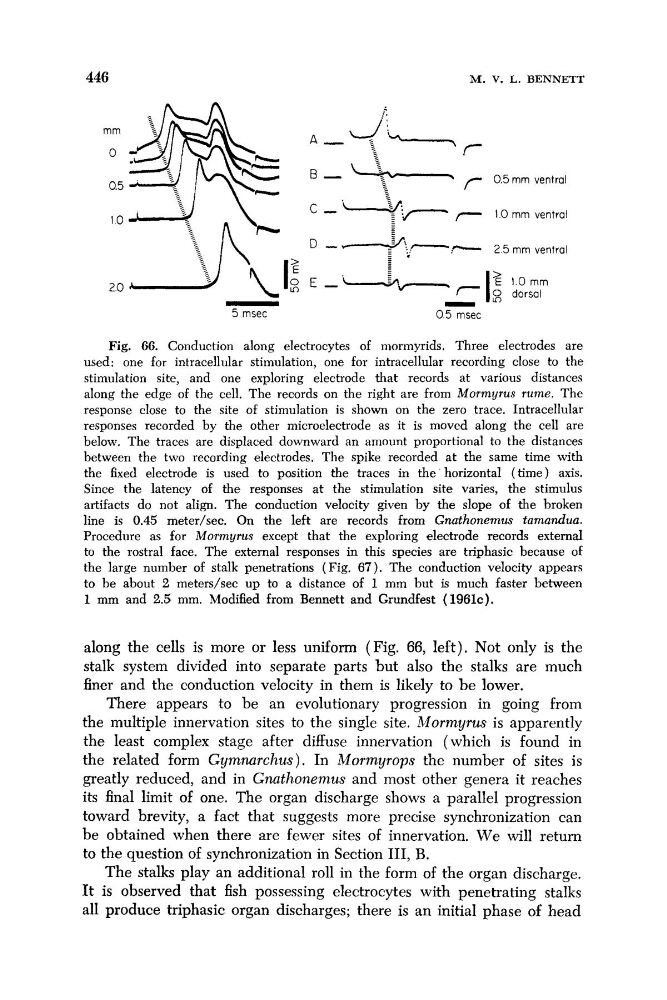
Fig. 66. Conduction along electrocytes of mormyrids. Three electrodes are
used: one for intracellular stimulation, one for intracellular recording close to the
stimulation site, and one exploring electrode that records at various distances
along the edge of the cell. The records on the right are from Mormyrus rume. The
response close to the site of stimulation is shown on the zero trace. Intracellular
responses recorded by the other microelectrode as it is moved along the cell are
below, The traces are displaced downward an amount proportional to the distances
between the two recording electrodes. The spike recorded at the same time with
the fixed electrode is used to position the traces in the horizontal (time) axis.
Since the latency of the responses at the stimulation site vanes, the stimulus
artifacts do not align. The conduction velocity given by the slope of the broken
line is 0.45 meter/sec. On the left are records from Gnathonemus tamandua.
Procedure as for Mormyrus except that the exploring electrode records external
to the rostra1 face. The external responses in this species are triphasic because of
the large number of stalk penetrations (Fig. 67). The conduction velocity appears
to be about 2 meters/sec up to a distance of 1 mm but is much faster between
1 mm and 2.5 mm. Modified from Bennett and Grundfest (1961~).
along the cells is more or less uniform (Fig. 66, left). Not only is the
stalk system divided into separate parts but also the stalks are much
finer and the conduction velocity in them is likely to be lower.
There appears to be an evolutionary progression in going from
the multiple innervation sites to the single site. Mormyrus is apparently
the least complex stage after diffuse innervation (which is found in
the related form Gymnarchus). In Mormyrops the number of sites is
greatly reduced, and in Gnathonemus and most other genera it reaches
its final limit of one. The organ discharge shows a parallel progression
toward brevity, a fact that suggests more precise synchronization can
be obtained when there are fewer sites of innervation. We will return
to the question of synchronization in Section 111, B.
The stalks play an additional roll in the form of the organ discharge.
It is observed that fish possessing electrocytes with penetrating stalks
all produce triphasic organ discharges; there is an initial phase of head
M. V. L. BENNETT
m m
0
0.5
10
2 0
A
B
C
D
0.5 mm ventral
1.0 mm ventral
2 5 mm ventral
1% g '.O dorsal mm
5 msec
0 5 msec
Fig. 66. Conduction along electrocytes of mormyrids. Three electrodes are
used: one for intracellular stimulation, one for intracellular recording close to the
stimulation site, and one exploring electrode that records at various distances
along the edge of the cell. The records on the right are from Mormyrus rume. The
response close to the site of stimulation is shown on the zero trace. Intracellular
responses recorded by the other microelectrode as it is moved along the cell are
below, The traces are displaced downward an amount proportional to the distances
between the two recording electrodes. The spike recorded at the same time with
the fixed electrode is used to position the traces in the horizontal (time) axis.
Since the latency of the responses at the stimulation site vanes, the stimulus
artifacts do not align. The conduction velocity given by the slope of the broken
line is 0.45 meter/sec. On the left are records from Gnathonemus tamandua.
Procedure as for Mormyrus except that the exploring electrode records external
to the rostra1 face. The external responses in this species are triphasic because of
the large number of stalk penetrations (Fig. 67). The conduction velocity appears
to be about 2 meters/sec up to a distance of 1 mm but is much faster between
1 mm and 2.5 mm. Modified from Bennett and Grundfest (1961~).
along the cells is more or less uniform (Fig. 66, left). Not only is the
stalk system divided into separate parts but also the stalks are much
finer and the conduction velocity in them is likely to be lower.
There appears to be an evolutionary progression in going from
the multiple innervation sites to the single site. Mormyrus is apparently
the least complex stage after diffuse innervation (which is found in
the related form Gymnarchus). In Mormyrops the number of sites is
greatly reduced, and in Gnathonemus and most other genera it reaches
its final limit of one. The organ discharge shows a parallel progression
toward brevity, a fact that suggests more precise synchronization can
be obtained when there are fewer sites of innervation. We will return
to the question of synchronization in Section 111, B.
The stalks play an additional roll in the form of the organ discharge.
It is observed that fish possessing electrocytes with penetrating stalks
all produce triphasic organ discharges; there is an initial phase of head