

10. ELECTRIC ORGANS
445
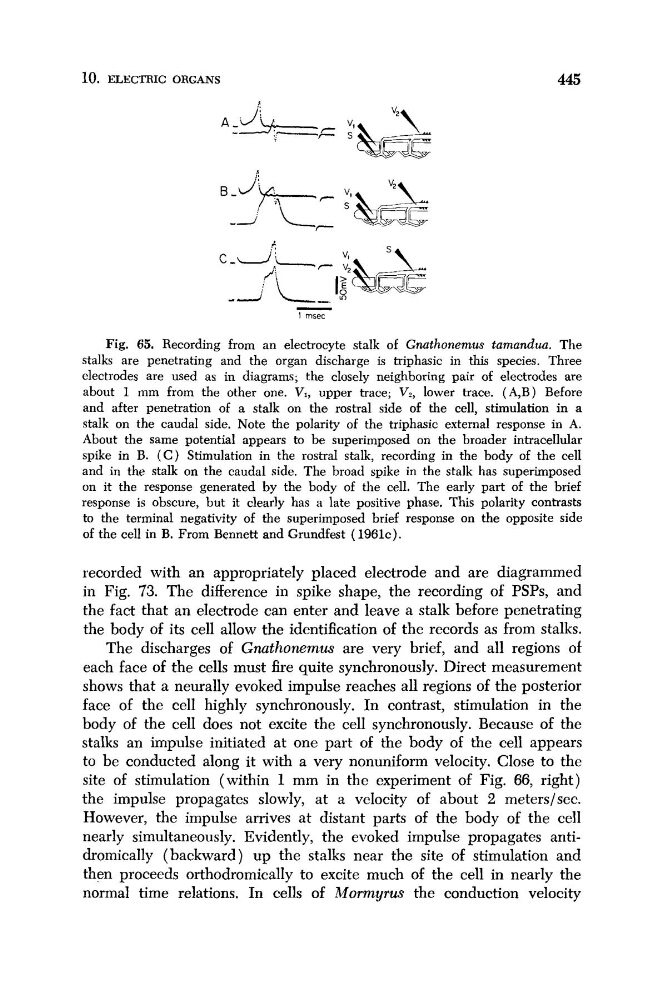
Fig. 65. Recording from an electrocyte stalk of Gnathonernus tamandua. The
stalks are penetrating and the organ discharge is triphasic in this species. Three
electrodes are used as in diagrams; the closely neighboring pair of electrodes are
about 1 mm from the other one. V,, upper trace; V,, lower trace. (A,B) Before
and after penetration of a stalk on the rostral side of the cell, stimulation in a
stalk on the caudal side. Note the polarity of the triphasic external response in A.
About the same potential appears to be superimposed on the broader intracellular
spike in B. ( C ) Stimulation in the rostral stalk, recording in the body of the cell
and in the stalk on the caudal side. The broad spike in the stalk has superimposed
on it the response generated by the body of the cell. The early part of the brief
response is obscure, but it clearly has a late positive phase. This polarity contrasts
to the terminal negativity of the superimposed brief response on the opposite side
of the cell in B. From Bennett and Grundfest ( 1 9 6 1 ~ ) .
recorded with an appropriately placed electrode and are diagrammed
in Fig. 73. The difference in spike shape, the recording of PSPs, and
the fact that an electrode can enter and leave a stalk before penetrating
the body of its cell allow the identification of the records as from stalks.
The discharges of Gnathonernus are very brief, and all regions of
each face of the cells must fire quite synchronously. Direct measurement
shows that a neurally evoked impulse reaches all regions of the posterior
face of the cell highly synchronously. In contrast, stimulation in the
body of the cell does not excite the cell synchronously. Because of the
stalks an impulse initiated at one part of the body of the cell appears
to be conducted along it with a very nonuniform velocity. Close to the
site of stimulation (within 1 mm in the experiment of Fig. 66, right)
the impulse propagates slowly, at a velocity of about 2 meters/sec.
However, the impulse arrives at distant parts of the body of the cell
nearly simultaneously. Evidently, the evoked impulse propagates antidromically (backward) up the stalks near the site of stimulation and
then proceeds orthodromically to excite much of the cell in nearly the
normal time relations. In cells of Morrnyrus the conduction velocity
445
Fig. 65. Recording from an electrocyte stalk of Gnathonernus tamandua. The
stalks are penetrating and the organ discharge is triphasic in this species. Three
electrodes are used as in diagrams; the closely neighboring pair of electrodes are
about 1 mm from the other one. V,, upper trace; V,, lower trace. (A,B) Before
and after penetration of a stalk on the rostral side of the cell, stimulation in a
stalk on the caudal side. Note the polarity of the triphasic external response in A.
About the same potential appears to be superimposed on the broader intracellular
spike in B. ( C ) Stimulation in the rostral stalk, recording in the body of the cell
and in the stalk on the caudal side. The broad spike in the stalk has superimposed
on it the response generated by the body of the cell. The early part of the brief
response is obscure, but it clearly has a late positive phase. This polarity contrasts
to the terminal negativity of the superimposed brief response on the opposite side
of the cell in B. From Bennett and Grundfest ( 1 9 6 1 ~ ) .
recorded with an appropriately placed electrode and are diagrammed
in Fig. 73. The difference in spike shape, the recording of PSPs, and
the fact that an electrode can enter and leave a stalk before penetrating
the body of its cell allow the identification of the records as from stalks.
The discharges of Gnathonernus are very brief, and all regions of
each face of the cells must fire quite synchronously. Direct measurement
shows that a neurally evoked impulse reaches all regions of the posterior
face of the cell highly synchronously. In contrast, stimulation in the
body of the cell does not excite the cell synchronously. Because of the
stalks an impulse initiated at one part of the body of the cell appears
to be conducted along it with a very nonuniform velocity. Close to the
site of stimulation (within 1 mm in the experiment of Fig. 66, right)
the impulse propagates slowly, at a velocity of about 2 meters/sec.
However, the impulse arrives at distant parts of the body of the cell
nearly simultaneously. Evidently, the evoked impulse propagates antidromically (backward) up the stalks near the site of stimulation and
then proceeds orthodromically to excite much of the cell in nearly the
normal time relations. In cells of Morrnyrus the conduction velocity