

444
M. V. L. BENNETT
siveness of the two faces, the surfaces appear similar electron microscopically; both surfaces are moderately increased by tubules, that of
the anterior face slightly more so (Schwartz et al., 1971).
In Mormyrus r u m the organ discharge is predominantly head
negative. Both faces of the cells appear to generate spikes, although
it is difficult to be sure what fraction of responsiveness on the caudal
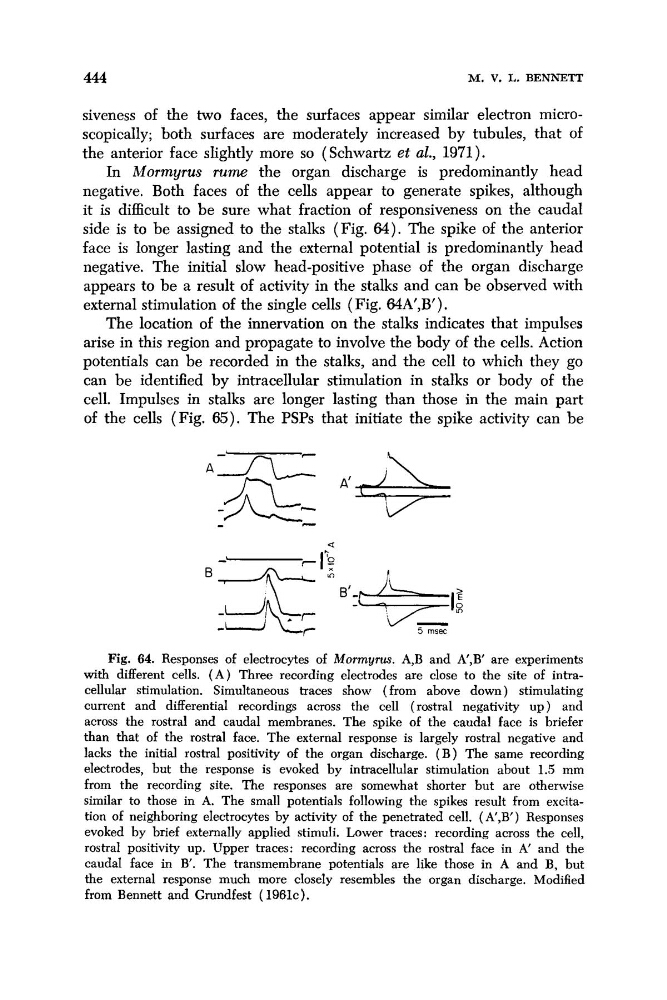
side is to be assigned to the stalks (Fig. 64). The spike of the anterior
face is longer lasting and the external potential is predominantly head
negative. The initial slow head-positive phase of the organ discharge
appears to be a result of activity in the stalks and can be observed with
external stimulation of the single cells (Fig. 64A',B').
The location of the innervation on the stalks indicates that impulses
arise in this region and propagate to involve the body of the cells. Action
potentials can be recorded in the stalks, and the cell to which they go
can be identified by intracellular stimulation in stalks or body of the
cell. Impulses in stalks are longer lasting than those in the main part
of the cells (Fig. 65). The PSPs that initiate the spike activity can be
Fig. 64. Responses of electrocytes of Mormyrus. A,B and A',B are experiments
with different cells. ( A ) Three recording electrodes are close to the site of intracellular stimulation. Simultaneous traces show ( from above down ) stimulating
current and differential recordings across the cell (rostral negativity up) and
across the rostral and caudal membranes. The spike of the caudal face is briefer
than that of the rostral face. The external response is largely rostral negative and
lacks the initial rostral positivity of the organ discharge. ( B ) The same recording
electrodes, but the response is evoked by intracellular stimulation about 1.5 mm
from the recording site. The responses are somewhat shorter but are otherwise
similar to those in A. The small potentials following the spikes result from excitation of neighboring electrocytes by activity of the penetrated cell. ( A',B') Responses
evoked by brief externally applied stimuli. Lower traces: recording across the cell,
rostral positivity up. Upper traces: recording across the rostral face in A' and the
caudal face in B . The transmembrane potentials are like those in A and B, but
the external response much more closely resembles the organ discharge. Modified
from Bennett and Grundfest ( 1 9 6 1 ~ ) .
M. V. L. BENNETT
siveness of the two faces, the surfaces appear similar electron microscopically; both surfaces are moderately increased by tubules, that of
the anterior face slightly more so (Schwartz et al., 1971).
In Mormyrus r u m the organ discharge is predominantly head
negative. Both faces of the cells appear to generate spikes, although
it is difficult to be sure what fraction of responsiveness on the caudal
side is to be assigned to the stalks (Fig. 64). The spike of the anterior
face is longer lasting and the external potential is predominantly head
negative. The initial slow head-positive phase of the organ discharge
appears to be a result of activity in the stalks and can be observed with
external stimulation of the single cells (Fig. 64A',B').
The location of the innervation on the stalks indicates that impulses
arise in this region and propagate to involve the body of the cells. Action
potentials can be recorded in the stalks, and the cell to which they go
can be identified by intracellular stimulation in stalks or body of the
cell. Impulses in stalks are longer lasting than those in the main part
of the cells (Fig. 65). The PSPs that initiate the spike activity can be
Fig. 64. Responses of electrocytes of Mormyrus. A,B and A',B are experiments
with different cells. ( A ) Three recording electrodes are close to the site of intracellular stimulation. Simultaneous traces show ( from above down ) stimulating
current and differential recordings across the cell (rostral negativity up) and
across the rostral and caudal membranes. The spike of the caudal face is briefer
than that of the rostral face. The external response is largely rostral negative and
lacks the initial rostral positivity of the organ discharge. ( B ) The same recording
electrodes, but the response is evoked by intracellular stimulation about 1.5 mm
from the recording site. The responses are somewhat shorter but are otherwise
similar to those in A. The small potentials following the spikes result from excitation of neighboring electrocytes by activity of the penetrated cell. ( A',B') Responses
evoked by brief externally applied stimuli. Lower traces: recording across the cell,
rostral positivity up. Upper traces: recording across the rostral face in A' and the
caudal face in B . The transmembrane potentials are like those in A and B, but
the external response much more closely resembles the organ discharge. Modified
from Bennett and Grundfest ( 1 9 6 1 ~ ) .