

10. ELECTRIC ORGANS
443
the discharge is also diphasic, but the second, head-negative phase is
much larger than the initial phase (Fig. 24) and the entire response
can be longer lasting (Bennett and Grundfest, 1961~; Szabo, 1961).
The single cells operate in a manner similar to those of electric
fish already described (Bennett and Grundfest, 1961~). Both faces of
the main part of the cells generate spikes. The external potentials are
diphasic to nearly monophasic depending on the relations between the
two faces.
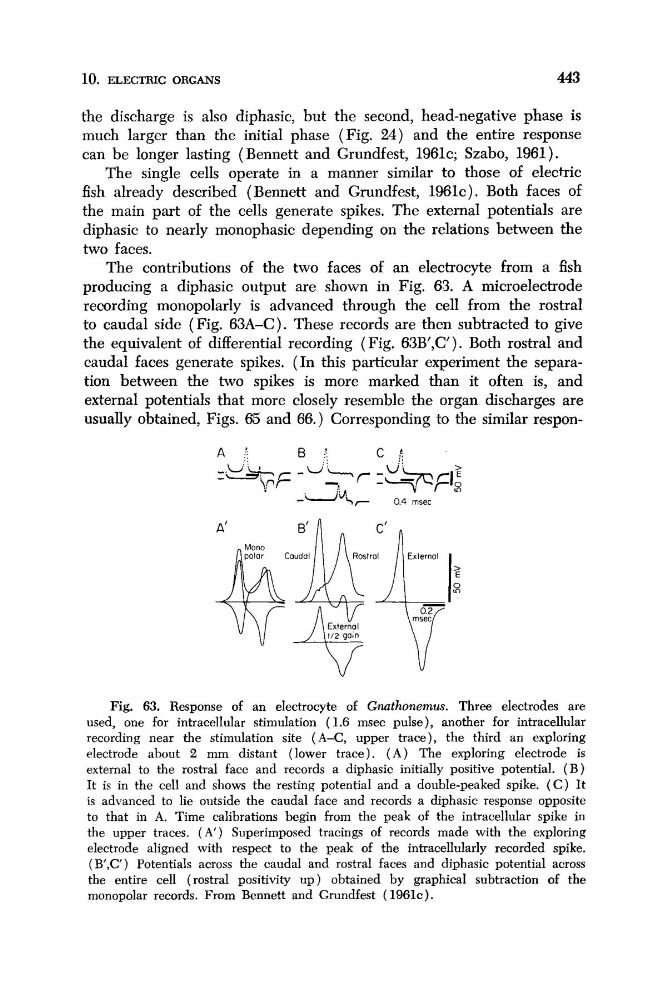
The contributions of the two faces of an electrocyte from a fish
producing a diphasic output are shown in Fig. 63. A microelectrode
recording monopolarly is advanced through the cell from the rostral
to caudal side (Fig. 63A-C). These records are then subtracted to give
the equivalent of differential recording ( Fig. 63B',C'). Both rostral and
caudal faces generate spikes. (In this particular experiment the separation between the two spikes is more marked than it often is, and
external potentials that more closely resemble the organ discharges are
usually obtained, Figs. 65 and 66.) Corresponding to the similar responFig. 63. Response of an electrocyte of Gnuthonemus. Three electrodes are
used, one for intracellular stimulation (1.6 msec pulse), another for intracellular
recording near the stimulation site (A-C, upper trace), the third an exploring
electrode about 2 mm distant (lower trace). ( A ) The exploring electrode is
external to the rostral face and records a diphasic initially positive potential. ( B )
It is in the cell and shows the resting potential and a double-peaked spike. ( C ) It
is advanced to lie outside the caudal face and records a diphasic response opposite
to that in A. Time calibrations begin from the peak of the intracellular spike in
the upper traces. (A') Superimposed tracings of records made with the exploring
electrode aligned with respect to the peak of the intracellularly recorded spike.
(B',C) Potentials across the caudal and rostral faces and diphasic potential across
the entire cell (rostral positivity u p ) obtained by graphical subtraction of the
monopolar records. From Bennett and Grundfest ( 1 9 6 1 ~ ) .
443
the discharge is also diphasic, but the second, head-negative phase is
much larger than the initial phase (Fig. 24) and the entire response
can be longer lasting (Bennett and Grundfest, 1961~; Szabo, 1961).
The single cells operate in a manner similar to those of electric
fish already described (Bennett and Grundfest, 1961~). Both faces of
the main part of the cells generate spikes. The external potentials are
diphasic to nearly monophasic depending on the relations between the
two faces.
The contributions of the two faces of an electrocyte from a fish
producing a diphasic output are shown in Fig. 63. A microelectrode
recording monopolarly is advanced through the cell from the rostral
to caudal side (Fig. 63A-C). These records are then subtracted to give
the equivalent of differential recording ( Fig. 63B',C'). Both rostral and
caudal faces generate spikes. (In this particular experiment the separation between the two spikes is more marked than it often is, and
external potentials that more closely resemble the organ discharges are
usually obtained, Figs. 65 and 66.) Corresponding to the similar responFig. 63. Response of an electrocyte of Gnuthonemus. Three electrodes are
used, one for intracellular stimulation (1.6 msec pulse), another for intracellular
recording near the stimulation site (A-C, upper trace), the third an exploring
electrode about 2 mm distant (lower trace). ( A ) The exploring electrode is
external to the rostral face and records a diphasic initially positive potential. ( B )
It is in the cell and shows the resting potential and a double-peaked spike. ( C ) It
is advanced to lie outside the caudal face and records a diphasic response opposite
to that in A. Time calibrations begin from the peak of the intracellular spike in
the upper traces. (A') Superimposed tracings of records made with the exploring
electrode aligned with respect to the peak of the intracellularly recorded spike.
(B',C) Potentials across the caudal and rostral faces and diphasic potential across
the entire cell (rostral positivity u p ) obtained by graphical subtraction of the
monopolar records. From Bennett and Grundfest ( 1 9 6 1 ~ ) .