

442
M. V. L. BENNETT
through holes in the body of the cells (Fig, 61). They undergo their
final stages of fusion on the anterior side of the cells. The degree of
fusion before penetration depends on the species and correlates with
the size of the initial head-negative phase of organ discharge as will
be discussed below (Fig. 67). A similar penetrating stalk system occurs
in Mormyrops (Grosse and Szabo, 1960) and in one of two specimens
of a species of Hyperopisus that I have examined. As far as is known
Marcusenius and Petrocephalus have only nonpenetrating stalk systems.
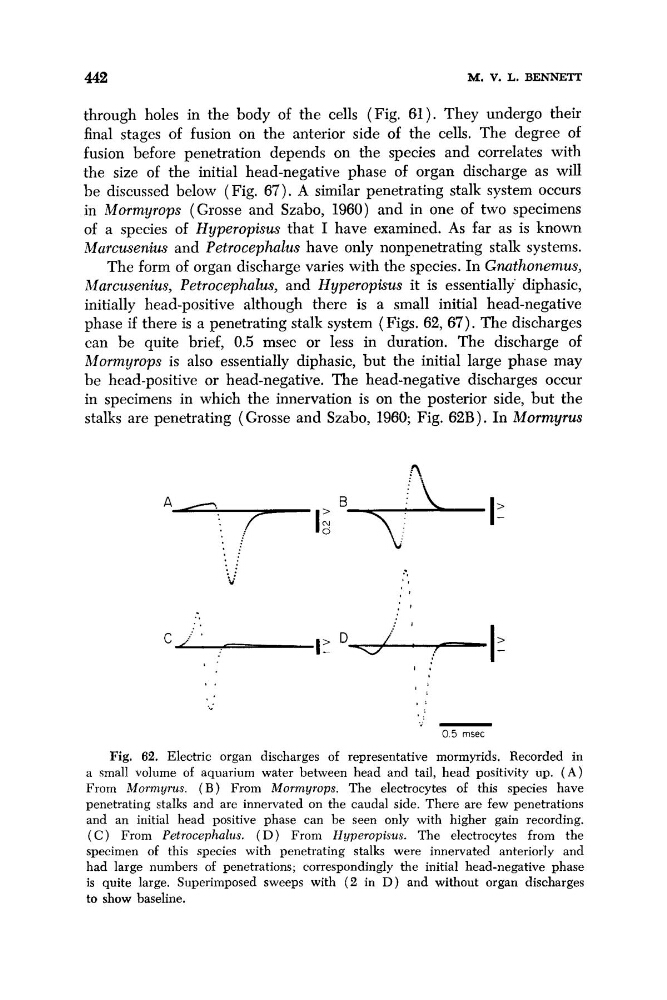
The form of organ discharge varies with the species. In Gnuthonemus,
Marcusenius, Petrocephalus, and Hyperopisus it is essentially diphasic,
initially head-positive although there is a small initial head-negative
phase if there is a penetrating stalk system (Figs. 62, 67). The discharges
can be quite brief, 0.5 msec or less in duration. The discharge of
Mormyrops is also essentially diphasic, but the initial large phase may
be head-positive or head-negative. The head-negative discharges occur
in specimens in which the innervation is on the posterior side, but the
stalks are penetrating (Grosse and Szabo, 1960; Fig. 62B). In Mormyrus
- :
. .
. .
. .
. .
. v:
I
,
I
.
" -
0 5 rnsec
Fig. 62. Electric organ discharges of representative mormyrids. Recorded in
a small volume of aquarium water between head and tail, head positivity up. ( A )
From Mormyrus. ( B ) From Mormyrops. The electrocytes of this species have
penetrating stalks and are innervated on the caudal side. There are few penetrations
and an initial head positive phase can be seen only with higher gain recording.
( C ) From Petrocephalus. ( D ) From Hyperopisus. The electrocytes from the
specimen of this species with penetrating stalks were innervated anteriorly and
had large numbers of penetrations; correspondingly the initial head-negative phase
is quite large. Superimposed sweeps with ( 2 in D ) and without organ discharges
to show baseline.
M. V. L. BENNETT
through holes in the body of the cells (Fig, 61). They undergo their
final stages of fusion on the anterior side of the cells. The degree of
fusion before penetration depends on the species and correlates with
the size of the initial head-negative phase of organ discharge as will
be discussed below (Fig. 67). A similar penetrating stalk system occurs
in Mormyrops (Grosse and Szabo, 1960) and in one of two specimens
of a species of Hyperopisus that I have examined. As far as is known
Marcusenius and Petrocephalus have only nonpenetrating stalk systems.
The form of organ discharge varies with the species. In Gnuthonemus,
Marcusenius, Petrocephalus, and Hyperopisus it is essentially diphasic,
initially head-positive although there is a small initial head-negative
phase if there is a penetrating stalk system (Figs. 62, 67). The discharges
can be quite brief, 0.5 msec or less in duration. The discharge of
Mormyrops is also essentially diphasic, but the initial large phase may
be head-positive or head-negative. The head-negative discharges occur
in specimens in which the innervation is on the posterior side, but the
stalks are penetrating (Grosse and Szabo, 1960; Fig. 62B). In Mormyrus
- :
. .
. .
. .
. .
. v:
I
,
I
.
" -
0 5 rnsec
Fig. 62. Electric organ discharges of representative mormyrids. Recorded in
a small volume of aquarium water between head and tail, head positivity up. ( A )
From Mormyrus. ( B ) From Mormyrops. The electrocytes of this species have
penetrating stalks and are innervated on the caudal side. There are few penetrations
and an initial head positive phase can be seen only with higher gain recording.
( C ) From Petrocephalus. ( D ) From Hyperopisus. The electrocytes from the
specimen of this species with penetrating stalks were innervated anteriorly and
had large numbers of penetrations; correspondingly the initial head-negative phase
is quite large. Superimposed sweeps with ( 2 in D ) and without organ discharges
to show baseline.