

M. V. L. BENNETT
428
found over much of the body surface, are powerful excitants. However,
the effectiveness of the discharge in stunning small fish is minimal. The
amplitude recorded in air is about 150 V from an animal 30 cm in
length and even a small fish 5 cm long can generate 30 V (Keynes et al.,
1961). The amplitudes are considerably reduced in water but are still
uncomfortably strong to someone trying to pick up the fish. The fish
reaches a length of at least 50 cm, and 350 V discharges have been
reported ( Keynes, 1957).
It is interesting that the cells produce an almost entirely head-negative
potential, although they are innervated on their posterior faces; in fact,
the mechanism is not so different from that in the diphasicly discharging
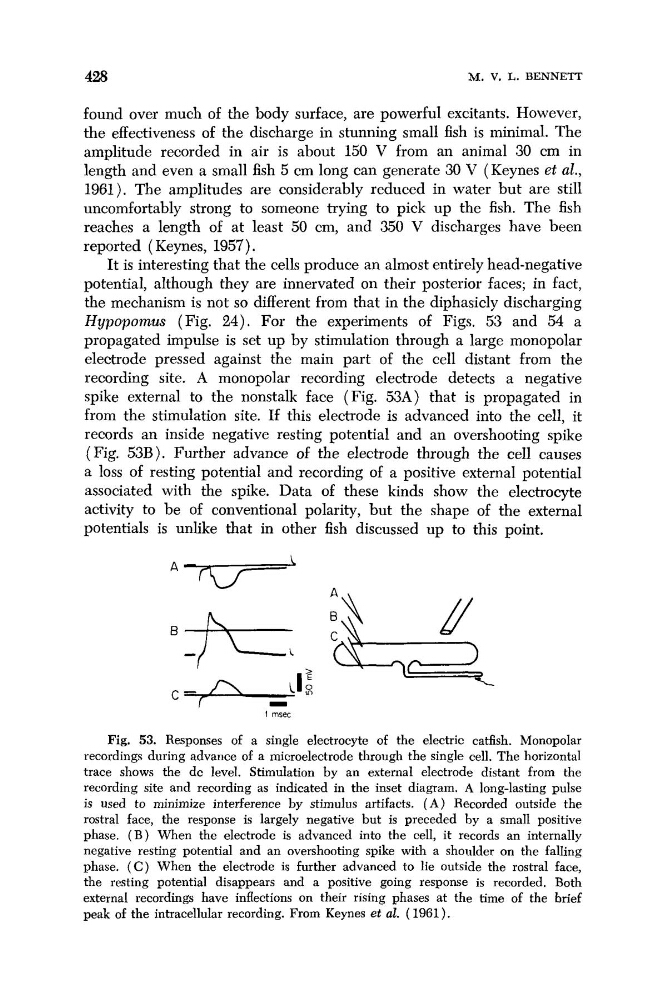
Hypopornus (Fig. 24). For the experiments of Figs. 53 and 54 a
propagated impulse is set up by stimulation through a large monopolar
electrode pressed against the main part of the cell distant from the
recording site. A monopolar recording electrode detects a negative
spike external to the nonstalk face (Fig. 53A) that is propagated in
from the stimulation site. If this electrode is advanced into the cell, it
records an inside negative resting potential and an overshooting spike
(Fig. 53B). Further advance of the electrode through the cell causes
a loss of resting potential and recording of a positive external potential
associated with the spike. Data of these kinds show the electrocyte
activity to be of conventional polarity, but the shape of the external
potentials is unlike that in other fish discussed up to this point.
1 msec
Fig. 53. Responses of a single electrocyte of the electric catfish. Monopolar
recordings during advance of a microelectrode through the single cell. The horizontal
trace shows the dc level. Stimulation by an external electrode distant from the
recording site and recording as indicated in the inset diagram. A long-lasting pulse
is used to minimize interference by stimulus artifacts. ( A ) Recorded outside the
rostral face, the response is largely negative but is preceded by a small positive
phase. ( B ) When the electrode is advanced into the cell, it records an internally
negative resting potential and an overshooting spike with a shoulder on the falling
phase. ( C ) When the electrode is further advanced to lie outside the rostral face,
the resting potential disappears and a positive going response is recorded. Both
external recordings have inflections on their rising phases at the time of the brief
peak of the intracellular recording. From Keynes et al. ( 1961).
428
found over much of the body surface, are powerful excitants. However,
the effectiveness of the discharge in stunning small fish is minimal. The
amplitude recorded in air is about 150 V from an animal 30 cm in
length and even a small fish 5 cm long can generate 30 V (Keynes et al.,
1961). The amplitudes are considerably reduced in water but are still
uncomfortably strong to someone trying to pick up the fish. The fish
reaches a length of at least 50 cm, and 350 V discharges have been
reported ( Keynes, 1957).
It is interesting that the cells produce an almost entirely head-negative
potential, although they are innervated on their posterior faces; in fact,
the mechanism is not so different from that in the diphasicly discharging
Hypopornus (Fig. 24). For the experiments of Figs. 53 and 54 a
propagated impulse is set up by stimulation through a large monopolar
electrode pressed against the main part of the cell distant from the
recording site. A monopolar recording electrode detects a negative
spike external to the nonstalk face (Fig. 53A) that is propagated in
from the stimulation site. If this electrode is advanced into the cell, it
records an inside negative resting potential and an overshooting spike
(Fig. 53B). Further advance of the electrode through the cell causes
a loss of resting potential and recording of a positive external potential
associated with the spike. Data of these kinds show the electrocyte
activity to be of conventional polarity, but the shape of the external
potentials is unlike that in other fish discussed up to this point.
1 msec
Fig. 53. Responses of a single electrocyte of the electric catfish. Monopolar
recordings during advance of a microelectrode through the single cell. The horizontal
trace shows the dc level. Stimulation by an external electrode distant from the
recording site and recording as indicated in the inset diagram. A long-lasting pulse
is used to minimize interference by stimulus artifacts. ( A ) Recorded outside the
rostral face, the response is largely negative but is preceded by a small positive
phase. ( B ) When the electrode is advanced into the cell, it records an internally
negative resting potential and an overshooting spike with a shoulder on the falling
phase. ( C ) When the electrode is further advanced to lie outside the rostral face,
the resting potential disappears and a positive going response is recorded. Both
external recordings have inflections on their rising phases at the time of the brief
peak of the intracellular recording. From Keynes et al. ( 1961).