

10. ELECTRIC ORGANS
429
The origin of the peculiar shape of the external potential becomes
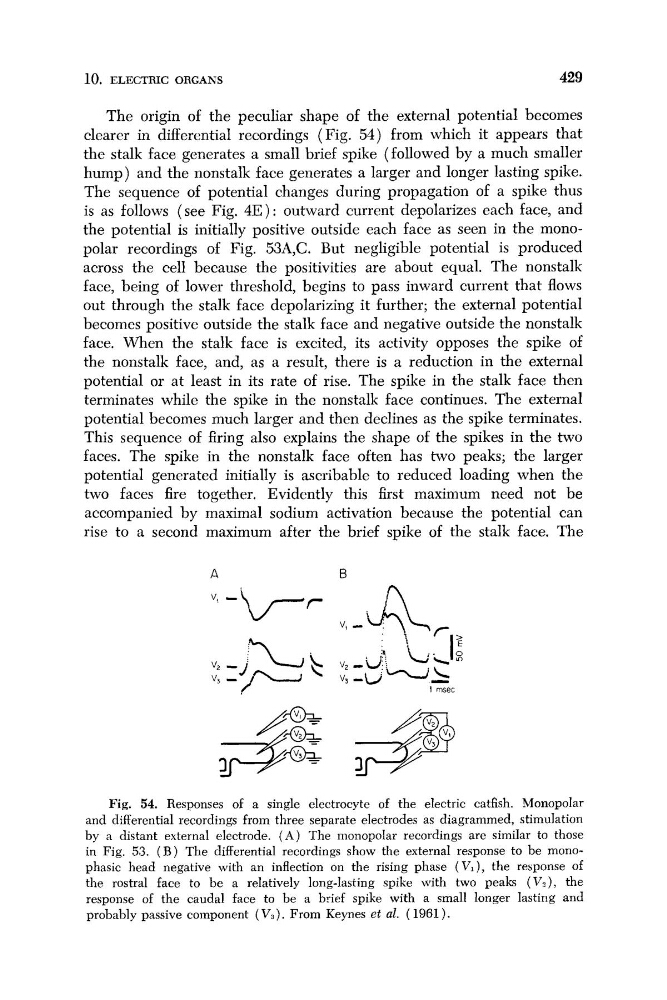
clearer in differential recordings (Fig. 54) from which it appears that
the stalk face generates a small brief spike (followed by a much smaller
hump) and the nonstalk face generates a larger and longer lasting spike.
The sequence of potential changes during propagation of a spike thus
is as follows (see Fig. 4 E ) : outward current depolarizes each face, and
the potential is initially positive outside each face as seen in the monopolar recordings of Fig. 53A,C. But negligible potential is produced
across the cell because the positivities are about equal. The nonstalk
face, being of lower threshold, begins to pass inward current that flows
out through the stalk face depolarizing it further; the external potential
becomes positive outside the stalk face and negative outside the nonstalk
face. When the stalk face is excited, its activity opposes the spike of
the noiistalk face, and, as a result, there is a reduction in the external
potential or at least in its rate of rise. The spike in the stalk face then
terminates while the spike in the nonstalk face continues. The external
potential becomes much larger and then declines as the spike terminates.
This sequence of firing also explains the shape of the spikes in the two
faces. The spike in the nonstalk face often has two peaks; the larger
potential generated initially is ascribable to reduced loading when the
two faces fire together. Evidently this first maximum need not be
accompanied by maximal sodium activation because the potential can
rise to a second maximum after the brief spike of the stalk face. The
A
B
Fig. 54. Responses of a single electrocyte of the electric catfish. Monopolar
and differential recordings from three separate electrodes as diagrammed, stimulation
by a distant external electrode. ( A ) The monopolar recordings are similar to those
in Fig. 53. ( B ) The differential recordings show the external response to be monophasic head negative with an inflection on the rising phase (Vi), the response of
the rostra1 face to be a relatively long-lasting spike with two peaks ( V 2 ) , the
response of the caudal face to be a brief spike with a small longer lasting and
probably passive component ( V3). From Keynes et aZ. ( 1961).
429
The origin of the peculiar shape of the external potential becomes
clearer in differential recordings (Fig. 54) from which it appears that
the stalk face generates a small brief spike (followed by a much smaller
hump) and the nonstalk face generates a larger and longer lasting spike.
The sequence of potential changes during propagation of a spike thus
is as follows (see Fig. 4 E ) : outward current depolarizes each face, and
the potential is initially positive outside each face as seen in the monopolar recordings of Fig. 53A,C. But negligible potential is produced
across the cell because the positivities are about equal. The nonstalk
face, being of lower threshold, begins to pass inward current that flows
out through the stalk face depolarizing it further; the external potential
becomes positive outside the stalk face and negative outside the nonstalk
face. When the stalk face is excited, its activity opposes the spike of
the noiistalk face, and, as a result, there is a reduction in the external
potential or at least in its rate of rise. The spike in the stalk face then
terminates while the spike in the nonstalk face continues. The external
potential becomes much larger and then declines as the spike terminates.
This sequence of firing also explains the shape of the spikes in the two
faces. The spike in the nonstalk face often has two peaks; the larger
potential generated initially is ascribable to reduced loading when the
two faces fire together. Evidently this first maximum need not be
accompanied by maximal sodium activation because the potential can
rise to a second maximum after the brief spike of the stalk face. The
A
B
Fig. 54. Responses of a single electrocyte of the electric catfish. Monopolar
and differential recordings from three separate electrodes as diagrammed, stimulation
by a distant external electrode. ( A ) The monopolar recordings are similar to those
in Fig. 53. ( B ) The differential recordings show the external response to be monophasic head negative with an inflection on the rising phase (Vi), the response of
the rostra1 face to be a relatively long-lasting spike with two peaks ( V 2 ) , the
response of the caudal face to be a brief spike with a small longer lasting and
probably passive component ( V3). From Keynes et aZ. ( 1961).