

10. ELECTRIC ORGANS
427
is better known for the corpuscles that bear his name) and generated
potentials similar in sign to those known from some glandular tissue.
It turns out that the discharge polarity is explicable in terms of ordinary
mechanisms of excitability (Keynes et al., 1961), and recent physiological and embryological data are consistent with a muscle origin for
the organ (Johnels, 1956).
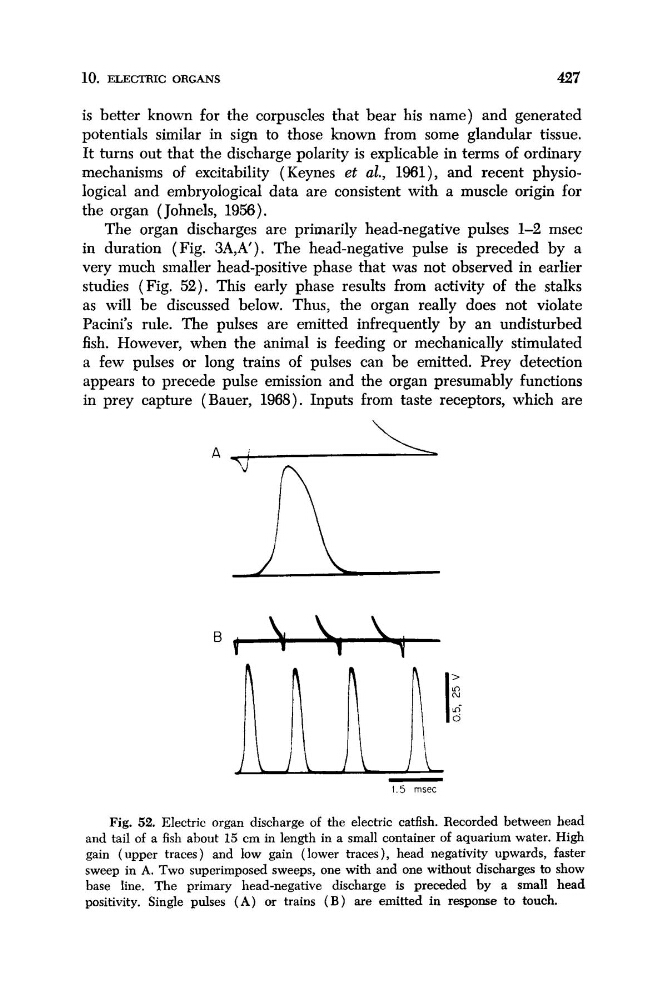
The organ discharges are primarily head-negative pulses 1-2 msec
in duration (Fig. 3A,A'). The head-negative pulse is preceded by a
very much smaller head-positive phase that was not observed in earlier
studies (Fig. 52). This early phase results from activity of the stalks
as will be discussed below. Thus, the organ really does not violate
Pacini's rule. The pulses are emitted infrequently by an undisturbed
fish. However, when the animal is feeding or mechanically stimulated
a few pulses or long trains of pulses can be emitted. Prey detection
appears to precede pulse emission and the organ presumably functions
in prey capture (Bauer, 1968). Inputs from taste receptors, which are
i
1.5 rnsec
Fig. 52. Electric organ discharge of the electric catfish. Recorded between head
and tail of a fish about 15 cm in length in a small container of aquarium water. High
gain (upper traces) and low gain (lower traces), head negativity upwards, faster
sweep in A. Two superimposed sweeps, one with and one without discharges to show
base line. The primary head-negative discharge is preceded by a small head
positivity. Single pulses (A) or trains ( B ) are emitted in response to touch.
427
is better known for the corpuscles that bear his name) and generated
potentials similar in sign to those known from some glandular tissue.
It turns out that the discharge polarity is explicable in terms of ordinary
mechanisms of excitability (Keynes et al., 1961), and recent physiological and embryological data are consistent with a muscle origin for
the organ (Johnels, 1956).
The organ discharges are primarily head-negative pulses 1-2 msec
in duration (Fig. 3A,A'). The head-negative pulse is preceded by a
very much smaller head-positive phase that was not observed in earlier
studies (Fig. 52). This early phase results from activity of the stalks
as will be discussed below. Thus, the organ really does not violate
Pacini's rule. The pulses are emitted infrequently by an undisturbed
fish. However, when the animal is feeding or mechanically stimulated
a few pulses or long trains of pulses can be emitted. Prey detection
appears to precede pulse emission and the organ presumably functions
in prey capture (Bauer, 1968). Inputs from taste receptors, which are
i
1.5 rnsec
Fig. 52. Electric organ discharge of the electric catfish. Recorded between head
and tail of a fish about 15 cm in length in a small container of aquarium water. High
gain (upper traces) and low gain (lower traces), head negativity upwards, faster
sweep in A. Two superimposed sweeps, one with and one without discharges to show
base line. The primary head-negative discharge is preceded by a small head
positivity. Single pulses (A) or trains ( B ) are emitted in response to touch.