

10. ELECTRIC ORGANS
425
A
B
-
0.5 msec
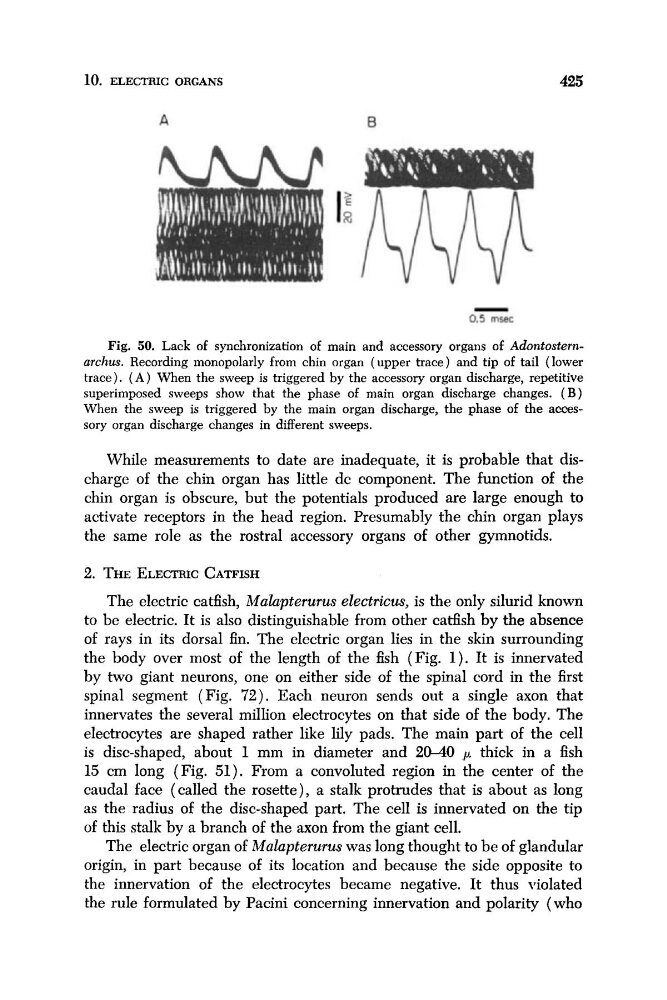
Fig. 50. Lack of synchronization of main and accessory organs of Adontosternarchw. Recording monopolarly from chin organ (upper trace) and tip of tail (lower
trace). ( A ) When the sweep is triggered by the accessory organ discharge, repetitive
superimposed sweeps show that the phase of main organ discharge changes. ( B )
When the sweep is triggered by the main organ discharge, the phase of the accessory organ discharge changes in different sweeps.
While measurements to date are inadequate, it is probable that discharge of the chin organ has little dc component. The function of the
chin organ is obscure, but the potentials produced are large enough to
activate receptors in the head region. Presumably the chin organ plays
the same role as the rostra1 accessory organs of other gymnotids.
2. THE ELECTRIC CATFISH
The electric catfish, Malupterurus electricus, is the only silurid known
to be electric. It is also distinguishable from other catfish by the absence
of rays in its dorsal fin. The electric organ lies in the skin surrounding
the body over most of the length of the fish (Fig. 1). It is innervated
by two giant neurons, one on either side of the spinal cord in the first
spinal segment (Fig. 72). Each neuron sends out a single axon that
innervates the several million electrocytes on that side of the body. The
electrocytes are shaped rather like lily pads. The main part of the cell
is disc-shaped, about 1 mm in diameter and 2040 p thick in a fish
15 cm long (Fig. 51). From a convoluted region in the center of the
caudal face (called the rosette), a stalk protrudes that is about as long
as the radius of the disc-shaped part. The cell is innervated on the tip
of this stalk by a branch of the axon from the giant cell.
The electric organ of Malapterurus was long thought to be of glandular
origin, in part because of its location and because the side opposite to
the innervation of the electrocytes became negative. It thus violated
the rule formulated by Pacini concerning innervation and polarity (who
425
A
B
-
0.5 msec
Fig. 50. Lack of synchronization of main and accessory organs of Adontosternarchw. Recording monopolarly from chin organ (upper trace) and tip of tail (lower
trace). ( A ) When the sweep is triggered by the accessory organ discharge, repetitive
superimposed sweeps show that the phase of main organ discharge changes. ( B )
When the sweep is triggered by the main organ discharge, the phase of the accessory organ discharge changes in different sweeps.
While measurements to date are inadequate, it is probable that discharge of the chin organ has little dc component. The function of the
chin organ is obscure, but the potentials produced are large enough to
activate receptors in the head region. Presumably the chin organ plays
the same role as the rostra1 accessory organs of other gymnotids.
2. THE ELECTRIC CATFISH
The electric catfish, Malupterurus electricus, is the only silurid known
to be electric. It is also distinguishable from other catfish by the absence
of rays in its dorsal fin. The electric organ lies in the skin surrounding
the body over most of the length of the fish (Fig. 1). It is innervated
by two giant neurons, one on either side of the spinal cord in the first
spinal segment (Fig. 72). Each neuron sends out a single axon that
innervates the several million electrocytes on that side of the body. The
electrocytes are shaped rather like lily pads. The main part of the cell
is disc-shaped, about 1 mm in diameter and 2040 p thick in a fish
15 cm long (Fig. 51). From a convoluted region in the center of the
caudal face (called the rosette), a stalk protrudes that is about as long
as the radius of the disc-shaped part. The cell is innervated on the tip
of this stalk by a branch of the axon from the giant cell.
The electric organ of Malapterurus was long thought to be of glandular
origin, in part because of its location and because the side opposite to
the innervation of the electrocytes became negative. It thus violated
the rule formulated by Pacini concerning innervation and polarity (who