

424
M. V. L. BENNETT
portion. Unfortunately, it is not possible to test these mechanisms by
activating the organ over a wide range of frequencies. The cells continue
to fire spontaneously after spinal section, and synchronous low frequency
activity cannot be obtained.
One sternarchid, Adontosternarchus, has an accessory organ in the
chin region (M. V. L. Bennett and A. B. Steinbach, unpublished data).
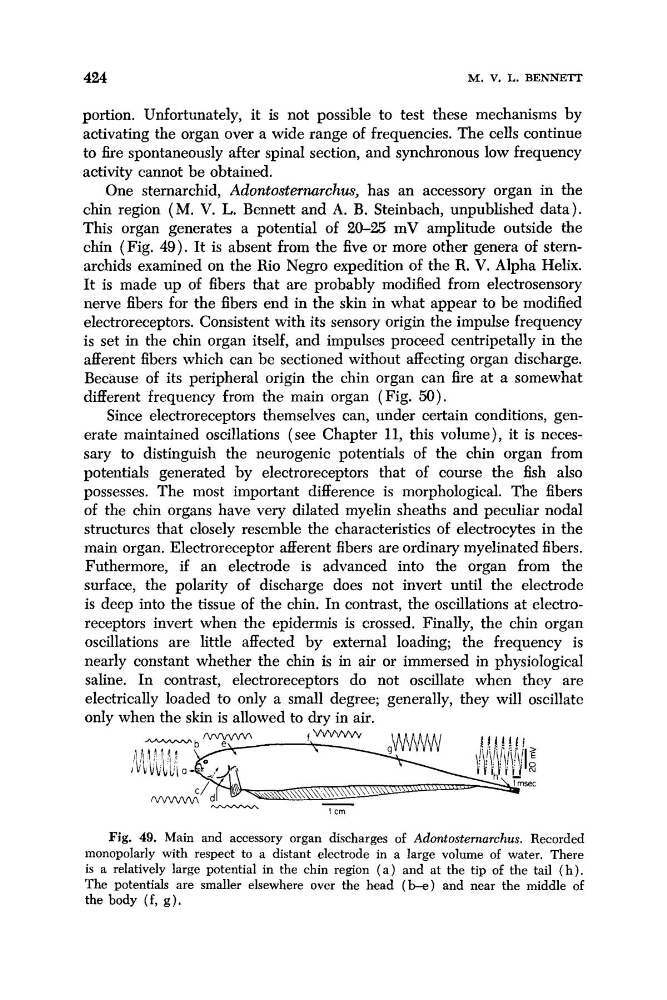
This organ generates a potential of 20-25 mV amplitude outside the
chin (Fig. 49). It is absent from the five or more other genera of sternarchids examined on the Rio Negro expedition of the R. V. Alpha Helix.
It is made up of fibers that are probably modified from electrosensory
nerve fibers for the fibers end in the skin in what appear to be modified
electroreceptors. Consistent with its sensory origin the impulse frequency
is set in the chin organ itself, and impulses proceed centripetally in the
afferent fibers which can be sectioned without affecting organ discharge.
Because of its peripheral origin the chin organ can fire at a somewhat
different frequency from the main organ (Fig. So).
Since electroreceptors themselves can, under certain conditions, generate maintained oscillations (see Chapter 11, this volume), it is necessary to distinguish the neurogenic potentials of the chin organ from
potentials generated by electroreceptors that of course the fish also
possesses. The most important difference is morphological. The fibers
of the chin organs have very dilated myelin sheaths and peculiar nodal
structures that closely resemble the characteristics of electrocytes in the
main organ. Electroreceptor afferent fibers are ordinary myelinated fibers.
Futhermore, if an electrode is advanced into the organ from the
surface, the polarity of discharge does not invert until the electrode
is deep into the tissue of the chin. In contrast, the oscillations at electroreceptors invert when the epidermis is crossed. Finally, the chin organ
oscillations are little affected by external loading; the frequency is
nearly constant whether the chin is in air or immersed in physiological
saline. In contrast, electroreceptors do not oscillate when they are
electrically loaded to only a small degree; generally, they will oscillate
only when the skin is allowed to dry in air.
Fig. 49. Main and accessory organ discharges of Adontostemarchus. Recorded
monopolarly with respect to a distant electrode in a large volume of water. There
is a relatively large potential in the chin region ( a ) and at the tip of the tail ( h ) .
The potentials are smaller elsewhere over the head (b-e) and near the middle of
the body (f, g ) .
M. V. L. BENNETT
portion. Unfortunately, it is not possible to test these mechanisms by
activating the organ over a wide range of frequencies. The cells continue
to fire spontaneously after spinal section, and synchronous low frequency
activity cannot be obtained.
One sternarchid, Adontosternarchus, has an accessory organ in the
chin region (M. V. L. Bennett and A. B. Steinbach, unpublished data).
This organ generates a potential of 20-25 mV amplitude outside the
chin (Fig. 49). It is absent from the five or more other genera of sternarchids examined on the Rio Negro expedition of the R. V. Alpha Helix.
It is made up of fibers that are probably modified from electrosensory
nerve fibers for the fibers end in the skin in what appear to be modified
electroreceptors. Consistent with its sensory origin the impulse frequency
is set in the chin organ itself, and impulses proceed centripetally in the
afferent fibers which can be sectioned without affecting organ discharge.
Because of its peripheral origin the chin organ can fire at a somewhat
different frequency from the main organ (Fig. So).
Since electroreceptors themselves can, under certain conditions, generate maintained oscillations (see Chapter 11, this volume), it is necessary to distinguish the neurogenic potentials of the chin organ from
potentials generated by electroreceptors that of course the fish also
possesses. The most important difference is morphological. The fibers
of the chin organs have very dilated myelin sheaths and peculiar nodal
structures that closely resemble the characteristics of electrocytes in the
main organ. Electroreceptor afferent fibers are ordinary myelinated fibers.
Futhermore, if an electrode is advanced into the organ from the
surface, the polarity of discharge does not invert until the electrode
is deep into the tissue of the chin. In contrast, the oscillations at electroreceptors invert when the epidermis is crossed. Finally, the chin organ
oscillations are little affected by external loading; the frequency is
nearly constant whether the chin is in air or immersed in physiological
saline. In contrast, electroreceptors do not oscillate when they are
electrically loaded to only a small degree; generally, they will oscillate
only when the skin is allowed to dry in air.
Fig. 49. Main and accessory organ discharges of Adontostemarchus. Recorded
monopolarly with respect to a distant electrode in a large volume of water. There
is a relatively large potential in the chin region ( a ) and at the tip of the tail ( h ) .
The potentials are smaller elsewhere over the head (b-e) and near the middle of
the body (f, g ) .