

10. ELECTRIC ORGANS
423
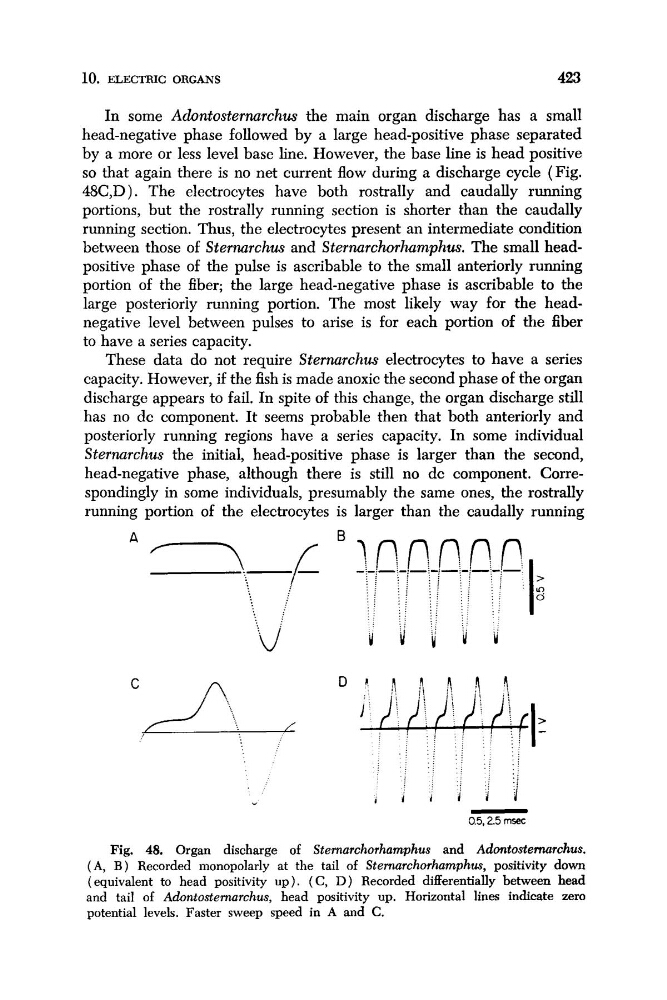
In some Adontosternarchus the main organ discharge has a small
head-negative phase followed by a large head-positive phase separated
by a more or less level base line. However, the base line is head positive
so that again there is no net current flow during a discharge cycle (Fig.
48C,D). The electrocytes have both rostrally and caudally running
portions, but the rostrally running section is shorter than the caudally
running section. Thus, the electrocytes present an intermediate condition
between those of Sternarchus and Sternarchorhamphus, The small headpositive phase of the pulse is ascribable to the small anteriorly running
portion of the fiber; the large head-negative phase is ascribable to the
large posterioriy running portion. The most likely way for the headnegative level between pulses to arise is for each portion of the fiber
to have a series capacity.
These data do not require Sternarchus electrocytes to have a series
capacity. However, if the fish is made anoxic the second phase of the organ
discharge appears to fail. In spite of this change, the organ discharge still
has no dc component. It seems probable then that both anteriorly and
posteriorly running regions have a series capacity. In some individual
Sternarchus the initial, head-positive phase is larger than the second,
head-negative phase, although there is still no dc component. Correspondingly in some individuals, presumably the same ones, the rostrally
running portion of the electrocytes is larger than the caudally running
6 . 2 . 5 mSec
Fig. 48. Organ discharge of Sternurchorhamphus and Adontosternarchus.
(A, B ) Recorded monopolarly at the tail of Sternurchorhamphus, positivity down
(equivalent to head positivity up). ( C, D) Recorded differentially between head
and tail of Adontosternarchus, head positivity up. Horizontal lines indicate zero
potential levels. Faster sweep speed in A and C.
423
In some Adontosternarchus the main organ discharge has a small
head-negative phase followed by a large head-positive phase separated
by a more or less level base line. However, the base line is head positive
so that again there is no net current flow during a discharge cycle (Fig.
48C,D). The electrocytes have both rostrally and caudally running
portions, but the rostrally running section is shorter than the caudally
running section. Thus, the electrocytes present an intermediate condition
between those of Sternarchus and Sternarchorhamphus, The small headpositive phase of the pulse is ascribable to the small anteriorly running
portion of the fiber; the large head-negative phase is ascribable to the
large posterioriy running portion. The most likely way for the headnegative level between pulses to arise is for each portion of the fiber
to have a series capacity.
These data do not require Sternarchus electrocytes to have a series
capacity. However, if the fish is made anoxic the second phase of the organ
discharge appears to fail. In spite of this change, the organ discharge still
has no dc component. It seems probable then that both anteriorly and
posteriorly running regions have a series capacity. In some individual
Sternarchus the initial, head-positive phase is larger than the second,
head-negative phase, although there is still no dc component. Correspondingly in some individuals, presumably the same ones, the rostrally
running portion of the electrocytes is larger than the caudally running
6 . 2 . 5 mSec
Fig. 48. Organ discharge of Sternurchorhamphus and Adontosternarchus.
(A, B ) Recorded monopolarly at the tail of Sternurchorhamphus, positivity down
(equivalent to head positivity up). ( C, D) Recorded differentially between head
and tail of Adontosternarchus, head positivity up. Horizontal lines indicate zero
potential levels. Faster sweep speed in A and C.