

10. ELECTRIC ORGANS
421
-
0.5, 2.5 msec
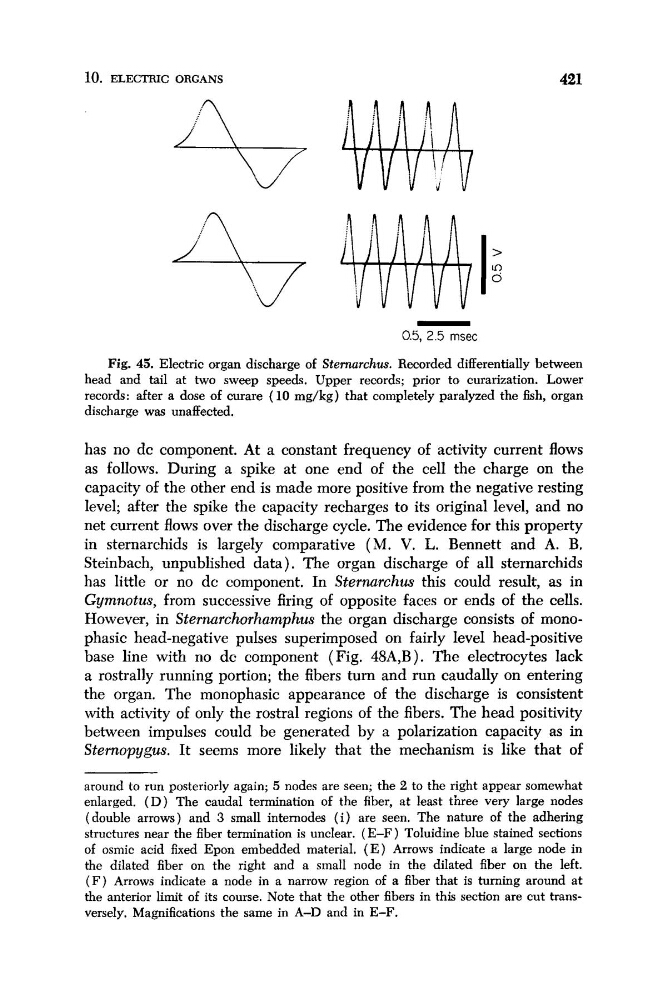
Fig. 45. Electric organ discharge of Stemarchus. Recorded differentially between
head and tail at two sweep speeds. Upper records; prior to curarization. Lower
records: after a dose of curare (10 mg/kg) that completely paralyzed the fish, organ
discharge was unaffected.
has no dc component. At a constant frequency of activity current flows
as follows. During a spike at one end of the cell the charge on the
capacity of the other end is made more positive from the negative resting
level; after the spike the capacity recharges to its original level, and no
net current flows over the discharge cycle. The evidence for this property
in sternarchids is largely comparative (M. V. L. Bennett and A. B.
Steinbach, unpublished data). The organ discharge of all sternarchids
has little or no dc component. In Sternarchus this could result, as in
Gymnotus, from successive firing of opposite faces or ends of the cells.
However, in Sternurchorhamphus the organ discharge consists of monophasic head-negative pulses superimposed on fairly level head-positive
base line with no dc component (Fig. 48A,B). The electrocytes lack
a rostrally running portion; the fibers turn and run caudally on entering
the organ. The monophasic appearance of the discharge is consistent
with activity of only the rostra1 regions of the fibers. The head positivity
between impulses could be generated by a polarization capacity as in
Stemopygus. It seems more likely that the mechanism is like that of
around to run posteriorly again; 5 nodes are seen; the 2 to the right appear somewhat
enlarged. ( D ) The caudal termination of the fiber, at least three very large nodes
(double arrows) and 3 small internodes ( i ) are seen. The nature of the adhering
structures near the fiber termination is unclear. (E-F) Toluidine blue stained sections
of osmic acid fixed Epon embedded material. ( E ) Arrows indicate a large node in
the dilated fiber on the right and a small node in the dilated fiber on the left.
( F ) Arrows indicate a node in a narrow region of a fiber that is turning around a t
the anterior limit of its course. Note that the other fibers in this section are cut transversely. Magnifications the same in A-l3 and in E-F.
421
-
0.5, 2.5 msec
Fig. 45. Electric organ discharge of Stemarchus. Recorded differentially between
head and tail at two sweep speeds. Upper records; prior to curarization. Lower
records: after a dose of curare (10 mg/kg) that completely paralyzed the fish, organ
discharge was unaffected.
has no dc component. At a constant frequency of activity current flows
as follows. During a spike at one end of the cell the charge on the
capacity of the other end is made more positive from the negative resting
level; after the spike the capacity recharges to its original level, and no
net current flows over the discharge cycle. The evidence for this property
in sternarchids is largely comparative (M. V. L. Bennett and A. B.
Steinbach, unpublished data). The organ discharge of all sternarchids
has little or no dc component. In Sternarchus this could result, as in
Gymnotus, from successive firing of opposite faces or ends of the cells.
However, in Sternurchorhamphus the organ discharge consists of monophasic head-negative pulses superimposed on fairly level head-positive
base line with no dc component (Fig. 48A,B). The electrocytes lack
a rostrally running portion; the fibers turn and run caudally on entering
the organ. The monophasic appearance of the discharge is consistent
with activity of only the rostra1 regions of the fibers. The head positivity
between impulses could be generated by a polarization capacity as in
Stemopygus. It seems more likely that the mechanism is like that of
around to run posteriorly again; 5 nodes are seen; the 2 to the right appear somewhat
enlarged. ( D ) The caudal termination of the fiber, at least three very large nodes
(double arrows) and 3 small internodes ( i ) are seen. The nature of the adhering
structures near the fiber termination is unclear. (E-F) Toluidine blue stained sections
of osmic acid fixed Epon embedded material. ( E ) Arrows indicate a large node in
the dilated fiber on the right and a small node in the dilated fiber on the left.
( F ) Arrows indicate a node in a narrow region of a fiber that is turning around a t
the anterior limit of its course. Note that the other fibers in this section are cut transversely. Magnifications the same in A-l3 and in E-F.