

10. ELECTRIC ORGANS
415
-
20 rnsec
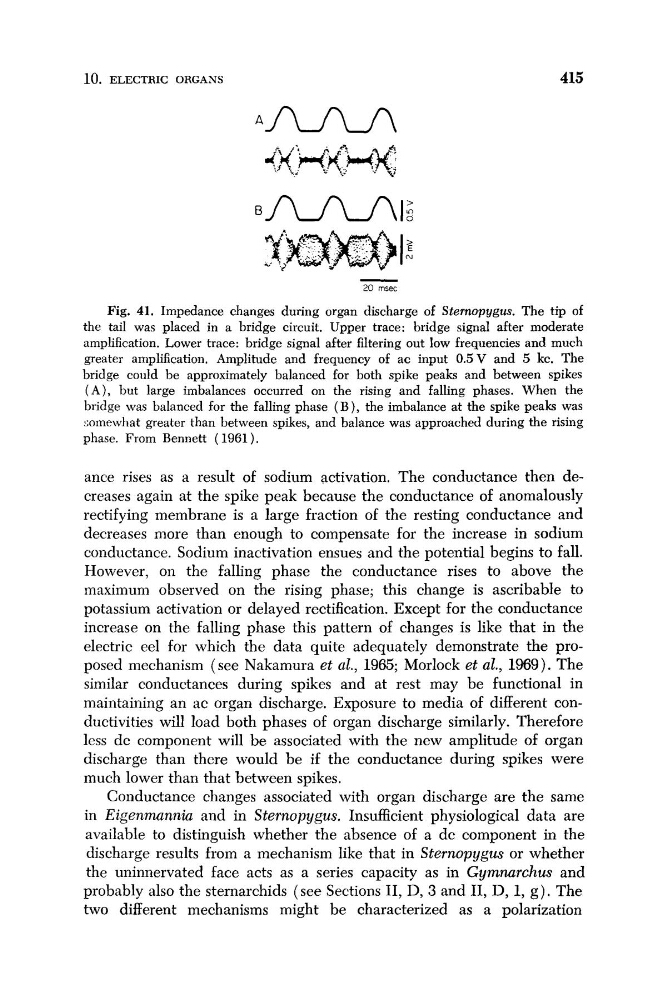
Fig. 41. Impedance changes during organ discharge of Sternopygus. The tip of
the tail was placed in a bridge circuit. Upper trace: bridge signal after moderate
amplification. Lower trace: bridge signal after filtering out low frequencies and much
greater amplification. Amplitude and frequency of ac input 0.5V and 5 kc. The
bridge could be approximately balanced for both spike peaks and between spikes
( A ) , but large imbalances occurred on the rising and falling phases. When the
bridge was balanced for the falling phase ( B ), the imbalance at the spike peaks was
somewhat greater than between spikes, and balance was approached during the rising
phase. From Bennett ( 1961).
ance rises as a result of sodium activation. The conductance then decreases again at the spike peak because the conductance of anomalously
rectifying membrane is a large fraction of the resting conductance and
decreases more than enough to compensate for the increase in sodium
conductance. Sodium inactivation ensues and the potential begins to fall.
However, on the falling phase the conductance rises to above the
maximum observed on the rising phase; this change is ascribable to
potassium activation or delayed rectification. Except for the conductance
increase on the falling phase this pattern of changes is like that in the
electric eel for which the data quite adequately demonstrate the proposed mechanism (see Nakamura et d., 1965; Morlock et al., 1969). The
similar conductances during spikes and at rest may be functional in
maintaining an ac organ discharge. Exposure to media of different conductivities will load both phases of organ discharge similarly. Therefore
less dc component will be associated with the new amplitude of organ
discharge than there would be if the conductance during spikes were
much lower than that between spikes.
Conductance changes associated with organ discharge are the same
in Eigenmunnia and in Sternopygus. Insufficient physiological data are
available to distinguish whether the absence of a dc component in the
discharge results from a mechanism like that in Sternopygus or whether
the uninnervated face acts as a series capacity as in Gymnarchus and
probably also the sternarchids (see Sections 11, D, 3 and 11, D, 1, g ) . The
two different mechanisms might be characterized as a polarization
415
-
20 rnsec
Fig. 41. Impedance changes during organ discharge of Sternopygus. The tip of
the tail was placed in a bridge circuit. Upper trace: bridge signal after moderate
amplification. Lower trace: bridge signal after filtering out low frequencies and much
greater amplification. Amplitude and frequency of ac input 0.5V and 5 kc. The
bridge could be approximately balanced for both spike peaks and between spikes
( A ) , but large imbalances occurred on the rising and falling phases. When the
bridge was balanced for the falling phase ( B ), the imbalance at the spike peaks was
somewhat greater than between spikes, and balance was approached during the rising
phase. From Bennett ( 1961).
ance rises as a result of sodium activation. The conductance then decreases again at the spike peak because the conductance of anomalously
rectifying membrane is a large fraction of the resting conductance and
decreases more than enough to compensate for the increase in sodium
conductance. Sodium inactivation ensues and the potential begins to fall.
However, on the falling phase the conductance rises to above the
maximum observed on the rising phase; this change is ascribable to
potassium activation or delayed rectification. Except for the conductance
increase on the falling phase this pattern of changes is like that in the
electric eel for which the data quite adequately demonstrate the proposed mechanism (see Nakamura et d., 1965; Morlock et al., 1969). The
similar conductances during spikes and at rest may be functional in
maintaining an ac organ discharge. Exposure to media of different conductivities will load both phases of organ discharge similarly. Therefore
less dc component will be associated with the new amplitude of organ
discharge than there would be if the conductance during spikes were
much lower than that between spikes.
Conductance changes associated with organ discharge are the same
in Eigenmunnia and in Sternopygus. Insufficient physiological data are
available to distinguish whether the absence of a dc component in the
discharge results from a mechanism like that in Sternopygus or whether
the uninnervated face acts as a series capacity as in Gymnarchus and
probably also the sternarchids (see Sections 11, D, 3 and 11, D, 1, g ) . The
two different mechanisms might be characterized as a polarization