

M. V. L. BENNETT
416
capacity in contrast to a true membrane dielectric capacity. Ultrastructural data suggest that Eigenmannia may employ a dielectric
capacity. The uninnervated face of its electrocytes has many fine branching tubules or canaliculi that greatly increase the surface; the situation
thus resembles that in Gymnurchus (Schwartz et al., 1971). In Sternopygus, the innervated and uninnervated faces are similar and rather smooth,
their areas being little increased compared to surface seen at the light
microscope level of resolution. ( A question here is why there is little
extracellular space in the electric organ of Eigenmanniu.) The significance of an ac discharge will be discussed in Section 11, F.
g. Sternarchids. This is the largest of the gymnotid families in terms
of numbers of genera and species (Tables I and 11). The group is characterized by the presence of a small caudal fin. There is also the so-called
dorsal filament that arises about the middle of the back and runs
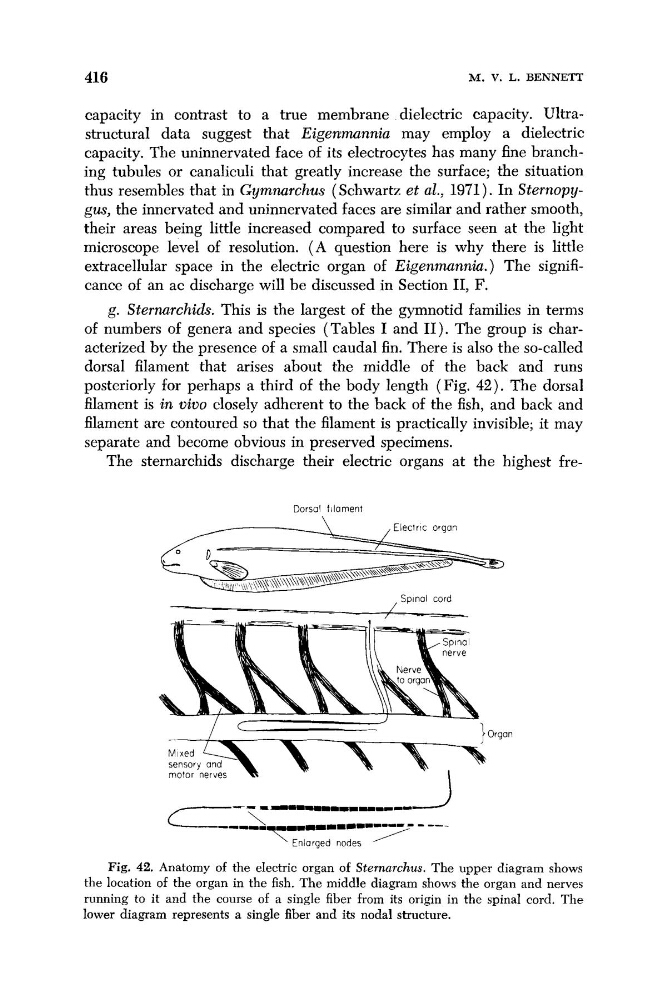
posteriorly for perhaps a third of the body length (Fig. 42). The dorsal
filament is in vivo closely adherent to the back of the fish, and back and
filament are contoured so that the filament is practically invisible; it may
separate and become obvious in preserved specimens.
The sternarchids discharge their electric organs at the highest fre-- =n=mmrnmm---m1--Enlarged nodes
Fig. 42. Anatomy of the electric organ of Sternarchus. The upper diagram shows
the location of the organ in the fish. The middle diagram shows the organ and nerves
running to it and the course of a single fiber from its origin in the spinal cord. The
lower diagram represents a single fiber and its nodal structure.
416
capacity in contrast to a true membrane dielectric capacity. Ultrastructural data suggest that Eigenmannia may employ a dielectric
capacity. The uninnervated face of its electrocytes has many fine branching tubules or canaliculi that greatly increase the surface; the situation
thus resembles that in Gymnurchus (Schwartz et al., 1971). In Sternopygus, the innervated and uninnervated faces are similar and rather smooth,
their areas being little increased compared to surface seen at the light
microscope level of resolution. ( A question here is why there is little
extracellular space in the electric organ of Eigenmanniu.) The significance of an ac discharge will be discussed in Section 11, F.
g. Sternarchids. This is the largest of the gymnotid families in terms
of numbers of genera and species (Tables I and 11). The group is characterized by the presence of a small caudal fin. There is also the so-called
dorsal filament that arises about the middle of the back and runs
posteriorly for perhaps a third of the body length (Fig. 42). The dorsal
filament is in vivo closely adherent to the back of the fish, and back and
filament are contoured so that the filament is practically invisible; it may
separate and become obvious in preserved specimens.
The sternarchids discharge their electric organs at the highest fre-- =n=mmrnmm---m1--Enlarged nodes
Fig. 42. Anatomy of the electric organ of Sternarchus. The upper diagram shows
the location of the organ in the fish. The middle diagram shows the organ and nerves
running to it and the course of a single fiber from its origin in the spinal cord. The
lower diagram represents a single fiber and its nodal structure.