

10. ELECTRIC ORGANS
399
-
7
I rnsec
-
$ 3
f l
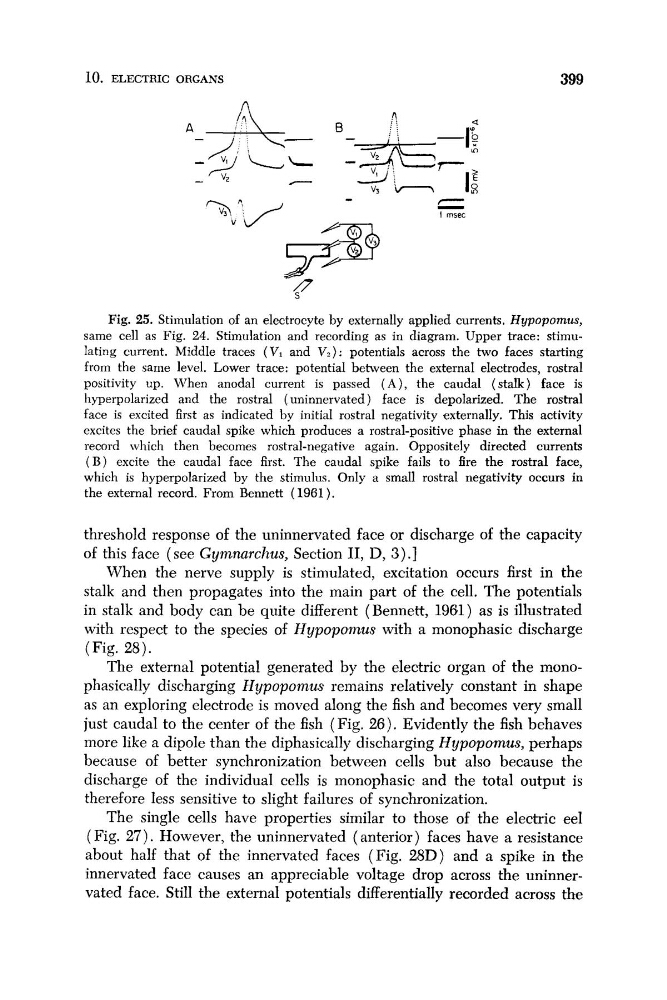
Fig. 25. Stimulation of an electrocyte by externally applied currents. Hypopomus,
same cell as Fig. 24. Stimulation and recording as in diagram. Upper trace: stimulating current. Middle traces (V, and V2): potentials across the two faces starting
from the same level. Lower trace: potential between the external electrodes, rostral
positivity up. When anodal current is passed ( A ) , the caudal (stalk) face is
hyperpolarized and the rostral ( uninnervated) face is depolarized. The rostral
face is excited first as indicated by initial rostral negativity externally. This activity
excites the brief caudal spike which produces a rostral-positive phase in the external
record which then becomes rostral-negative again. Oppositely directed currents
( B ) excite the caudal face first. The caudal spike fails to fire the rostral face,
which is hyperpolarized by the stimulus. Only a small rostral negativity occurs in
the external record. From Bennett (1961 ),
threshold response of the uninnervated face or discharge of the capacity
of this face (see Gymnurchus, Section 11, D, 3 ) .]
When the nerve supply is stimulated, excitation occurs first in the
stalk and then propagates into the main part of the cell. The potentials
in stalk and body can be quite different (Bennett, 1961) as is illustrated
with respect to the species of Hypopomus with a monophasic discharge
(Fig. 28).
The external potential generated by the electric organ of the monophasically discharging Hypopomus remains relatively constant in shape
as an exploring electrode is moved along the fish and becomes very small
just caudal to the center of the fish (Fig. 26). Evidently the fish behaves
more like a dipole than the diphasically discharging Hypopomus, perhaps
because of better synchronization between cells but also because the
discharge of the individual cells is monophasic and the total output is
therefore less sensitive to slight failures of synchronization.
The single cells have properties similar to those of the electric eel
( Fig. 27). However, the uninnervated ( anterior) faces have a resistance
about half that of the innervated faces (Fig. 28D) and a spike in the
innervated face causes an appreciable voltage drop across the uninnervated face. Still the external potentials differentially recorded across the
399
-
7
I rnsec
-
$ 3
f l
Fig. 25. Stimulation of an electrocyte by externally applied currents. Hypopomus,
same cell as Fig. 24. Stimulation and recording as in diagram. Upper trace: stimulating current. Middle traces (V, and V2): potentials across the two faces starting
from the same level. Lower trace: potential between the external electrodes, rostral
positivity up. When anodal current is passed ( A ) , the caudal (stalk) face is
hyperpolarized and the rostral ( uninnervated) face is depolarized. The rostral
face is excited first as indicated by initial rostral negativity externally. This activity
excites the brief caudal spike which produces a rostral-positive phase in the external
record which then becomes rostral-negative again. Oppositely directed currents
( B ) excite the caudal face first. The caudal spike fails to fire the rostral face,
which is hyperpolarized by the stimulus. Only a small rostral negativity occurs in
the external record. From Bennett (1961 ),
threshold response of the uninnervated face or discharge of the capacity
of this face (see Gymnurchus, Section 11, D, 3 ) .]
When the nerve supply is stimulated, excitation occurs first in the
stalk and then propagates into the main part of the cell. The potentials
in stalk and body can be quite different (Bennett, 1961) as is illustrated
with respect to the species of Hypopomus with a monophasic discharge
(Fig. 28).
The external potential generated by the electric organ of the monophasically discharging Hypopomus remains relatively constant in shape
as an exploring electrode is moved along the fish and becomes very small
just caudal to the center of the fish (Fig. 26). Evidently the fish behaves
more like a dipole than the diphasically discharging Hypopomus, perhaps
because of better synchronization between cells but also because the
discharge of the individual cells is monophasic and the total output is
therefore less sensitive to slight failures of synchronization.
The single cells have properties similar to those of the electric eel
( Fig. 27). However, the uninnervated ( anterior) faces have a resistance
about half that of the innervated faces (Fig. 28D) and a spike in the
innervated face causes an appreciable voltage drop across the uninnervated face. Still the external potentials differentially recorded across the