

398
M. V. L. BENNETT
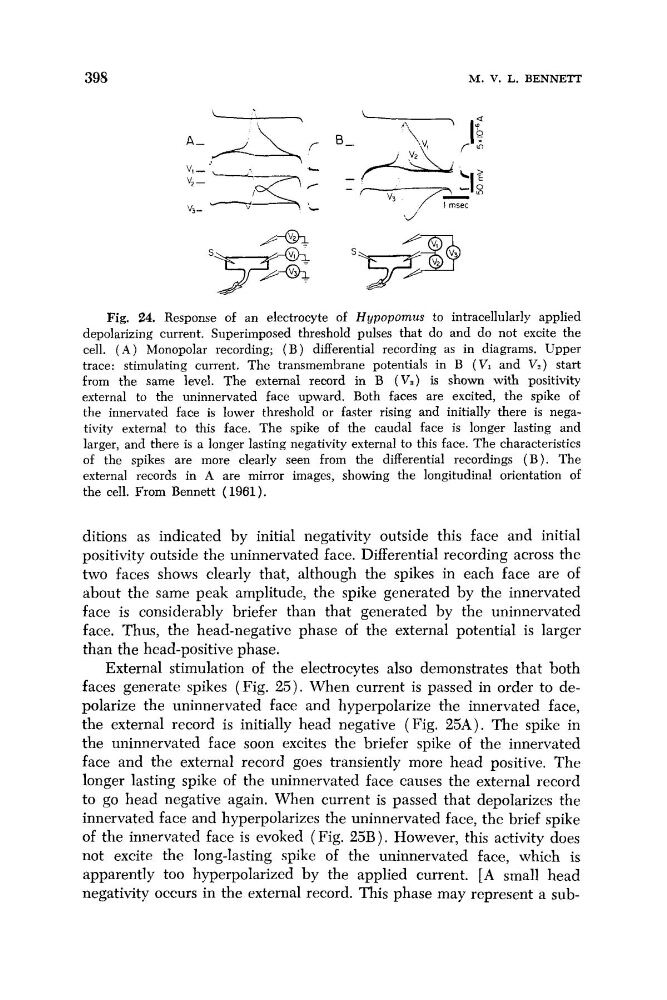
Fig. 24. Response of an electrocyte of Hypopomus to intracellularly applied
depolarizing current. Superimposed threshold pulses that do and do not excite the
cell. ( A ) Monopolar recording; ( B ) differential recording as in diagrams. Upper
trace: stimulating current. The transmembrane potentials in B (V, and V,) start
from the same level. The external record in B (V,) is shown with positivity
external to the uninnervated face upward. Both faces are excited, the spike of
the innervated face is lower threshold or faster rising and initially there is negativity external to this face. The spike of the caudal face is longer lasting and
larger, and there is a longer lasting negativity external to this face. The characteristics
of the spikes are more clearly seen from the differential recordings ( B ) . The
external records in A are mirror images, showing the longitudinal orientation of
the cell. From Bennett (1961).
ditions as indicated by initial negativity outside this face and initial
positivity outside the uninnervated face. Differential recording across the
two faces shows clearly that, although the spikes in each face are of
about the same peak amplitude, the spike generated by the innervated
face is considerably briefer than that generated by the uninnervated
face. Thus, the head-negative phase of the external potential is larger
than the head-positive phase.
External stimulation of the electrocytes also demonstrates that both
faces generate spikes (Fig. 25). When current is passed in order to depolarize the uninnervated face and hyperpolarize the innervated face,
the external record is initially head negative (Fig. 25A). The spike in
the uninnervated face soon excites the briefer spike of the innervated
face and the external record goes transiently more head positive, The
longer lasting spike of the uninnervated face causes the external record
to go head negative again. When current is passed that depolarizes the
innervated face and hyperpolarizes the uninnervated face, the brief spike
of the innervated face is evoked (Fig. 25B). However, this activity does
not excite the long-lasting spike of the uninnervated face, which is
apparently too hyperpolarized by the applied current. [A small head
negativity occurs in the external record. This phase may represent a sub-
M. V. L. BENNETT
Fig. 24. Response of an electrocyte of Hypopomus to intracellularly applied
depolarizing current. Superimposed threshold pulses that do and do not excite the
cell. ( A ) Monopolar recording; ( B ) differential recording as in diagrams. Upper
trace: stimulating current. The transmembrane potentials in B (V, and V,) start
from the same level. The external record in B (V,) is shown with positivity
external to the uninnervated face upward. Both faces are excited, the spike of
the innervated face is lower threshold or faster rising and initially there is negativity external to this face. The spike of the caudal face is longer lasting and
larger, and there is a longer lasting negativity external to this face. The characteristics
of the spikes are more clearly seen from the differential recordings ( B ) . The
external records in A are mirror images, showing the longitudinal orientation of
the cell. From Bennett (1961).
ditions as indicated by initial negativity outside this face and initial
positivity outside the uninnervated face. Differential recording across the
two faces shows clearly that, although the spikes in each face are of
about the same peak amplitude, the spike generated by the innervated
face is considerably briefer than that generated by the uninnervated
face. Thus, the head-negative phase of the external potential is larger
than the head-positive phase.
External stimulation of the electrocytes also demonstrates that both
faces generate spikes (Fig. 25). When current is passed in order to depolarize the uninnervated face and hyperpolarize the innervated face,
the external record is initially head negative (Fig. 25A). The spike in
the uninnervated face soon excites the briefer spike of the innervated
face and the external record goes transiently more head positive, The
longer lasting spike of the uninnervated face causes the external record
to go head negative again. When current is passed that depolarizes the
innervated face and hyperpolarizes the uninnervated face, the brief spike
of the innervated face is evoked (Fig. 25B). However, this activity does
not excite the long-lasting spike of the uninnervated face, which is
apparently too hyperpolarized by the applied current. [A small head
negativity occurs in the external record. This phase may represent a sub-