

373
M. V. L. BENNETT
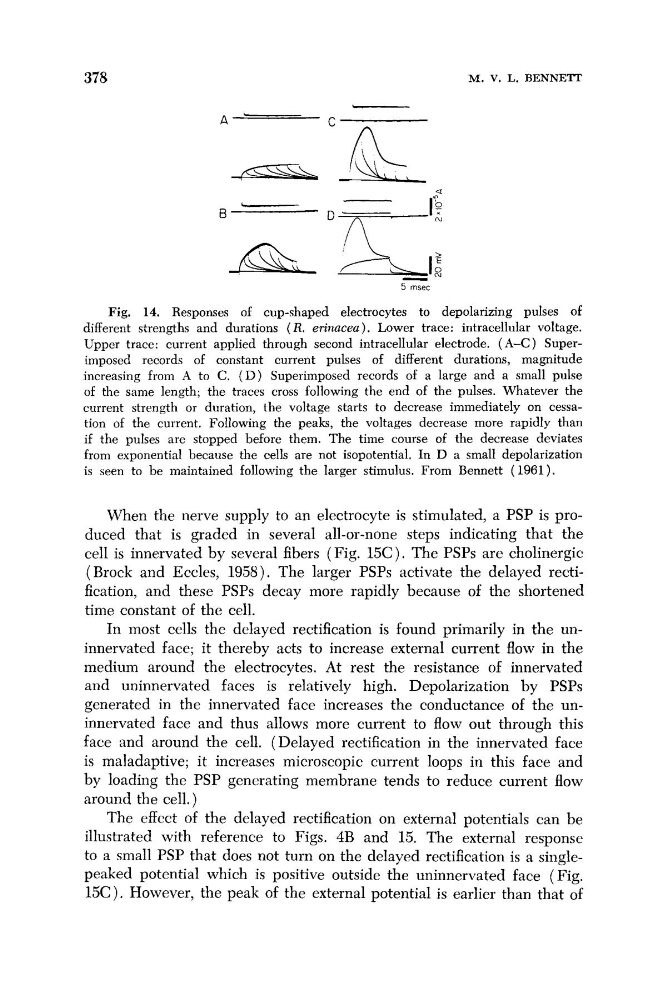
Fig. 14. Responses of cup-shaped electrocytes to depolarizing pulses of
different strengths and durations ( R. erinacea ). Lower trace: intracellular voltage.
Upper trace: current applied through second intracellular electrode. ( A-C ) Superimposed records of constant current pulses of different durations, magnitude
increasing from A to C. ( D ) Superimposed records of a large and a small pulse
of the same length; the traces cross following the end of the pulses. Whatever the
current strength or duration, the voltage starts to decrease immediately on cessation of the current. Following the peaks, the voltages decrease more rapidly than
if the pulses are stopped before them. The time course of the decrease deviates
from exponential because the cells are not isopotential. In D a small depolarization
is seen to be maintained following the larger stimulus. From Bennett (1961).
When the nerve supply to an electrocyte is stimulated, a PSP is produced that is graded in several all-or-none steps indicating that the
cell is innervated by several fibers (Fig. 15C). The PSPs are cholinergic
(Brock and Eccles, 1958). The larger PSPs activate the delayed rectification, and these PSPs decay more rapidly because of the shortened
time constant of the cell.
In most cells the delayed rectification is found primarily in the uninnervated face; it thereby acts to increase external current flow in the
medium around the electrocytes. At rest the resistance of innervated
and uninnervated faces is relatively high. Depolarization by PSPs
generated in the innervated face increases the conductance of the uninnervated face and thus allows more current to flow out through this
face and around the cell. (Delayed rectification in the innervated face
is maladaptive; it increases microscopic current loops in this face and
by loading the PSP generating membrane tends to reduce current flow
around the cell.)
The effect of the delayed rectification on external potentials can be
illustrated with reference to Figs. 4B and 15. The external response
to a small PSP that does not turn on the delayed rectification is a singlepeaked potential which is positive outside the uninnervated face (Fig.
15C ) . However, the peak of the external potential is earlier than that of
M. V. L. BENNETT
Fig. 14. Responses of cup-shaped electrocytes to depolarizing pulses of
different strengths and durations ( R. erinacea ). Lower trace: intracellular voltage.
Upper trace: current applied through second intracellular electrode. ( A-C ) Superimposed records of constant current pulses of different durations, magnitude
increasing from A to C. ( D ) Superimposed records of a large and a small pulse
of the same length; the traces cross following the end of the pulses. Whatever the
current strength or duration, the voltage starts to decrease immediately on cessation of the current. Following the peaks, the voltages decrease more rapidly than
if the pulses are stopped before them. The time course of the decrease deviates
from exponential because the cells are not isopotential. In D a small depolarization
is seen to be maintained following the larger stimulus. From Bennett (1961).
When the nerve supply to an electrocyte is stimulated, a PSP is produced that is graded in several all-or-none steps indicating that the
cell is innervated by several fibers (Fig. 15C). The PSPs are cholinergic
(Brock and Eccles, 1958). The larger PSPs activate the delayed rectification, and these PSPs decay more rapidly because of the shortened
time constant of the cell.
In most cells the delayed rectification is found primarily in the uninnervated face; it thereby acts to increase external current flow in the
medium around the electrocytes. At rest the resistance of innervated
and uninnervated faces is relatively high. Depolarization by PSPs
generated in the innervated face increases the conductance of the uninnervated face and thus allows more current to flow out through this
face and around the cell. (Delayed rectification in the innervated face
is maladaptive; it increases microscopic current loops in this face and
by loading the PSP generating membrane tends to reduce current flow
around the cell.)
The effect of the delayed rectification on external potentials can be
illustrated with reference to Figs. 4B and 15. The external response
to a small PSP that does not turn on the delayed rectification is a singlepeaked potential which is positive outside the uninnervated face (Fig.
15C ) . However, the peak of the external potential is earlier than that of