

10. ELECTRIC ORGANS
379
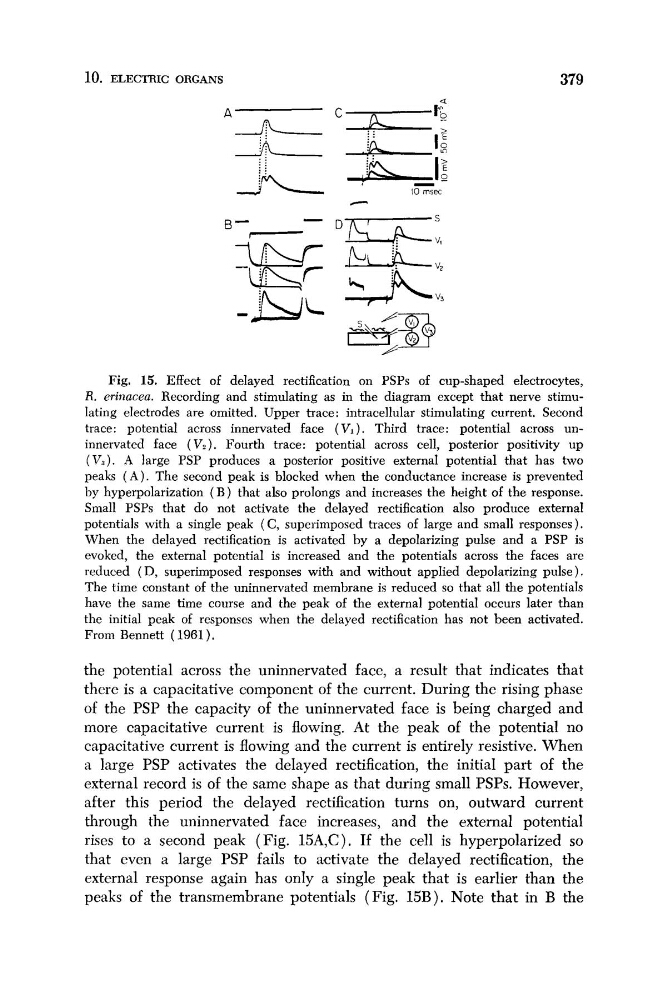
Fig. 15. Effect of delayed rectification on PSPs of cup-shaped electrocytes,
R. erinacea. Recording and stimulating as in the diagram except that nerve stimulating electrodes are omitted. Upper trace: intracellular stimulating current. Second
trace: potential across innervated face (V,). Third trace: potential across uninnervated face ( V2). Fourth trace: potential across cell, posterior positivity up
(Vx). A large PSP produces a posterior positive external potential that has two
peaks ( A ) . The second peak is blocked when the conductance increase is prevented
by hyperpolarization ( B ) that also prolongs and increases the height of the response.
Small PSPs that do not activate the delayed rectification also produce external
potentials with a single peak (C, superimposed traces of large and small responses).
When the delayed rectification is activated by a depolarizing pulse and a PSP is
evoked, the external potential is increased and the potentials across the faces are
reduced ( D, superimposed responses with and without applied depolarizing pulse).
The time constant of the uninnervated membrane is reduced so that all the potentials
have the same time course and the peak of the external potential occurs later than
the initial peak of responses when the delayed rectification has not been activated.
From Bennett ( 1961).
the potential across the uninnervated face, a result that indicates that
there is a capacitative component of the current. During the rising phase
of the PSP the capacity of the uninnervated face is being charged and
more capacitative current is flowing. At the peak of the potential no
capacitative current is flowing and the current is entirely resistive. When
a large PSP activates the delayed rectification, the initial part of the
external record is of the same shape as that during small PSPs. However,
after this period the delayed rectification turns on, outward current
through the uninnervated face increases, and the external potential
rises to a second peak (Fig. 15A,C). If the cell is hyperpolarized so
that even a large PSP fails to activate the delayed rectification, the
external response again has only a single peak that is earlier than the
peaks of the transmembrane potentials (Fig. 15B). Note that in B the
379
Fig. 15. Effect of delayed rectification on PSPs of cup-shaped electrocytes,
R. erinacea. Recording and stimulating as in the diagram except that nerve stimulating electrodes are omitted. Upper trace: intracellular stimulating current. Second
trace: potential across innervated face (V,). Third trace: potential across uninnervated face ( V2). Fourth trace: potential across cell, posterior positivity up
(Vx). A large PSP produces a posterior positive external potential that has two
peaks ( A ) . The second peak is blocked when the conductance increase is prevented
by hyperpolarization ( B ) that also prolongs and increases the height of the response.
Small PSPs that do not activate the delayed rectification also produce external
potentials with a single peak (C, superimposed traces of large and small responses).
When the delayed rectification is activated by a depolarizing pulse and a PSP is
evoked, the external potential is increased and the potentials across the faces are
reduced ( D, superimposed responses with and without applied depolarizing pulse).
The time constant of the uninnervated membrane is reduced so that all the potentials
have the same time course and the peak of the external potential occurs later than
the initial peak of responses when the delayed rectification has not been activated.
From Bennett ( 1961).
the potential across the uninnervated face, a result that indicates that
there is a capacitative component of the current. During the rising phase
of the PSP the capacity of the uninnervated face is being charged and
more capacitative current is flowing. At the peak of the potential no
capacitative current is flowing and the current is entirely resistive. When
a large PSP activates the delayed rectification, the initial part of the
external record is of the same shape as that during small PSPs. However,
after this period the delayed rectification turns on, outward current
through the uninnervated face increases, and the external potential
rises to a second peak (Fig. 15A,C). If the cell is hyperpolarized so
that even a large PSP fails to activate the delayed rectification, the
external response again has only a single peak that is earlier than the
peaks of the transmembrane potentials (Fig. 15B). Note that in B the