

M. V. L. BENNETT
376
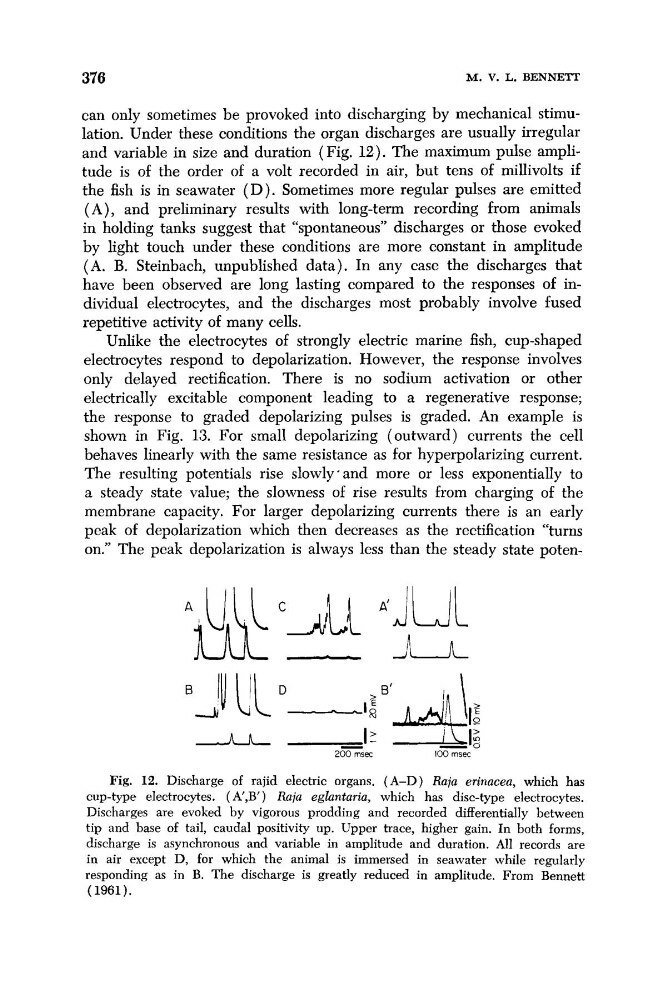
can only sometimes be provoked into discharging by mechanical stimulation. Under these conditions the organ discharges are usually irregular
and variable in size and duration (Fig. 12). The maximum pulse amplitude is of the order of a volt recorded in air, but tens of millivolts if
the fish is in seawater (D). Sometimes more regular pulses are emitted
(A), and preliminary results with long-term recording from animals
in holding tanks suggest that “spontaneous” discharges or those evoked
by light touch under these conditions are more constant in amplitude
(A, B. Steinbach, unpublished data). In any case the discharges that
have been observed are long lasting compared to the responses of individual electrocytes, and the discharges most probably involve fused
repetitive activity of many cells.
Unlike the electrocytes of strongly electric marine fish, cup-shaped
electrocytes respond to depolarization. However, the response involves
only delayed rectification. There is no sodium activation or other
electrically excitable component leading to a regenerative response;
the response to graded depolarizing pulses is graded. An example is
shown in Fig. 13. For small depolarizing (outward) currents the cell
behaves linearly with the same resistance as for hyperpolarizing current.
The resulting potentials rise slowly. and more or less exponentially to
a steady state value; the slowness of rise results from charging of the
membrane capacity. For larger depolarizing currents there is an early
peak of depolarization which then decreases as the rectification “turns
on.” The peak depolarization is always less than the steady state potenFig. 12. Discharge of rajid electric organs. (A-D) Raja erinacea, which has
cup-type electrocytes. ( A‘,B’ ) Raja eglantaria, which has disc-type electrocytes.
Discharges are evoked by vigorous prodding and recorded differentially between
tip and base of tail, caudal positivity up. Upper trace, higher gain. In both forms,
discharge is asynchronous and variable in amplitude and duration. All records are
in air except D, for which the animal is immersed in seawater while regularly
responding as in B. The discharge is greatly reduced in amplitude. From Bennett
(1961).
376
can only sometimes be provoked into discharging by mechanical stimulation. Under these conditions the organ discharges are usually irregular
and variable in size and duration (Fig. 12). The maximum pulse amplitude is of the order of a volt recorded in air, but tens of millivolts if
the fish is in seawater (D). Sometimes more regular pulses are emitted
(A), and preliminary results with long-term recording from animals
in holding tanks suggest that “spontaneous” discharges or those evoked
by light touch under these conditions are more constant in amplitude
(A, B. Steinbach, unpublished data). In any case the discharges that
have been observed are long lasting compared to the responses of individual electrocytes, and the discharges most probably involve fused
repetitive activity of many cells.
Unlike the electrocytes of strongly electric marine fish, cup-shaped
electrocytes respond to depolarization. However, the response involves
only delayed rectification. There is no sodium activation or other
electrically excitable component leading to a regenerative response;
the response to graded depolarizing pulses is graded. An example is
shown in Fig. 13. For small depolarizing (outward) currents the cell
behaves linearly with the same resistance as for hyperpolarizing current.
The resulting potentials rise slowly. and more or less exponentially to
a steady state value; the slowness of rise results from charging of the
membrane capacity. For larger depolarizing currents there is an early
peak of depolarization which then decreases as the rectification “turns
on.” The peak depolarization is always less than the steady state potenFig. 12. Discharge of rajid electric organs. (A-D) Raja erinacea, which has
cup-type electrocytes. ( A‘,B’ ) Raja eglantaria, which has disc-type electrocytes.
Discharges are evoked by vigorous prodding and recorded differentially between
tip and base of tail, caudal positivity up. Upper trace, higher gain. In both forms,
discharge is asynchronous and variable in amplitude and duration. All records are
in air except D, for which the animal is immersed in seawater while regularly
responding as in B. The discharge is greatly reduced in amplitude. From Bennett
(1961).