

9. THE MAUTHNER CELL
335
a
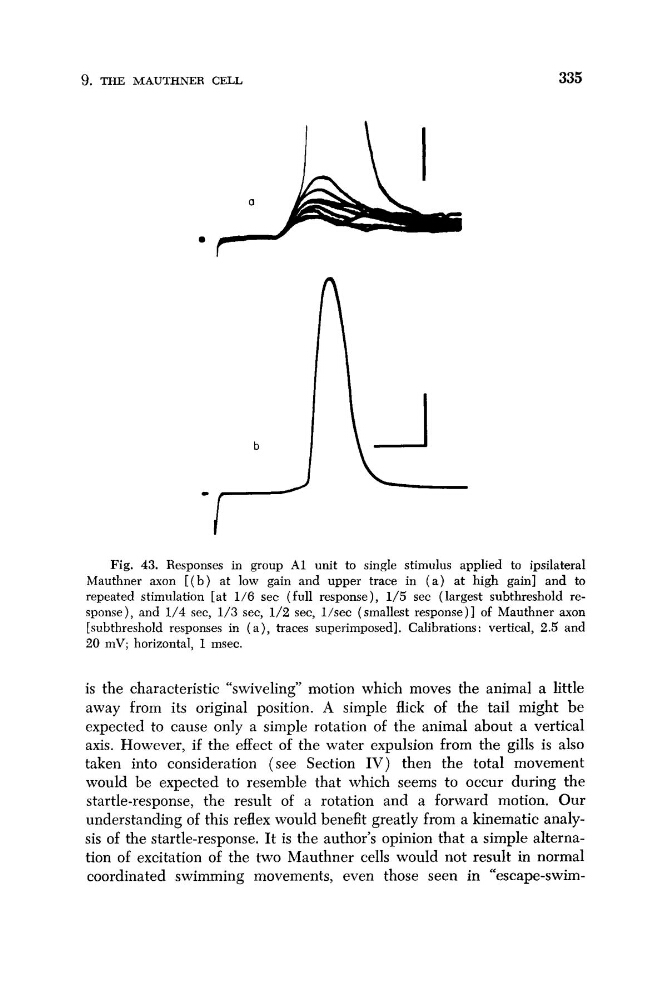
Fig. 43. Responses in group A1 unit to single stimulus applied to ipsilateral
Mauthner axon [( b ) at low gain and upper trace in ( a ) at high gain] and to
repeated stimulation [at 1/6 sec (full response), 1/5 sec (largest subthreshold response), and 1/4 sec, 1/3 sec, 1/2 sec, Usec (smallest response)] of Mauthner axon
[subthreshold responses in ( a ) , traces superimposed]. Calibrations: vertical, 2.5 and
20 mV; horizontal, 1 msec.
is the characteristic “swiveling” motion which moves the animal a little
away from its original position. A simple flick of the tail might be
expected to cause only a simple rotation of the animal about a vertical
axis. However, if the effect of the water expulsion from the gills is also
taken into consideration (see Section IV) then the total movement
would be expected to resemble that which seems to occur during the
startle-response, the result of a rotation and a forward motion. Our
understanding of this reflex would benefit greatly from a kinematic analysis of the startle-response. It is the author’s opinion that a simple alternation of excitation of the two Mauthner cells would not result in normal
coordinated swimming movements, even those seen in “escape-swim-
335
a
Fig. 43. Responses in group A1 unit to single stimulus applied to ipsilateral
Mauthner axon [( b ) at low gain and upper trace in ( a ) at high gain] and to
repeated stimulation [at 1/6 sec (full response), 1/5 sec (largest subthreshold response), and 1/4 sec, 1/3 sec, 1/2 sec, Usec (smallest response)] of Mauthner axon
[subthreshold responses in ( a ) , traces superimposed]. Calibrations: vertical, 2.5 and
20 mV; horizontal, 1 msec.
is the characteristic “swiveling” motion which moves the animal a little
away from its original position. A simple flick of the tail might be
expected to cause only a simple rotation of the animal about a vertical
axis. However, if the effect of the water expulsion from the gills is also
taken into consideration (see Section IV) then the total movement
would be expected to resemble that which seems to occur during the
startle-response, the result of a rotation and a forward motion. Our
understanding of this reflex would benefit greatly from a kinematic analysis of the startle-response. It is the author’s opinion that a simple alternation of excitation of the two Mauthner cells would not result in normal
coordinated swimming movements, even those seen in “escape-swim-