

336
J. DIAMOND
Stim. to L axon
L EMG
t
Stim. to R axon
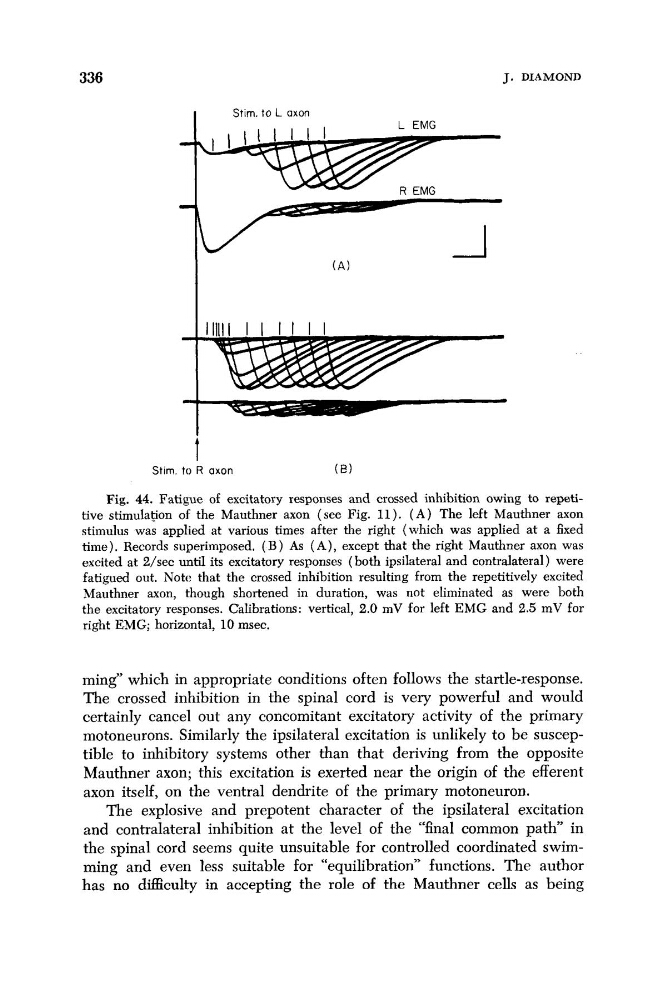
Fig. 44. Fatigue of excitatory responses and crossed inhibition owing to repetitive stimulation of the Mauthner axon (see Fig. 11). ( A ) The left Mauthner axon
stimulus was applied at various times after the right (which was applied at a fixed
time). Records superimposed, ( B ) As ( A ) , except that the right Mauthner axon was
excited at 2/sec until its excitatory responses (both ipsilateral and contralateral) were
fatigued out. Note that the crossed inhibition resulting from the repetitively excited
Mauthner axon, though shortened in duration, was not eliminated as were both
the excitatory responses. Calibrations: vertical, 2.0 mV for left EMG and 2.5 mV for
right EMG; horizontal, 10 msec.
ming” which in appropriate conditions often follows the startle-response.
The crossed inhibition in the spinal cord is very powerful and would
certainly cancel out any concomitant excitatory activity of the primary
motoneurons. Similarly the ipsilateral excitation is unlikely to be susceptible to inhibitory systems other than that deriving from the opposite
Mauthner axon; this excitation is exerted near the origin of the efferent
axon itself, on the ventral dendrite of the primary motoneuron.
The explosive and prepotent character of the ipsilateral excitation
and contralateral inhibition at the level of the “final common path” in
the spinal cord seems quite unsuitable for controlled coordinated swimming and even less suitable for “equilibration” functions. The author
has no daculty in accepting the role of the Mauthner cells as being
J. DIAMOND
Stim. to L axon
L EMG
t
Stim. to R axon
Fig. 44. Fatigue of excitatory responses and crossed inhibition owing to repetitive stimulation of the Mauthner axon (see Fig. 11). ( A ) The left Mauthner axon
stimulus was applied at various times after the right (which was applied at a fixed
time). Records superimposed, ( B ) As ( A ) , except that the right Mauthner axon was
excited at 2/sec until its excitatory responses (both ipsilateral and contralateral) were
fatigued out. Note that the crossed inhibition resulting from the repetitively excited
Mauthner axon, though shortened in duration, was not eliminated as were both
the excitatory responses. Calibrations: vertical, 2.0 mV for left EMG and 2.5 mV for
right EMG; horizontal, 10 msec.
ming” which in appropriate conditions often follows the startle-response.
The crossed inhibition in the spinal cord is very powerful and would
certainly cancel out any concomitant excitatory activity of the primary
motoneurons. Similarly the ipsilateral excitation is unlikely to be susceptible to inhibitory systems other than that deriving from the opposite
Mauthner axon; this excitation is exerted near the origin of the efferent
axon itself, on the ventral dendrite of the primary motoneuron.
The explosive and prepotent character of the ipsilateral excitation
and contralateral inhibition at the level of the “final common path” in
the spinal cord seems quite unsuitable for controlled coordinated swimming and even less suitable for “equilibration” functions. The author
has no daculty in accepting the role of the Mauthner cells as being