

334
J. DIAMOND
0.5sec
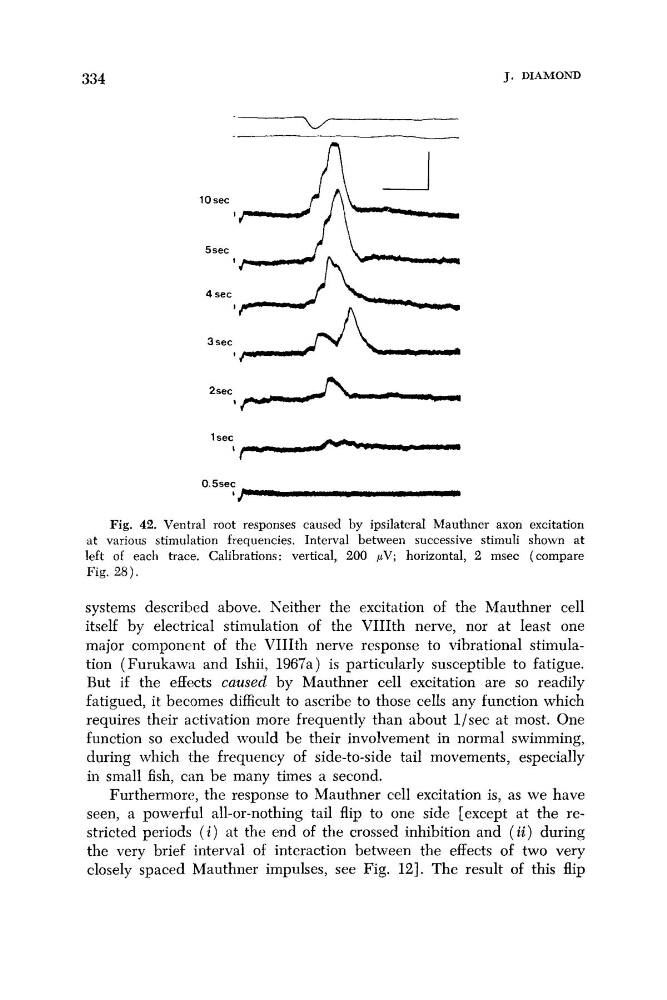
Fig. 42. Ventral root responses caused by ipsilateral Mauthner axon excitation
at various stimulation frequencies. Interval between successive stimuli shown at
left of each trace. Calibrations: vertical, 200 pV; horizontal, 2 msec (compare
Fig. 28).
systems described above. Neither the excitation of the Mauthner cell
itself by electrical stimulation of the VIIIth nerve, nor at least one
major component of the VIIIth nerve response to vibrational stimulation (Furukawa and Ishii, 1967a) is particularly susceptible to fatigue.
But if the effects caused by Mauthner cell excitation are so readily
fatigued, it becomes difficult to ascribe to those cells any function which
requires their activation more frequently than about l/sec at most. One
function so excluded would be their involvement in normal swimming,
during which i he frequency of side-to-side tail movements, especially
in small fish, can be many times a second.
Furthermore, the response to Mauthner cell excitation is, as we have
seen, a powerful all-or-nothing tail flip to one side [except at the restricted periods ( i ) at the end of the crossed inhibition and ( i i ) during
the very brief interval of interaction between the effects of two very
closely spaced Mauthner impulses, see Fig. 121. The result of this flip
J. DIAMOND
0.5sec
Fig. 42. Ventral root responses caused by ipsilateral Mauthner axon excitation
at various stimulation frequencies. Interval between successive stimuli shown at
left of each trace. Calibrations: vertical, 200 pV; horizontal, 2 msec (compare
Fig. 28).
systems described above. Neither the excitation of the Mauthner cell
itself by electrical stimulation of the VIIIth nerve, nor at least one
major component of the VIIIth nerve response to vibrational stimulation (Furukawa and Ishii, 1967a) is particularly susceptible to fatigue.
But if the effects caused by Mauthner cell excitation are so readily
fatigued, it becomes difficult to ascribe to those cells any function which
requires their activation more frequently than about l/sec at most. One
function so excluded would be their involvement in normal swimming,
during which i he frequency of side-to-side tail movements, especially
in small fish, can be many times a second.
Furthermore, the response to Mauthner cell excitation is, as we have
seen, a powerful all-or-nothing tail flip to one side [except at the restricted periods ( i ) at the end of the crossed inhibition and ( i i ) during
the very brief interval of interaction between the effects of two very
closely spaced Mauthner impulses, see Fig. 121. The result of this flip