

294
I
J. DIAMOND
I
r
L
b
d
.
-
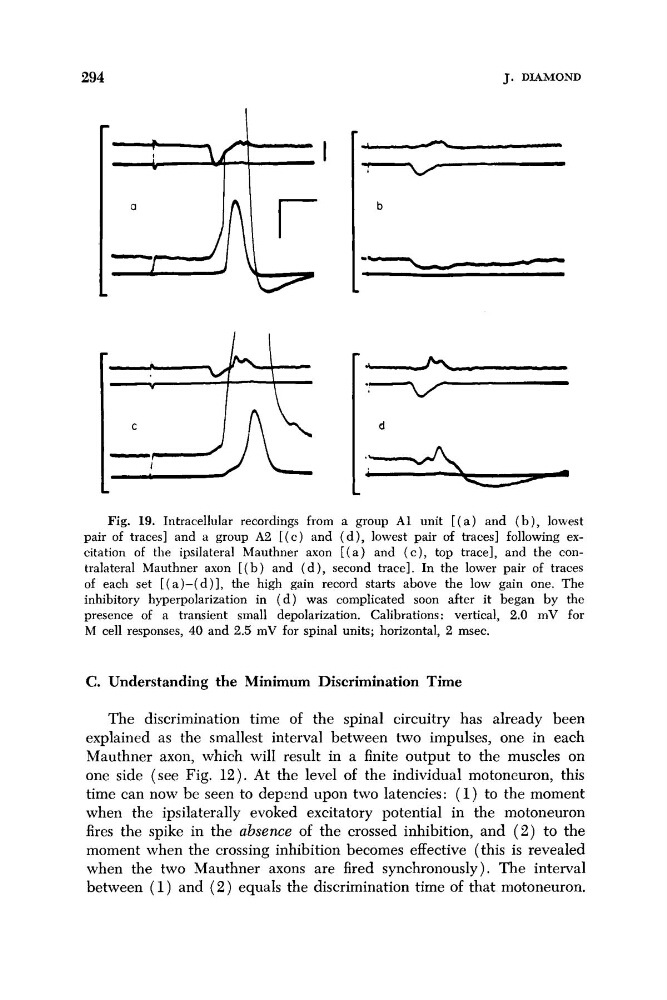
Fig. 19. Intracellular recordings from a group A1 unit [ ( a ) and ( b ) , lowest
pair of traces] and a group A2 [ ( c ) and ( d ) , lowest pair of traces] following excitation of the ipsilateral Mauthner axon [ ( a ) and ( c ) , top trace], and the contralateral Mauthner axon [ ( b ) and ( d ) , second trace]. In the lower pair of traces
of each set [ ( a ) - ( d ) ] , the high gain record starts above the low gain one. The
inhibitory hyperpolarization in ( d ) was complicated soon after it began by the
presence of a transient small depolarization. Calibrations : vertical, 2.0 mV for
M cell responses, 40 and 2.5 mV for spinal units; horizontal, 2 msec.
C. Understanding the Minimum Discrimination Time
The discrimination time of the spinal circuitry has already been
explained as the smallest interval between two impulses, one in each
Mauthner axon, which will result in a finite output to the muscles on
one side (see Fig. 12). At the level of the individual motoneuron, this
time can now be seen to depend upon two latencies: (1) to the moment
when the ipsilaterally evoked excitatory potential in the motoneuron
fires the spike in the absence of the crossed inhibition, and ( 2 ) to the
moment when the crossing inhibition becomes effective (this is revealed
when the two Mauthner axons are fired synchronously). The interval
between ( 1 ) and ( 2 ) equals the discrimination time of that motoneuron.
I
J. DIAMOND
I
r
L
b
d
.
-
Fig. 19. Intracellular recordings from a group A1 unit [ ( a ) and ( b ) , lowest
pair of traces] and a group A2 [ ( c ) and ( d ) , lowest pair of traces] following excitation of the ipsilateral Mauthner axon [ ( a ) and ( c ) , top trace], and the contralateral Mauthner axon [ ( b ) and ( d ) , second trace]. In the lower pair of traces
of each set [ ( a ) - ( d ) ] , the high gain record starts above the low gain one. The
inhibitory hyperpolarization in ( d ) was complicated soon after it began by the
presence of a transient small depolarization. Calibrations : vertical, 2.0 mV for
M cell responses, 40 and 2.5 mV for spinal units; horizontal, 2 msec.
C. Understanding the Minimum Discrimination Time
The discrimination time of the spinal circuitry has already been
explained as the smallest interval between two impulses, one in each
Mauthner axon, which will result in a finite output to the muscles on
one side (see Fig. 12). At the level of the individual motoneuron, this
time can now be seen to depend upon two latencies: (1) to the moment
when the ipsilaterally evoked excitatory potential in the motoneuron
fires the spike in the absence of the crossed inhibition, and ( 2 ) to the
moment when the crossing inhibition becomes effective (this is revealed
when the two Mauthner axons are fired synchronously). The interval
between ( 1 ) and ( 2 ) equals the discrimination time of that motoneuron.