

9. THE MAUTHNER CELL
293
Ventra I
dendrite
Intermediate
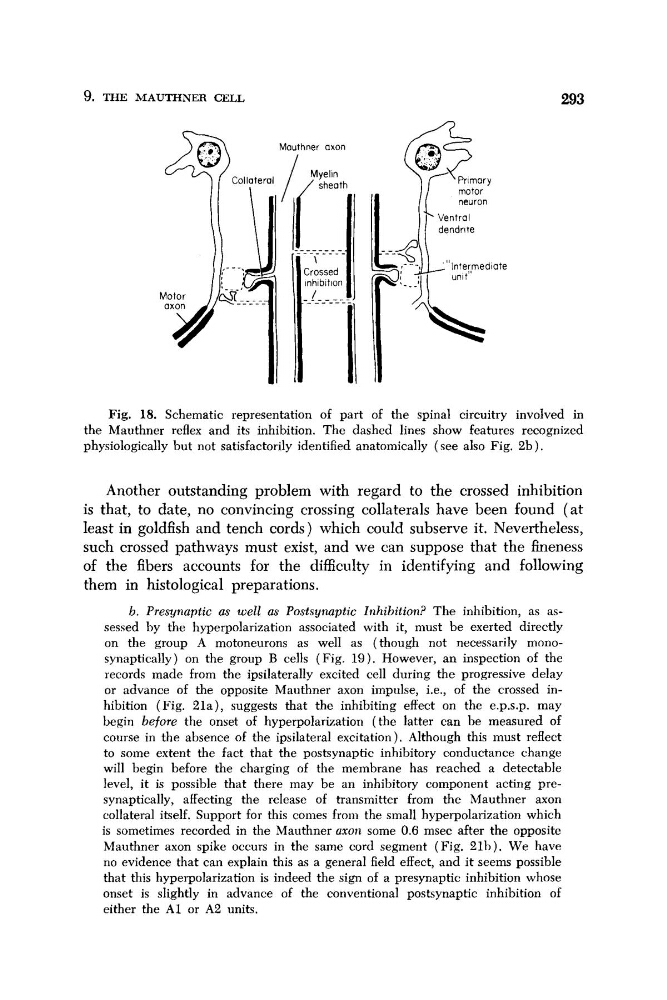
Fig. 18. Schematic representation of part of the spinal circuitry involved in
the Mauthner reflex and its inhibition. The dashed lines show features recognized
physiologically but not satisfactorily identified anatomically (see also Fig. 2b).
Another outstanding problem with regard to the crossed inhibition
is that, to date, no convincing crossing collaterals have been found ( a t
least in goldfish and tench cords) which could subserve it. Nevertheless,
such crossed pathways must exist, and we can suppose that the fineness
of the fibers accounts for the difficulty in identifying and following
them in histological preparations.
b. Presynaptic as well as Postsynaptic Inhibition? The inhibition, as assessed by the hyperpolarization associated with it, must be exerted directly
on the group A motoneurons as well as (though not necessarily monosynaptically) on the group B cells (Fig. 19). However, an inspection of the
records made from the ipsilaterally excited cell during the progressive delay
or advance of the opposite Mauthner axon impulse, i.e., of the crossed inhibition (Fig. 21a), suggests that the inhibiting effect on the e.p.s.p. may
begin before the onset of hyperpolarization (the latter can be measured of
course in the absence of the ipsilateral excitation). Although this must reflect
to some extent the fact that the postsynaptic inhibitory conductance change
will begin before the charging of the membrane has reached a detectable
level, it is possible that there may be an inhibitory component acting presynaptically, affecting the release of transmitter from the Mauthner axon
collateral itself. Support for this comes from the small hyperpolarization which
is sometimes recorded in the Mauthner axon some 0.6 msec after the opposite
Mauthner axon spike occurs in the same cord segment (Fig. 21b). We have
no evidence that can explain this as a general field effect, and it seems possible
that this hyperpolarization is indeed the sign of a presynaptic inhibition whose
onset is slightly in advance of the conventional postsynaptic inhibition of
either the A 1 or A2 units.
293
Ventra I
dendrite
Intermediate
Fig. 18. Schematic representation of part of the spinal circuitry involved in
the Mauthner reflex and its inhibition. The dashed lines show features recognized
physiologically but not satisfactorily identified anatomically (see also Fig. 2b).
Another outstanding problem with regard to the crossed inhibition
is that, to date, no convincing crossing collaterals have been found ( a t
least in goldfish and tench cords) which could subserve it. Nevertheless,
such crossed pathways must exist, and we can suppose that the fineness
of the fibers accounts for the difficulty in identifying and following
them in histological preparations.
b. Presynaptic as well as Postsynaptic Inhibition? The inhibition, as assessed by the hyperpolarization associated with it, must be exerted directly
on the group A motoneurons as well as (though not necessarily monosynaptically) on the group B cells (Fig. 19). However, an inspection of the
records made from the ipsilaterally excited cell during the progressive delay
or advance of the opposite Mauthner axon impulse, i.e., of the crossed inhibition (Fig. 21a), suggests that the inhibiting effect on the e.p.s.p. may
begin before the onset of hyperpolarization (the latter can be measured of
course in the absence of the ipsilateral excitation). Although this must reflect
to some extent the fact that the postsynaptic inhibitory conductance change
will begin before the charging of the membrane has reached a detectable
level, it is possible that there may be an inhibitory component acting presynaptically, affecting the release of transmitter from the Mauthner axon
collateral itself. Support for this comes from the small hyperpolarization which
is sometimes recorded in the Mauthner axon some 0.6 msec after the opposite
Mauthner axon spike occurs in the same cord segment (Fig. 21b). We have
no evidence that can explain this as a general field effect, and it seems possible
that this hyperpolarization is indeed the sign of a presynaptic inhibition whose
onset is slightly in advance of the conventional postsynaptic inhibition of
either the A 1 or A2 units.