

292
J. DIAMOND
a
b
I ' I / J
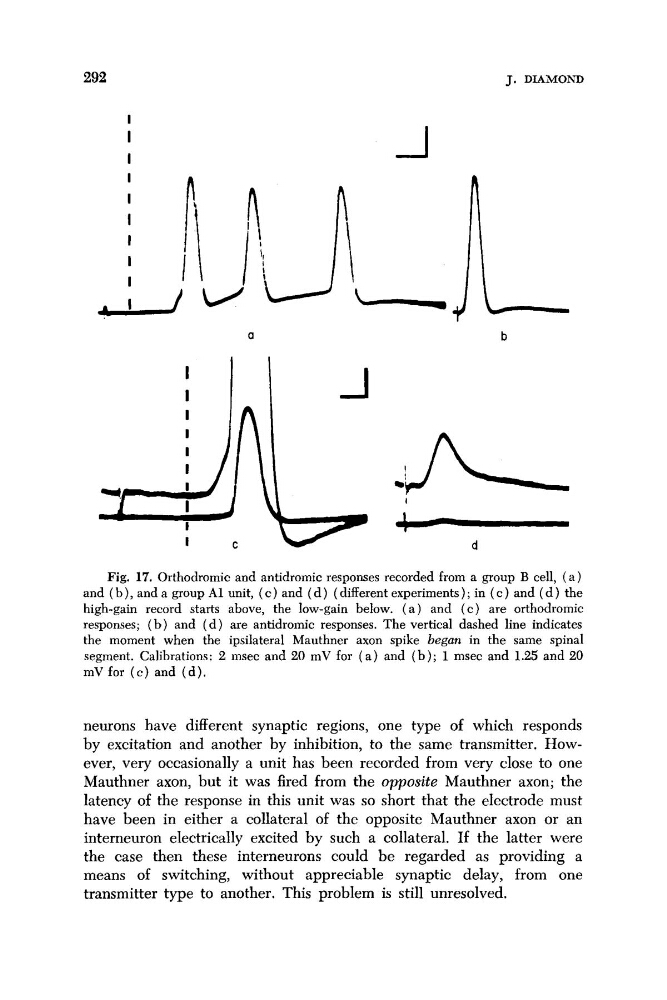
Fig. 17. Orthodromic and antidromic responses recorded from a group B cell, ( a )
and ( b ) , and a group A1 unit, ( c ) and ( d ) (different experiments); in ( c ) and ( d ) the
high-gain record starts above, the low-gain below. ( a ) and ( c ) are orthodromic
responses; ( b ) and ( d ) are antidromic responses. The vertical dashed line indicates
the moment when the ipsilateral Mauthner axon spike began in the same spinal
segment. Calibrations: 2 msec and 20 mV for ( a ) and ( b ) ; 1 msec and 1.25 and 20
mV for ( c ) and ( d ) .
neurons have different synaptic regions, one type of which responds
by excitation and another by inhibition, to the same transmitter. However, very occasionally a unit has been recorded from very close to one
Mauthner axon, but it was fired from the opposite Mauthner axon; the
latency of the response in this unit was so short that the electrode must
have been in either a collateral of the opposite Mauthner axon or an
interneuron electrically excited by such a collateral. If the latter were
the case then these interneurons could be regarded as providing a
means of switching, without appreciable synaptic delay, from one
transmitter type to another. This problem is still unresolved.
J. DIAMOND
a
b
I ' I / J
Fig. 17. Orthodromic and antidromic responses recorded from a group B cell, ( a )
and ( b ) , and a group A1 unit, ( c ) and ( d ) (different experiments); in ( c ) and ( d ) the
high-gain record starts above, the low-gain below. ( a ) and ( c ) are orthodromic
responses; ( b ) and ( d ) are antidromic responses. The vertical dashed line indicates
the moment when the ipsilateral Mauthner axon spike began in the same spinal
segment. Calibrations: 2 msec and 20 mV for ( a ) and ( b ) ; 1 msec and 1.25 and 20
mV for ( c ) and ( d ) .
neurons have different synaptic regions, one type of which responds
by excitation and another by inhibition, to the same transmitter. However, very occasionally a unit has been recorded from very close to one
Mauthner axon, but it was fired from the opposite Mauthner axon; the
latency of the response in this unit was so short that the electrode must
have been in either a collateral of the opposite Mauthner axon or an
interneuron electrically excited by such a collateral. If the latter were
the case then these interneurons could be regarded as providing a
means of switching, without appreciable synaptic delay, from one
transmitter type to another. This problem is still unresolved.