

8. THE LATERAL LINE ORGAN MECHANORECEPTORS
245
sides of the septum the cupula will be subjected to shearing displacement along the axis of the canal. The narrowing of the canal lumen at this
point may provide amplification of displacement amplitude. The cupula is
a rhomboid dome, the matrix consisting of a finely fibrillar substance as
seen in the transmission electron microscope. The surface outline clearly
demonstrates the striated appearance resulting from the columnar aggregation of cupular material. Concentric shelves of surface architecture
may reflect periodicity in the growth of the cupula.
With the cupula dissected away the surface of the sensory epithelium
becomes available for inspection (Fig. 2 ) . Sensory hair bundles from
several hundred hair cells extend perpendicular to the sensory epithelium
(Fig. 3 ) . They are about 7 p high, counting the kinocilium, and their
diameter is about 1.5 p. The surface of supporting cells exhibit numerous
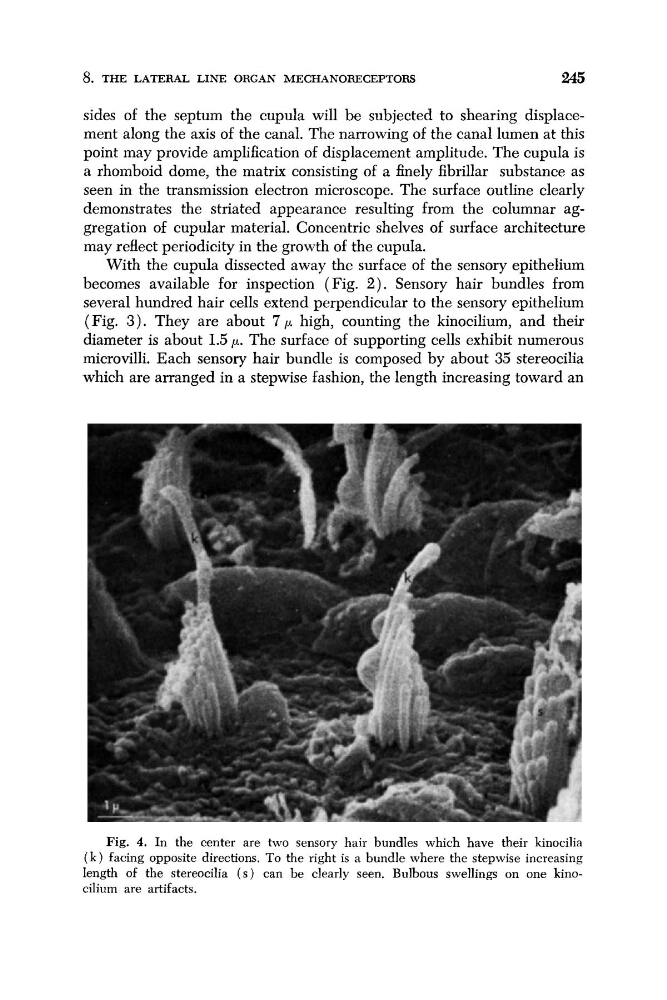
microvilli. Each sensory hair bundle is composed by about 35 stereocilia
which are arranged in a stepwise fashion, the length increasing toward an
Fig. 4. In the center are two sensory hair bundles which have their kinocilia
( k ) facing opposite directions. To the right is a bundle where the stepwise increasing
length of the stereocilia ( s ) can be clearly seen. Bulbous swellings on one kinocilium are artifacts.
245
sides of the septum the cupula will be subjected to shearing displacement along the axis of the canal. The narrowing of the canal lumen at this
point may provide amplification of displacement amplitude. The cupula is
a rhomboid dome, the matrix consisting of a finely fibrillar substance as
seen in the transmission electron microscope. The surface outline clearly
demonstrates the striated appearance resulting from the columnar aggregation of cupular material. Concentric shelves of surface architecture
may reflect periodicity in the growth of the cupula.
With the cupula dissected away the surface of the sensory epithelium
becomes available for inspection (Fig. 2 ) . Sensory hair bundles from
several hundred hair cells extend perpendicular to the sensory epithelium
(Fig. 3 ) . They are about 7 p high, counting the kinocilium, and their
diameter is about 1.5 p. The surface of supporting cells exhibit numerous
microvilli. Each sensory hair bundle is composed by about 35 stereocilia
which are arranged in a stepwise fashion, the length increasing toward an
Fig. 4. In the center are two sensory hair bundles which have their kinocilia
( k ) facing opposite directions. To the right is a bundle where the stepwise increasing
length of the stereocilia ( s ) can be clearly seen. Bulbous swellings on one kinocilium are artifacts.