

W W M N. TAVOLGA
148
been called the “Springfederapparat” ( Muller, 1842) and “elastic spring”
(Sdrensen, 1894). This structure is derived from the transverse processes
of the first few vertebrae and was first reported to function in sound
production by Sgrensen ( 1894) and later confirmed by Tavolga (1962).
In marine catfishes, Bagre marinus and Galeichthys felis, the sonic mechanism has been described in some detail as consisting of a pair of sonic
muscles that originate from the epiotic and neighboring bones of the
skull and insert on the upper surfaces of the elastic spring. Vibration of
these muscles causes the swim bladder to vibrate, and the elasticity of the
bony shelf acts as the antagonist to the contraction of the sonic muscles
( Tavolga, 1962).
Many species of fishes have been found to possess a pair of muscles
connecting the skull and swim bladder, and, on the basis of morphology,
sb
I
sb
idm
[
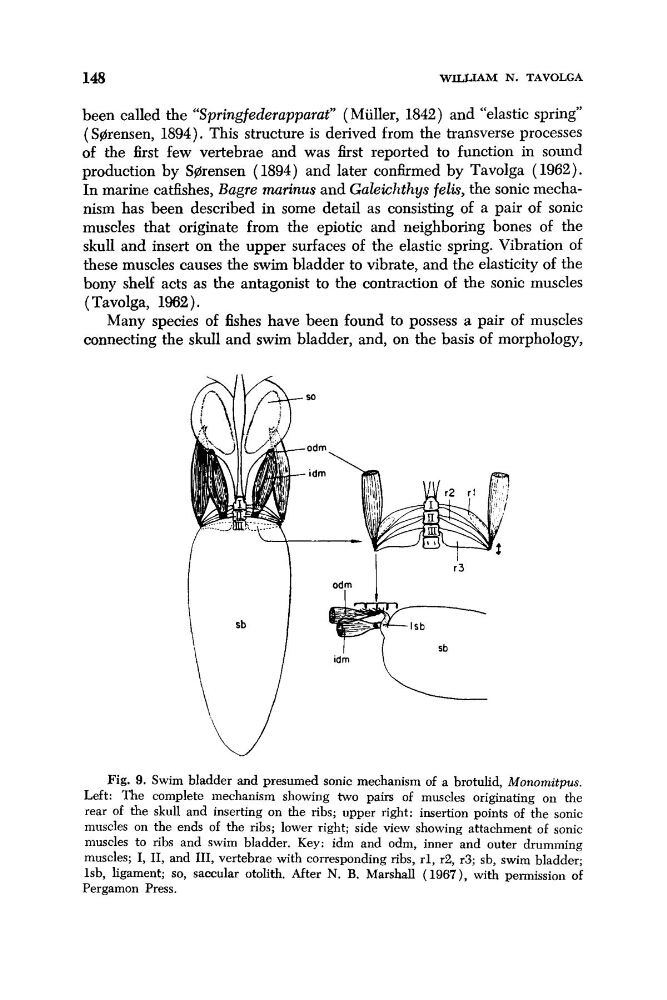
Fig. 9. Swim bladder and presumed sonic mechanism of a brotulid, Monornitpus.
Left: The complete mechanism showing two pairs of muscles originating on the
rear of the skull and inserting on the ribs; upper right: insertion points of the sonic
muscles on the ends of the ribs; lower right; side view showing attachment of sonic
muscles to ribs and swim bladder. Key: idm and odm, inner and outer drumming
muscles; I, 11, and 111, vertebrae with corresponding ribs, rl, r2, r3; sb, swim bladder;
lsb, ligament; so, saccular otolith. After N. B. Marshall (1967), with permission of
Pergamon Press.
148
been called the “Springfederapparat” ( Muller, 1842) and “elastic spring”
(Sdrensen, 1894). This structure is derived from the transverse processes
of the first few vertebrae and was first reported to function in sound
production by Sgrensen ( 1894) and later confirmed by Tavolga (1962).
In marine catfishes, Bagre marinus and Galeichthys felis, the sonic mechanism has been described in some detail as consisting of a pair of sonic
muscles that originate from the epiotic and neighboring bones of the
skull and insert on the upper surfaces of the elastic spring. Vibration of
these muscles causes the swim bladder to vibrate, and the elasticity of the
bony shelf acts as the antagonist to the contraction of the sonic muscles
( Tavolga, 1962).
Many species of fishes have been found to possess a pair of muscles
connecting the skull and swim bladder, and, on the basis of morphology,
sb
I
sb
idm
[
Fig. 9. Swim bladder and presumed sonic mechanism of a brotulid, Monornitpus.
Left: The complete mechanism showing two pairs of muscles originating on the
rear of the skull and inserting on the ribs; upper right: insertion points of the sonic
muscles on the ends of the ribs; lower right; side view showing attachment of sonic
muscles to ribs and swim bladder. Key: idm and odm, inner and outer drumming
muscles; I, 11, and 111, vertebrae with corresponding ribs, rl, r2, r3; sb, swim bladder;
lsb, ligament; so, saccular otolith. After N. B. Marshall (1967), with permission of
Pergamon Press.