

6. SOUND PRODUCTION AND DETECTION
149
it is probable that these are sonic muscles. Such structures have been
found in many brotulids, macrourids, and other deep-sea forms ( Walters,
1960; N. B. Marshall, 1967; Schneider, 1961) (Fig. 9). It is probable that
future deep-sea exploration will identify these forms as sound producers.
5. SWIM BLADDER MECHANISMS-INTRINSIC MUSCLES
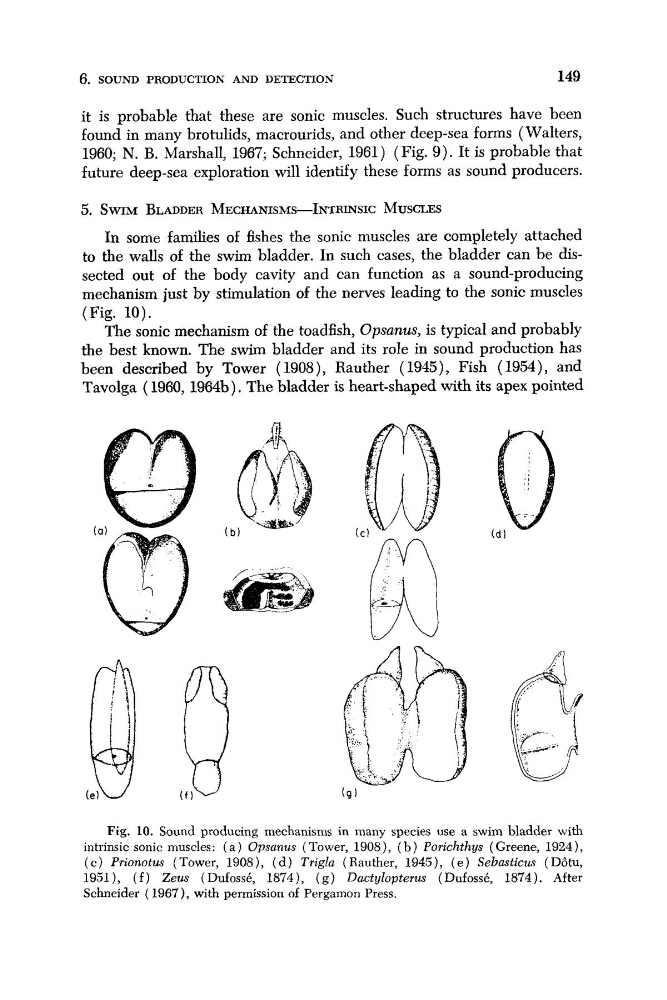
In some families of fishes the sonic muscles are completely attached
to the walls of the swim bladder. In such cases, the bladder can be dissected out of the body cavity and can function as a sound-producing
mechanism just by stimulation of the nerves leading to the sonic muscles
(Fig. 10).
The sonic mechanism of the toadfish, Opsanus, is typical and probably
the best known. The swim bladder and its role in sound production has
been described by Tower (1908), Rauther (1945), Fish (1954), and
Tavolga ( 1960, 1964b). The bladder is heart-shaped with its apex pointed
Fig. 10. Sound producing mechanisms in many species use a swim bladder with
intrinsic sonic muscles: ( a ) Opsanus (Tower, 1908), ( b ) Porichthys (Greene, 1924),
( c ) Prionotus (Tower, 1908), ( d ) Trigla (Rauther, 1945), ( e ) Sebasticus (DBtu,
1951), ( f ) Zeus ( DufossB, 1874), ( g ) Dactylopterus (Dufosst., 1874). After
Schneider ( 1967), with permission of Pergamon Press.
149
it is probable that these are sonic muscles. Such structures have been
found in many brotulids, macrourids, and other deep-sea forms ( Walters,
1960; N. B. Marshall, 1967; Schneider, 1961) (Fig. 9). It is probable that
future deep-sea exploration will identify these forms as sound producers.
5. SWIM BLADDER MECHANISMS-INTRINSIC MUSCLES
In some families of fishes the sonic muscles are completely attached
to the walls of the swim bladder. In such cases, the bladder can be dissected out of the body cavity and can function as a sound-producing
mechanism just by stimulation of the nerves leading to the sonic muscles
(Fig. 10).
The sonic mechanism of the toadfish, Opsanus, is typical and probably
the best known. The swim bladder and its role in sound production has
been described by Tower (1908), Rauther (1945), Fish (1954), and
Tavolga ( 1960, 1964b). The bladder is heart-shaped with its apex pointed
Fig. 10. Sound producing mechanisms in many species use a swim bladder with
intrinsic sonic muscles: ( a ) Opsanus (Tower, 1908), ( b ) Porichthys (Greene, 1924),
( c ) Prionotus (Tower, 1908), ( d ) Trigla (Rauther, 1945), ( e ) Sebasticus (DBtu,
1951), ( f ) Zeus ( DufossB, 1874), ( g ) Dactylopterus (Dufosst., 1874). After
Schneider ( 1967), with permission of Pergamon Press.