

6. SOUND PRODUCTION AND DETEXXION
147
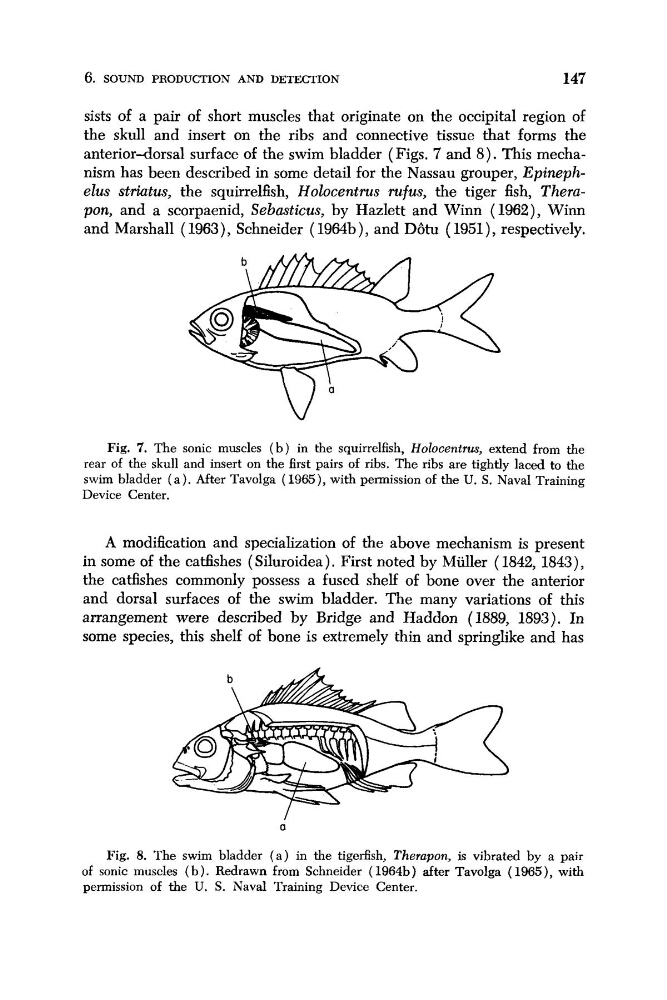
sists of a pair of short muscles that originate on the occipital region of
the skull and insert on the ribs and connective tissue that forms the
anterior-dorsal surface of the swim bladder (Figs. 7 and 8). This mechanism has been described in some detail for the Nassau grouper, Epinephelus striatus, the squirrelfish, Holocentrus rmfus, the tiger fish, Therapon, and a scorpaenid, Sebasticus, by Hazlett and Winn (1962), Winn
and Marshall ( 1963) , Schneider ( 196413 ), and Dbtu ( 1951), respectively.
Fig. 7. The sonic muscles ( b ) in the squirrelfish, Holocentrm, extend from the
rear of the skull and insert on the first pairs of ribs. The ribs are tightly laced to the
swim bladder ( a ) . After Tavolga ( 19sS), with permission of the U. S. Naval Training
Device Center.
A modification and specialization of the above mechanism is present
in some of the catfishes (Siluroidea). First noted by Muller (1842, 1843),
the catfishes commonly possess a fused shelf of bone over the anterior
and dorsal surfaces of the swim bladder. The many variations of this
arrangement were described by Bridge and Haddon (1889, 1893). In
some species, this shelf of bone is extremely thin and springlike and has
0
Fig. 8. The swim bladder ( a ) in the tigerfish, Therapon, is vibrated by a pair
of sonic muscles ( b ) . Redrawn from Schneider (196413) after Tavolga ( 1%5), with
permission of the U. S. Naval Training Device Center.
147
sists of a pair of short muscles that originate on the occipital region of
the skull and insert on the ribs and connective tissue that forms the
anterior-dorsal surface of the swim bladder (Figs. 7 and 8). This mechanism has been described in some detail for the Nassau grouper, Epinephelus striatus, the squirrelfish, Holocentrus rmfus, the tiger fish, Therapon, and a scorpaenid, Sebasticus, by Hazlett and Winn (1962), Winn
and Marshall ( 1963) , Schneider ( 196413 ), and Dbtu ( 1951), respectively.
Fig. 7. The sonic muscles ( b ) in the squirrelfish, Holocentrm, extend from the
rear of the skull and insert on the first pairs of ribs. The ribs are tightly laced to the
swim bladder ( a ) . After Tavolga ( 19sS), with permission of the U. S. Naval Training
Device Center.
A modification and specialization of the above mechanism is present
in some of the catfishes (Siluroidea). First noted by Muller (1842, 1843),
the catfishes commonly possess a fused shelf of bone over the anterior
and dorsal surfaces of the swim bladder. The many variations of this
arrangement were described by Bridge and Haddon (1889, 1893). In
some species, this shelf of bone is extremely thin and springlike and has
0
Fig. 8. The swim bladder ( a ) in the tigerfish, Therapon, is vibrated by a pair
of sonic muscles ( b ) . Redrawn from Schneider (196413) after Tavolga ( 1%5), with
permission of the U. S. Naval Training Device Center.