

146
WILLIAM N. TAVOLGA
(1961), however, stated that the drumming in triggerfishes was probably
produced only out of water. Hazlett and Winn (1962) described the
sonic mechanism of a serranid, Epinephelus striatus, as consisting of a
pair of sonic muscles (see below).
3. SWIM BLADDER MECHANISMS-GAS EXPULSION
In some fishes, where there is a pneumatic duct between the swim
bladder and esophagus, sounds can be detected when air bubbles are
eructed. Fish (1954) and Dufossk (1874) reported this type of sound production in some eels and catfishes. A characid fish, Glandulocauda inequalis, is reported to produce sounds by gulping air at the water surface
(K. Nelson, 1965).
4. SWIM BLADDER MECHANISMS-EXTRINSIC MUSCLES
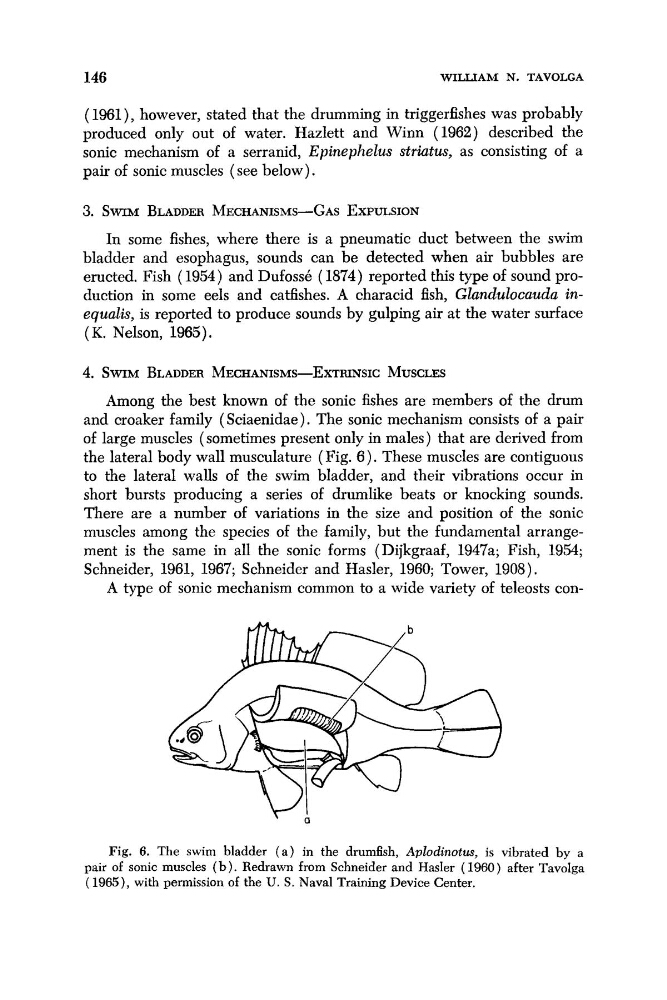
Among the best known of the sonic fishes are members of the drum
and croaker family (Sciaenidae). The sonic mechanism consists of a pair
of large muscles (sometimes present only in males) that are derived from
the lateral body wall musculature (Fig. 6 ) . These muscles are contiguous
to the lateral walls of the swim bladder, and their vibrations occur in
short bursts producing a series of drumlike beats or knocking sounds.
There are a number of variations in the size and position of the sonic
muscles among the species of the family, but the fundamental arrangement is the same in all the sonic forms (Dijkgraaf, 1947a; Fish, 1954;
Schneider, 1961, 1967; Schneider and Hasler, 1960; Tower, 1908).
A type of sonic mechanism common to a wide variety of teleosts conFig. 6. The swim bladder ( a ) in the drumfish, Aplodinotus, is vibrated by a
pair of sonic muscles (b). Redrawn from Schneider and Hasler (1960) after Tavolga
(19f%), with permission of the U. S. Naval Training Device Center.
WILLIAM N. TAVOLGA
(1961), however, stated that the drumming in triggerfishes was probably
produced only out of water. Hazlett and Winn (1962) described the
sonic mechanism of a serranid, Epinephelus striatus, as consisting of a
pair of sonic muscles (see below).
3. SWIM BLADDER MECHANISMS-GAS EXPULSION
In some fishes, where there is a pneumatic duct between the swim
bladder and esophagus, sounds can be detected when air bubbles are
eructed. Fish (1954) and Dufossk (1874) reported this type of sound production in some eels and catfishes. A characid fish, Glandulocauda inequalis, is reported to produce sounds by gulping air at the water surface
(K. Nelson, 1965).
4. SWIM BLADDER MECHANISMS-EXTRINSIC MUSCLES
Among the best known of the sonic fishes are members of the drum
and croaker family (Sciaenidae). The sonic mechanism consists of a pair
of large muscles (sometimes present only in males) that are derived from
the lateral body wall musculature (Fig. 6 ) . These muscles are contiguous
to the lateral walls of the swim bladder, and their vibrations occur in
short bursts producing a series of drumlike beats or knocking sounds.
There are a number of variations in the size and position of the sonic
muscles among the species of the family, but the fundamental arrangement is the same in all the sonic forms (Dijkgraaf, 1947a; Fish, 1954;
Schneider, 1961, 1967; Schneider and Hasler, 1960; Tower, 1908).
A type of sonic mechanism common to a wide variety of teleosts conFig. 6. The swim bladder ( a ) in the drumfish, Aplodinotus, is vibrated by a
pair of sonic muscles (b). Redrawn from Schneider and Hasler (1960) after Tavolga
(19f%), with permission of the U. S. Naval Training Device Center.