

6. SOUND PRODUCTION AND DETECTION
145
able mechanism is the stridulation of the posterior margin of the skull
against some vertebral element. A similar mechanism was described for
the pipefish, Syngnathus louisiunae, by Burkenroad ( 1931). Klausewitz
(1958) described sounds produced by the Indian loach, Both hymenophysu, which he attributed to the stridulation of Weberian ossicles, although this function of the Weberian ossicles should be considered highly
doubtful.
2. SWIM BLADDER MECHANISMS-INDIRECT
As noted above, Burkenroad (1930) observed that pharyngeal denticle
stridulation in the grunts (family Pomadasyidae) was affected by deflation of the swim bladder. In many such cases, the swim bladder may act
as a resonator and thus change the quality of the emitted sound. Stridulation of bones of the pectoral girdle has been found in a triggerfish,
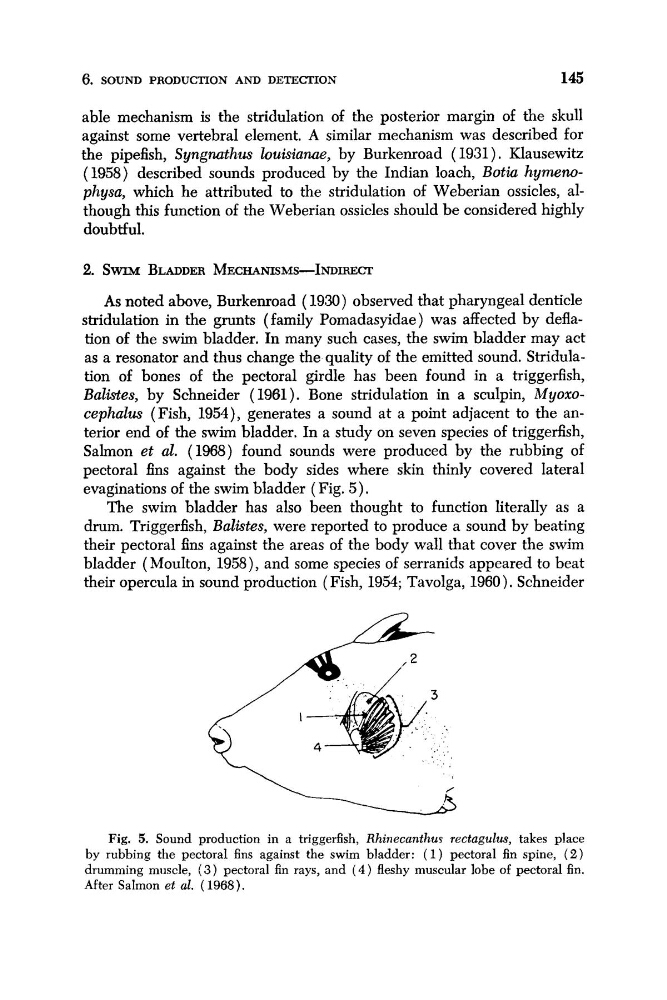
Balistes, by Schneider (1961). Bone stridulation in a sculpin, Myoxocephalus (Fish, 1954)) generates a sound at a point adjacent to the anterior end of the swim bladder. In a study on seven species of triggerfish,
Salmon et al. (1968) found sounds were produced by the rubbing of
pectoral fins against the body sides where skin thinly covered lateral
evaginations of the swim bladder ( Fig. 5 ) .
The swim bladder has also been thought to function literally as a
drum. Triggerfish, Balistes, were reported to produce a sound by beating
their pectoral fins against the areas of the body wall that cover the swim
bladder (Moulton, 1958), and some species of serranids appeared to beat
their opercula in sound production ( Fish, 1954; Tavolga, 1960 ) . Schneider
Fig. 5. Sound production in a triggerfish, Rhinecanthus rectagulus, takes place
by rubbing the pectoral fins against the swim bladder: ( 1 ) pectoral fin spine, ( 2 )
drumming muscle, ( 3 ) pectoral fin rays, and (4) fleshy muscular lobe of pectoral fin.
After Salmon et al. (1968).
145
able mechanism is the stridulation of the posterior margin of the skull
against some vertebral element. A similar mechanism was described for
the pipefish, Syngnathus louisiunae, by Burkenroad ( 1931). Klausewitz
(1958) described sounds produced by the Indian loach, Both hymenophysu, which he attributed to the stridulation of Weberian ossicles, although this function of the Weberian ossicles should be considered highly
doubtful.
2. SWIM BLADDER MECHANISMS-INDIRECT
As noted above, Burkenroad (1930) observed that pharyngeal denticle
stridulation in the grunts (family Pomadasyidae) was affected by deflation of the swim bladder. In many such cases, the swim bladder may act
as a resonator and thus change the quality of the emitted sound. Stridulation of bones of the pectoral girdle has been found in a triggerfish,
Balistes, by Schneider (1961). Bone stridulation in a sculpin, Myoxocephalus (Fish, 1954)) generates a sound at a point adjacent to the anterior end of the swim bladder. In a study on seven species of triggerfish,
Salmon et al. (1968) found sounds were produced by the rubbing of
pectoral fins against the body sides where skin thinly covered lateral
evaginations of the swim bladder ( Fig. 5 ) .
The swim bladder has also been thought to function literally as a
drum. Triggerfish, Balistes, were reported to produce a sound by beating
their pectoral fins against the areas of the body wall that cover the swim
bladder (Moulton, 1958), and some species of serranids appeared to beat
their opercula in sound production ( Fish, 1954; Tavolga, 1960 ) . Schneider
Fig. 5. Sound production in a triggerfish, Rhinecanthus rectagulus, takes place
by rubbing the pectoral fins against the swim bladder: ( 1 ) pectoral fin spine, ( 2 )
drumming muscle, ( 3 ) pectoral fin rays, and (4) fleshy muscular lobe of pectoral fin.
After Salmon et al. (1968).