

10. THE SWIM BLADDER AS A HYDROSTATIC ORGAN
417
Rete
Esophagus
( a )
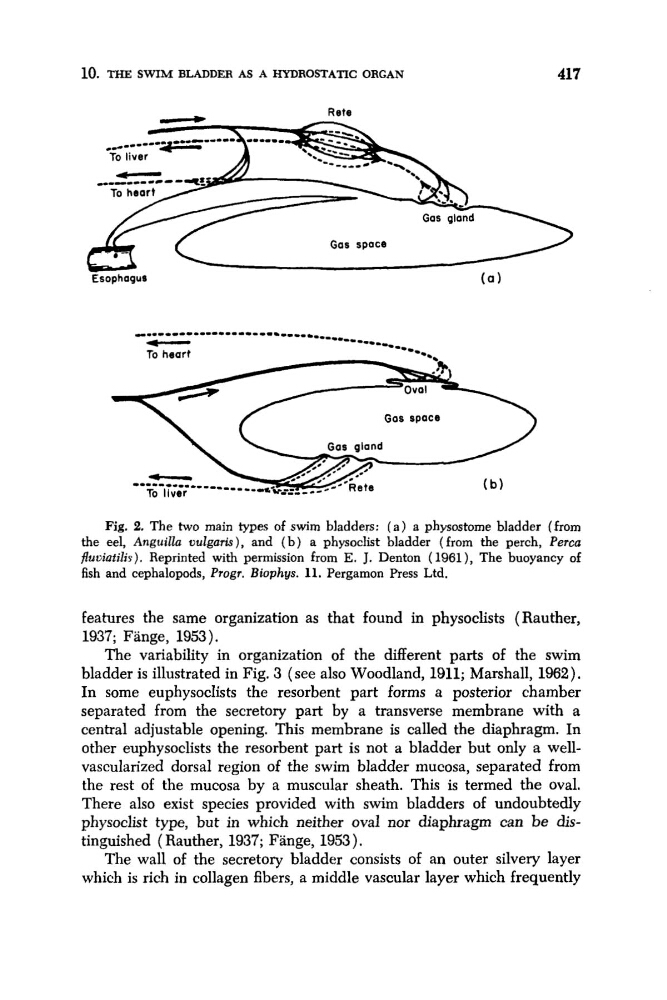
Fig. 2. The two main types of swim bladders: ( a ) a physostome bladder (from
the eel, Anguilla uulguris), and ( b ) a physoclist bladder (from the perch, Perca
fluuintilir). Reprinted with permission from E. J. Denton (1961), The buoyancy of
fish and cephalopods, Progr. Biophys. 11. Pergamon Press Ltd.
features the same organization as that found in physoclists (Rauther,
1937; Fange, 1953).
The variability in organization of the different parts of the swim
bladder is illustrated in Fig. 3 (see also Woodland, 1911; Marshall, 1962).
In some euphysoclists the resorbent part forms a posterior chamber
separated from the secretory part by a transverse membrane with a
central adjustable opening. This membrane is called the diaphragm. In
other euphysoclists the resorbent part is not a bladder but only a wellvascularized dorsal region of the swim bladder mucosa, separated from
the rest of the mucosa by a muscular sheath. This is termed the oval.
There also exist species provided with swim bladders of undoubtedly
physoclist type, but in which neither oval nor diaphragm can be distinguished ( Rauther, 1937; Fange, 1953).
The wall of the secretory bladder consists of an outer silvery layer
which is rich in collagen fibers, a middle vascular layer which frequently
417
Rete
Esophagus
( a )
Fig. 2. The two main types of swim bladders: ( a ) a physostome bladder (from
the eel, Anguilla uulguris), and ( b ) a physoclist bladder (from the perch, Perca
fluuintilir). Reprinted with permission from E. J. Denton (1961), The buoyancy of
fish and cephalopods, Progr. Biophys. 11. Pergamon Press Ltd.
features the same organization as that found in physoclists (Rauther,
1937; Fange, 1953).
The variability in organization of the different parts of the swim
bladder is illustrated in Fig. 3 (see also Woodland, 1911; Marshall, 1962).
In some euphysoclists the resorbent part forms a posterior chamber
separated from the secretory part by a transverse membrane with a
central adjustable opening. This membrane is called the diaphragm. In
other euphysoclists the resorbent part is not a bladder but only a wellvascularized dorsal region of the swim bladder mucosa, separated from
the rest of the mucosa by a muscular sheath. This is termed the oval.
There also exist species provided with swim bladders of undoubtedly
physoclist type, but in which neither oval nor diaphragm can be distinguished ( Rauther, 1937; Fange, 1953).
The wall of the secretory bladder consists of an outer silvery layer
which is rich in collagen fibers, a middle vascular layer which frequently