

314
G . SHELTON
$1
Orobronchiol
pressure
(cm H,O)
0
Close
Jaw
1
movement
Porobronchiol
pressure
t l
0
I
Close
Gill slit
movement
Add md
Lev hmd
Con hy
Con br
Interarc dot
Coroco -hy
Coroco -bi
Lev pq
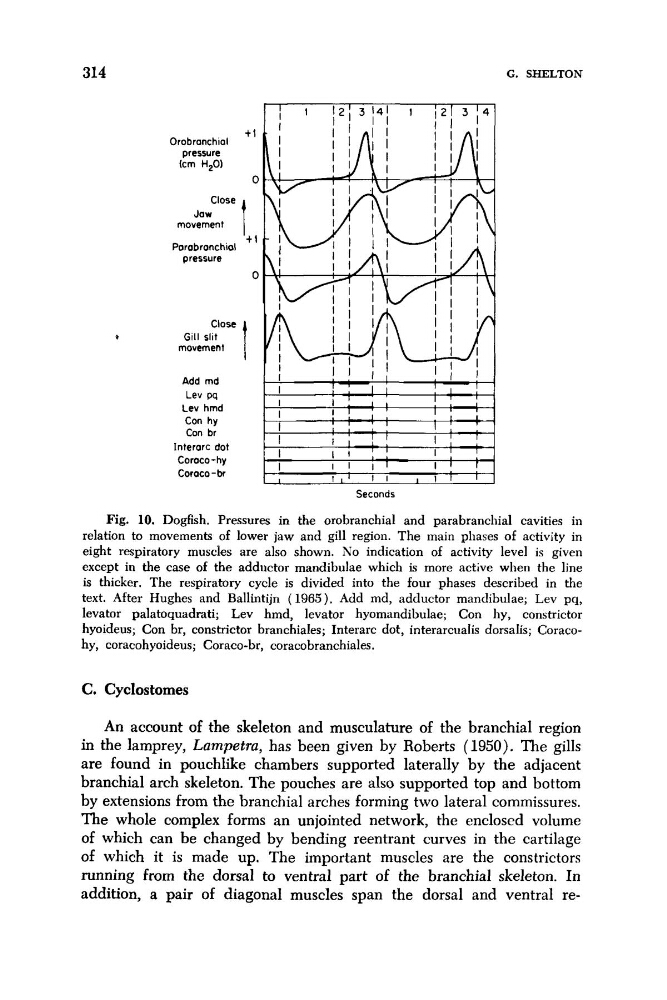
Fig. 10. Dogfish. Pressures in the orobranchial and parabranchial cavities in
relation to movements of lower jaw and gill region. The main phases of activity in
eight respiratory muscles are also shown. No indication of activity level is given
except in the case of the adductor mandibulae which is more active when the line
is thicker. The respiratory cycle is divided into the four phases described in the
text. After Hughes and Ballintijn (1965). Add md, adductor mandibulae; Lev pq,
levator palatoquadrati; Lev hmd, levator hyomandibulae; Con hy, constrictor
hyoideus; Con br, constrictor branchiales; Interarc dot, interarcualis dorsalis; Coracohy, coracohyoideus; Coraco-br, coracobranchiales.
C. Cyclostomes
An account of the skeleton and musculature of the branchial region
in the lamprey, Lumpetru, has been given by Roberts (1950). The gills
are found in pouchlike chambers supported laterally by the adjacent
branchial arch skeleton. The pouches are also supported top and bottom
by extensions from the branchial arches forming two lateral commissures.
The whole complex forms an unjointed network, the enclosed volume
of which can be changed by bending reentrant curves in the cartilage
of which it is made up. The important muscles are the constrictors
running from the dorsal to ventral part of the branchial skeleton. In
addition, a pair of diagonal muscles span the dorsal and ventral re-
G . SHELTON
$1
Orobronchiol
pressure
(cm H,O)
0
Close
Jaw
1
movement
Porobronchiol
pressure
t l
0
I
Close
Gill slit
movement
Add md
Lev hmd
Con hy
Con br
Interarc dot
Coroco -hy
Coroco -bi
Lev pq
Fig. 10. Dogfish. Pressures in the orobranchial and parabranchial cavities in
relation to movements of lower jaw and gill region. The main phases of activity in
eight respiratory muscles are also shown. No indication of activity level is given
except in the case of the adductor mandibulae which is more active when the line
is thicker. The respiratory cycle is divided into the four phases described in the
text. After Hughes and Ballintijn (1965). Add md, adductor mandibulae; Lev pq,
levator palatoquadrati; Lev hmd, levator hyomandibulae; Con hy, constrictor
hyoideus; Con br, constrictor branchiales; Interarc dot, interarcualis dorsalis; Coracohy, coracohyoideus; Coraco-br, coracobranchiales.
C. Cyclostomes
An account of the skeleton and musculature of the branchial region
in the lamprey, Lumpetru, has been given by Roberts (1950). The gills
are found in pouchlike chambers supported laterally by the adjacent
branchial arch skeleton. The pouches are also supported top and bottom
by extensions from the branchial arches forming two lateral commissures.
The whole complex forms an unjointed network, the enclosed volume
of which can be changed by bending reentrant curves in the cartilage
of which it is made up. The important muscles are the constrictors
running from the dorsal to ventral part of the branchial skeleton. In
addition, a pair of diagonal muscles span the dorsal and ventral re-