

7. GAS EXCHANGE IN FISH
263
can be considered as a residual volume, the magnitude of which will be
determined by Pvor.
The water shunt can be further divided into component volumes,
These are a diffusion dead space volume V D d l f f 0 2 , an anatomical dead
space volume V, :,,lulo2, and finally a distribution dead space volume
V D LIISIO_I. They are described below.
a. Difusion Dead Space. Water is probably in contact with the
respiratory surface for about 1 or 2 sec (see below), and since the rate
of diffusion of gases in water is slow (Krogh, 1941) water must be
brought into close contact with the gills if it is to exchange gases with
the blood. Distances between lamellae may be so large and/or flow
through the lamellae so rapid that there is not sufficient time for all
water to reach equilibration with the blood. In this case there will be
persistent gradients in the water, and these may be considered as representative of a diffusion dead space volume.
b. Distribution Dead Space. If ventilation of the pores formed by
the secondary lamellae is high, or if the pores are ventilated unequally,
more oxygen may be delivered to all or part of the respiratory surface
than is required to saturate the blood; hence, there may be a distribution dead space associated with unequal ventilation and perfusion of the
gills.
c. Anatomical Dead Space. Water flowing over the gills of teleosts
may pass through the pores formed by the secondary lamellae (Fig. 1)
or spill bctween the edges of the filaments. Only water passing through
the pores will be involved in gas exchanged, and water passing between
the ends of the filaments can be considered as part of the water shunt.
Hughes (1966a) referred to this portion of the water flow as the anatomical dead space volume.
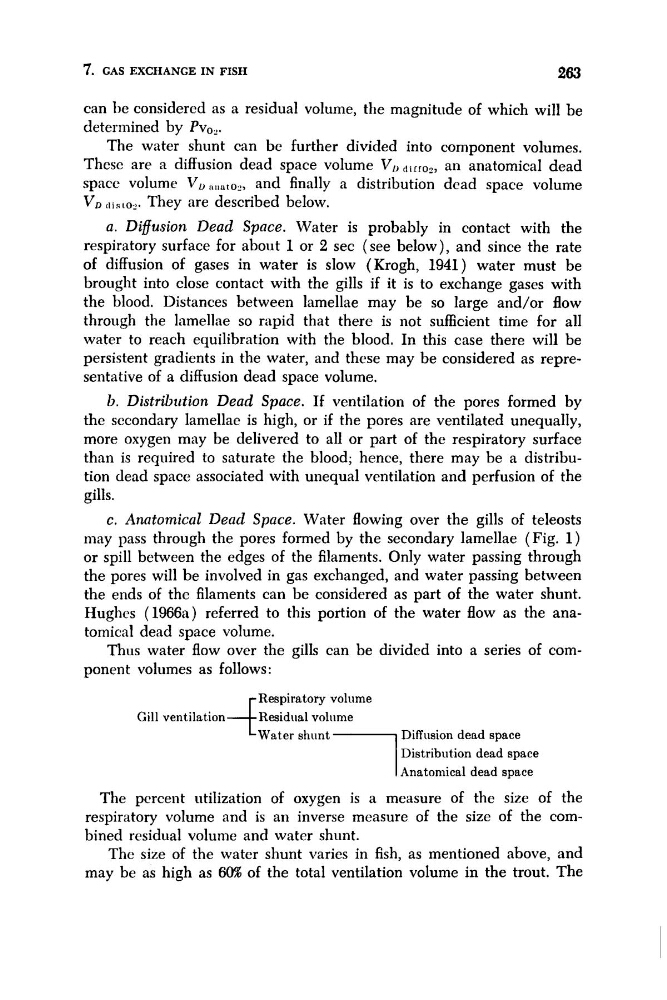
Thus water flow over the gills can be divided into a series of component volumes as follows:
Respiratory volume
Gill ventilation
Residual volume
Diffusion dead space
Distribution dead space
1 Anatomical dead space
- E Water shunt
The pcrcent utilization of oxygen is a measure of the size of the
respiratory volume and is an inverse measure of the size of the combined residual volume and water shunt.
The size of the water shunt varies in fish, as mentioned above, and
may be as high as 60% of the total ventilation volume in the trout. The
263
can be considered as a residual volume, the magnitude of which will be
determined by Pvor.
The water shunt can be further divided into component volumes,
These are a diffusion dead space volume V D d l f f 0 2 , an anatomical dead
space volume V, :,,lulo2, and finally a distribution dead space volume
V D LIISIO_I. They are described below.
a. Difusion Dead Space. Water is probably in contact with the
respiratory surface for about 1 or 2 sec (see below), and since the rate
of diffusion of gases in water is slow (Krogh, 1941) water must be
brought into close contact with the gills if it is to exchange gases with
the blood. Distances between lamellae may be so large and/or flow
through the lamellae so rapid that there is not sufficient time for all
water to reach equilibration with the blood. In this case there will be
persistent gradients in the water, and these may be considered as representative of a diffusion dead space volume.
b. Distribution Dead Space. If ventilation of the pores formed by
the secondary lamellae is high, or if the pores are ventilated unequally,
more oxygen may be delivered to all or part of the respiratory surface
than is required to saturate the blood; hence, there may be a distribution dead space associated with unequal ventilation and perfusion of the
gills.
c. Anatomical Dead Space. Water flowing over the gills of teleosts
may pass through the pores formed by the secondary lamellae (Fig. 1)
or spill bctween the edges of the filaments. Only water passing through
the pores will be involved in gas exchanged, and water passing between
the ends of the filaments can be considered as part of the water shunt.
Hughes (1966a) referred to this portion of the water flow as the anatomical dead space volume.
Thus water flow over the gills can be divided into a series of component volumes as follows:
Respiratory volume
Gill ventilation
Residual volume
Diffusion dead space
Distribution dead space
1 Anatomical dead space
- E Water shunt
The pcrcent utilization of oxygen is a measure of the size of the
respiratory volume and is an inverse measure of the size of the combined residual volume and water shunt.
The size of the water shunt varies in fish, as mentioned above, and
may be as high as 60% of the total ventilation volume in the trout. The