

264
D. J. RANDALL
relative contribution of the anatomical, diffusion, and distribution dead
space volume to the water shunt is difficult to assess. The size of the
anatomical dead space will be related to the arrangement of the filaments to each other and to the ventilation volume. The anatomical
dead space is probably larger at high water flow rates. Thc position of the
filaments is controlled by muscles at their base (Bitjel, 1949) which could
play a role in regulating the size of the anatomical dead space ( Pasztor and
Kleerekoper, 1962). The author has observed movements of trout gills during normal breathing movements, and these may be caused by changing
water velocitics or by the action of the muscles at the base of the filaments.
Whatever the cause, the effect of altering the relative position of filaments
to each other must be to change the size of the anatomical dead space,
which is probably very variable with time in a single fish, as well as between different species of fish. There appears to be a tendency to enlarge
supporting structures and fuse parts of the gill in fish exposed to high ventilation volumes. In tuna, the secondary lamellae of adjacent filaments
are used to form a compact sievelike gill structure (Muir and Kendall,
1968). This presumably helps to maintain 00w between the secondary
lamellae and reduces the size of the anatomical dead space, but it must
also increase the resistance to flow through the gills. Fusion of gill parts,
however, need not always be associated with the maintenance of flow between secondary lamellae. Hughes (1966b) has suggested that fusion in
Amia serves to prevent collapse of the gill sieve when the animal is in air.
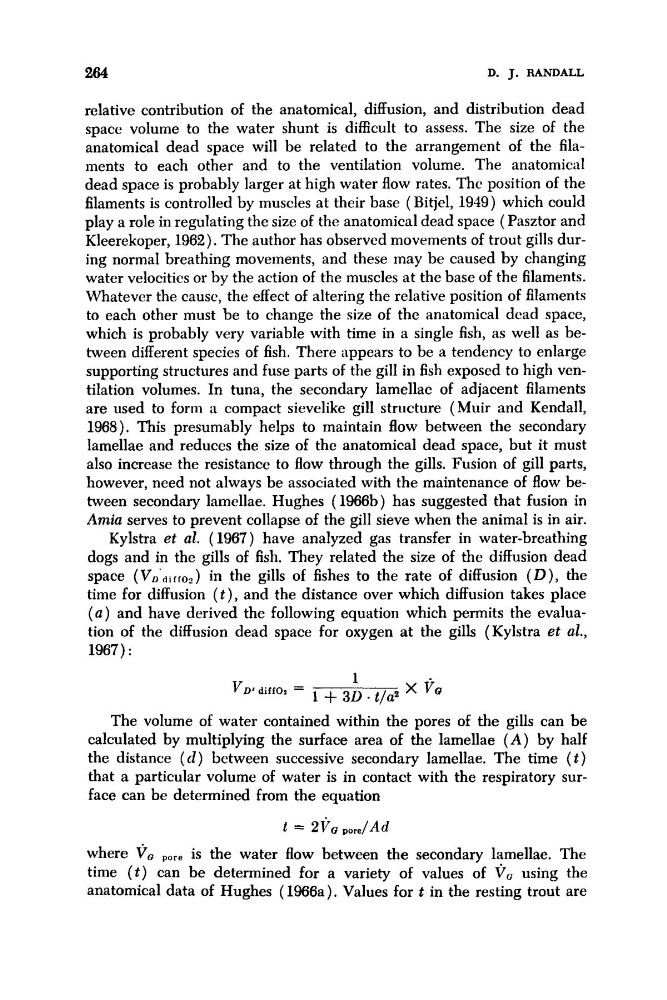
Kylstra et al. (1967) have analyzed gas transfer in water-breathing
dogs and in the gills of fish. They related the size of the diffusion dead
space (VD'dif102) in the gills of fishes to the rate of diffusion (D), the
time for diffusion ( t ) , and the distance over which diffusion takes place
( a ) and have derived the following equation which permits the evaluation of the diffusion dead space for oxygen at the gills (Kylstra et al.,
1967) :
x V G
1
1 + 3 0 . t/az
vD'diff02 =
The volume of water contained within the pores of the gills can be
calculated by multiplying the surface area of the lamellae ( A ) by half
the distance ( d ) between successive secondary lamellae. The time ( t )
that a particular volume of water is in contact with the respiratory surface can be determined from the equation
t = 2Va por,/Ad
where VG pore is the water flow between the secondary lamellae. The
time ( t ) can be determined for a variety of values of V" using the
anatomical data of Hughes (1966a). Values for t in the resting trout are
D. J. RANDALL
relative contribution of the anatomical, diffusion, and distribution dead
space volume to the water shunt is difficult to assess. The size of the
anatomical dead space will be related to the arrangement of the filaments to each other and to the ventilation volume. The anatomical
dead space is probably larger at high water flow rates. Thc position of the
filaments is controlled by muscles at their base (Bitjel, 1949) which could
play a role in regulating the size of the anatomical dead space ( Pasztor and
Kleerekoper, 1962). The author has observed movements of trout gills during normal breathing movements, and these may be caused by changing
water velocitics or by the action of the muscles at the base of the filaments.
Whatever the cause, the effect of altering the relative position of filaments
to each other must be to change the size of the anatomical dead space,
which is probably very variable with time in a single fish, as well as between different species of fish. There appears to be a tendency to enlarge
supporting structures and fuse parts of the gill in fish exposed to high ventilation volumes. In tuna, the secondary lamellae of adjacent filaments
are used to form a compact sievelike gill structure (Muir and Kendall,
1968). This presumably helps to maintain 00w between the secondary
lamellae and reduces the size of the anatomical dead space, but it must
also increase the resistance to flow through the gills. Fusion of gill parts,
however, need not always be associated with the maintenance of flow between secondary lamellae. Hughes (1966b) has suggested that fusion in
Amia serves to prevent collapse of the gill sieve when the animal is in air.
Kylstra et al. (1967) have analyzed gas transfer in water-breathing
dogs and in the gills of fish. They related the size of the diffusion dead
space (VD'dif102) in the gills of fishes to the rate of diffusion (D), the
time for diffusion ( t ) , and the distance over which diffusion takes place
( a ) and have derived the following equation which permits the evaluation of the diffusion dead space for oxygen at the gills (Kylstra et al.,
1967) :
x V G
1
1 + 3 0 . t/az
vD'diff02 =
The volume of water contained within the pores of the gills can be
calculated by multiplying the surface area of the lamellae ( A ) by half
the distance ( d ) between successive secondary lamellae. The time ( t )
that a particular volume of water is in contact with the respiratory surface can be determined from the equation
t = 2Va por,/Ad
where VG pore is the water flow between the secondary lamellae. The
time ( t ) can be determined for a variety of values of V" using the
anatomical data of Hughes (1966a). Values for t in the resting trout are