

262
D. J. RANDALL
in inspired water, P E ~ ~
that in expired water, and Pveq,, that in water
having the same Po, as venous blood entering the gills. If the expired
water has the same Po, as venous blood then both the diffusion resistance
and the water shunt are zero. In practice, however, PG? is always greater
than Pveqo, and there is probably both a diffusion resistance and a
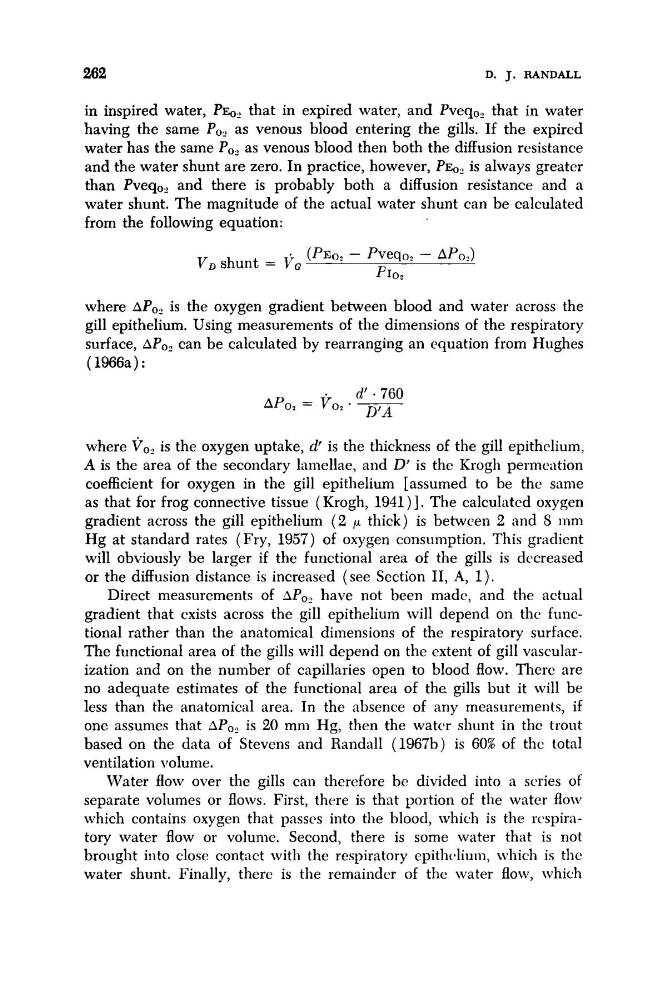
water shunt. The magnitude of the actual water shunt can be calculated
from the following equation:
. (PEo, - P v e q o , - APoJ
PIOZ
VDshunt = V G
where aP0, is the oxygen gradient between blood and water across the
gill epithelium. Using measurements of the dimensions of the respiratory
surface, APo2 can be calculated by rearranging an equation from Hughes
( 1966a) :
. d' . 760
APo, = V o l . ~ D'A
where Vo, is the oxygen uptake, d' is the thickness of the gill epithelium,
A is the area of the secondary lamellae, and D' is the Krogh permention
coefficient for oxygen in the gill epithelium [assumed to be thc same
as that for frog connective tissue (Krogh, 1941)l. The calculated oxygen
gradient across the gill epithelium ( 2 p thick) is between 2 and S mm
Hg at standard rates (Fry, 1957) of oxygen consumption. This gradient
will obviously be larger if the functional area of the gills is decreased
or the diffusion distance is increased (see Section 11, A, 1).
Direct measurements of 4PO2 have not been madc, and the actual
gradient that cxists across the gill epithelium will depend on the functional rather than the anatomical dimensions of the respiratory surface.
The functional area of the gills will depend on the cxtent of gill vascularization and on the number of capillaries open to blood flow. Therc are
no adequate estimates of the functional area of the gills but it will be
less than the anatomical area. In the absence of any measurements, if
one assumes that APo2 is 20 mni Hg, then the watcr shunt in the trout
based on the data of Stevens and Randall (1967b) is 60% of thc total
ventilation volume.
Water flow over the gills can therefore be divided into a wries of
separate volumes or flows. First, there is that portion of the water flow
which contains oxygen that passes into the blood, which is the rcspiratory water flow or volunic. Second, there is some water that is not
brought into close contact with the respiratory epithc.lium, which is thc
water shunt. Finally, there is the remainder of the water flow, which
D. J. RANDALL
in inspired water, P E ~ ~
that in expired water, and Pveq,, that in water
having the same Po, as venous blood entering the gills. If the expired
water has the same Po, as venous blood then both the diffusion resistance
and the water shunt are zero. In practice, however, PG? is always greater
than Pveqo, and there is probably both a diffusion resistance and a
water shunt. The magnitude of the actual water shunt can be calculated
from the following equation:
. (PEo, - P v e q o , - APoJ
PIOZ
VDshunt = V G
where aP0, is the oxygen gradient between blood and water across the
gill epithelium. Using measurements of the dimensions of the respiratory
surface, APo2 can be calculated by rearranging an equation from Hughes
( 1966a) :
. d' . 760
APo, = V o l . ~ D'A
where Vo, is the oxygen uptake, d' is the thickness of the gill epithelium,
A is the area of the secondary lamellae, and D' is the Krogh permention
coefficient for oxygen in the gill epithelium [assumed to be thc same
as that for frog connective tissue (Krogh, 1941)l. The calculated oxygen
gradient across the gill epithelium ( 2 p thick) is between 2 and S mm
Hg at standard rates (Fry, 1957) of oxygen consumption. This gradient
will obviously be larger if the functional area of the gills is decreased
or the diffusion distance is increased (see Section 11, A, 1).
Direct measurements of 4PO2 have not been madc, and the actual
gradient that cxists across the gill epithelium will depend on the functional rather than the anatomical dimensions of the respiratory surface.
The functional area of the gills will depend on the cxtent of gill vascularization and on the number of capillaries open to blood flow. Therc are
no adequate estimates of the functional area of the gills but it will be
less than the anatomical area. In the absence of any measurements, if
one assumes that APo2 is 20 mni Hg, then the watcr shunt in the trout
based on the data of Stevens and Randall (1967b) is 60% of thc total
ventilation volume.
Water flow over the gills can therefore be divided into a wries of
separate volumes or flows. First, there is that portion of the water flow
which contains oxygen that passes into the blood, which is the rcspiratory water flow or volunic. Second, there is some water that is not
brought into close contact with the respiratory epithc.lium, which is thc
water shunt. Finally, there is the remainder of the water flow, which