

7. GAS EXCHANGE IN FISH
261
however, even in high flows of water supersaturated with oxygen
(Fairey, 1966). In this instance, ventilation of the gills is largely a byproduct of maintaining position in a stream; hence, the cost of breathing is probably not an important factor in the total energy budget of
the fish, ventilation volumes are high, and the percent utilization of
oxygen is low (Baumgarten and Randall, 1967). The remora stops
breathing in water velocities greater than about 60 cm/sec (Muir
and Buckley, 1967), ventilation volume is probably regulated at high
velocities by altering the gape of the mouth. At low velocities the fish
actively ventilates its gills. This animal rides on the body of sharks
and uses the swimming efforts of its host to ventilate its gills. There
are no breathing movements in mackeral and tuna (Hall, 1930), and
forward motion of the fish through the water acts to ventilate the gills.
M ~ i r
and Kendall (1968) refer to this as “ram” ventilation. Thus some
fish can probably maintain a high ventilation volume at low cost while
others must continually pump water over their gills. Those animals
that can maintain a high ventilation volume will have a low percent
utilization of oxygen from the water. The advantage of a low percent
utilization is that the water Po? at the respiratory surface remains high
along the whole length of the secondary lamellae.
If the respiratory surface area is infinitely large, the diffusion
distance between blood and water infinitely small, and gas exchange
across the gills passive, then, as there is a countercurrent arrangement
of the flows of blood and water in teleosts it is theoretically possible for
the Po, in water leaving the gills to be in equilibrium with that of venous
blood. In practice, however, the Po? in water leaving the gills is not in
equilibrium with that of venous blood in either teleosts (Garey, 1967;
Holeton and Randall, 1967b; Stevens, 19681,) or elasmobranchs (Piiper
and Baumgarten-Schumann, 1968b). Thus not all the oxygen that can
be removed from the water is utilized by the animal. There are two
possible explanations for this: first, there could be a large diffusion resistance across the gills, and, second, some of the water may not come into
close contact with the gills and be shunted past the gills. This volume of
water can be considered as a water shunt (V, shunt) and expressed as
a percentage of the total ventilation volume.
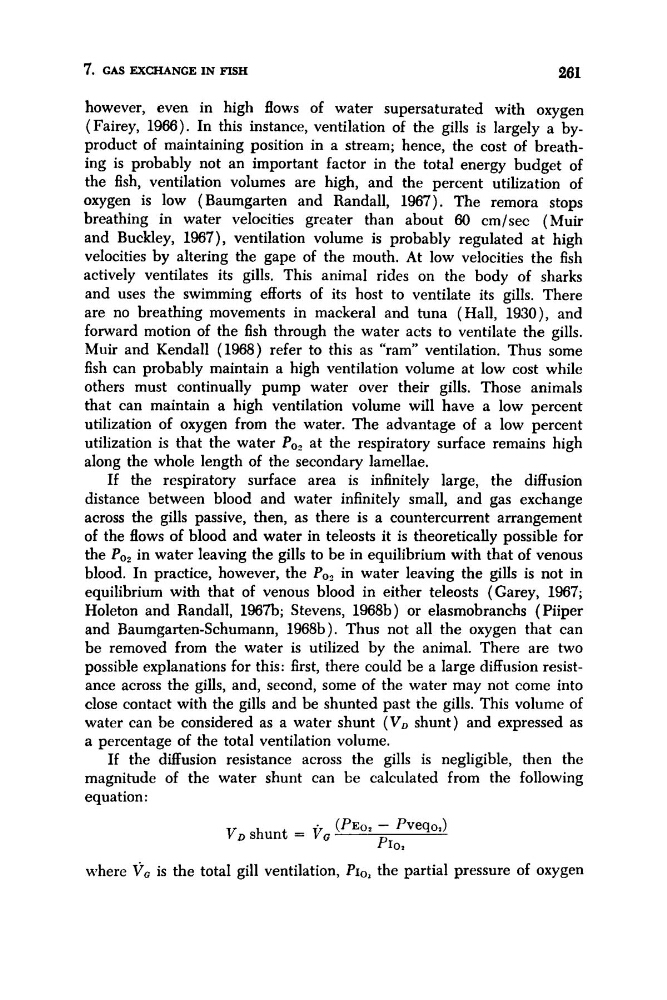
If the diffusion resistance across the gills is negligible, then the
magnitude of the water shunt can be calculated from the following
equation:
where V G is the total gill ventilation, PI^, the partial pressure of oxygen
261
however, even in high flows of water supersaturated with oxygen
(Fairey, 1966). In this instance, ventilation of the gills is largely a byproduct of maintaining position in a stream; hence, the cost of breathing is probably not an important factor in the total energy budget of
the fish, ventilation volumes are high, and the percent utilization of
oxygen is low (Baumgarten and Randall, 1967). The remora stops
breathing in water velocities greater than about 60 cm/sec (Muir
and Buckley, 1967), ventilation volume is probably regulated at high
velocities by altering the gape of the mouth. At low velocities the fish
actively ventilates its gills. This animal rides on the body of sharks
and uses the swimming efforts of its host to ventilate its gills. There
are no breathing movements in mackeral and tuna (Hall, 1930), and
forward motion of the fish through the water acts to ventilate the gills.
M ~ i r
and Kendall (1968) refer to this as “ram” ventilation. Thus some
fish can probably maintain a high ventilation volume at low cost while
others must continually pump water over their gills. Those animals
that can maintain a high ventilation volume will have a low percent
utilization of oxygen from the water. The advantage of a low percent
utilization is that the water Po? at the respiratory surface remains high
along the whole length of the secondary lamellae.
If the respiratory surface area is infinitely large, the diffusion
distance between blood and water infinitely small, and gas exchange
across the gills passive, then, as there is a countercurrent arrangement
of the flows of blood and water in teleosts it is theoretically possible for
the Po, in water leaving the gills to be in equilibrium with that of venous
blood. In practice, however, the Po? in water leaving the gills is not in
equilibrium with that of venous blood in either teleosts (Garey, 1967;
Holeton and Randall, 1967b; Stevens, 19681,) or elasmobranchs (Piiper
and Baumgarten-Schumann, 1968b). Thus not all the oxygen that can
be removed from the water is utilized by the animal. There are two
possible explanations for this: first, there could be a large diffusion resistance across the gills, and, second, some of the water may not come into
close contact with the gills and be shunted past the gills. This volume of
water can be considered as a water shunt (V, shunt) and expressed as
a percentage of the total ventilation volume.
If the diffusion resistance across the gills is negligible, then the
magnitude of the water shunt can be calculated from the following
equation:
where V G is the total gill ventilation, PI^, the partial pressure of oxygen