

258
D. J. RANDALL
Man
t
N
- 1000
t
a
t
Mouse
1
1 0
I00
1000
10,000 IOQOOO
I
Weight (g)
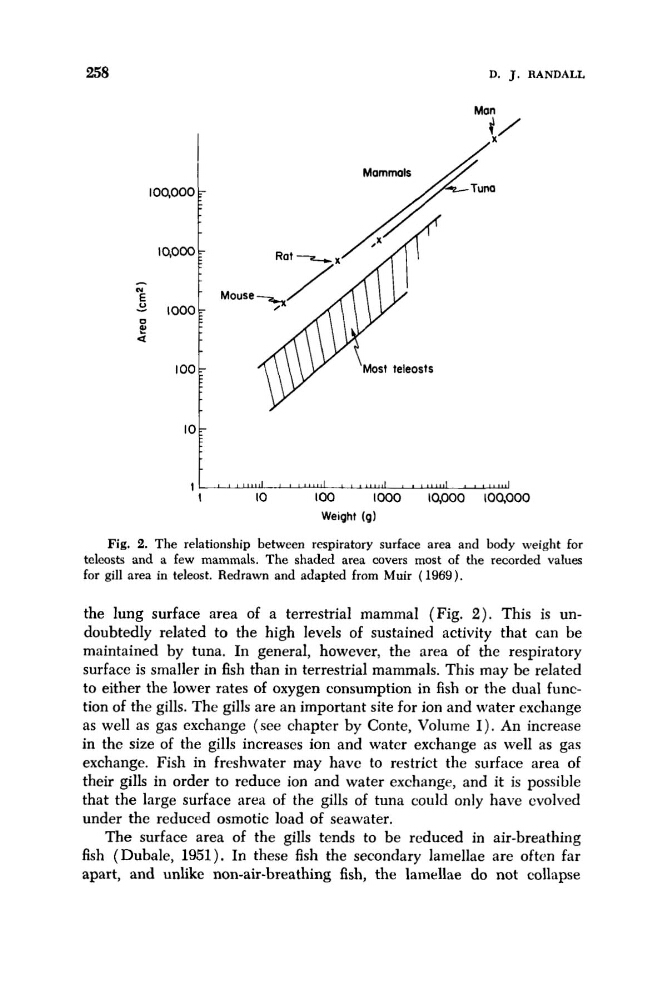
Fig. 2. The relationship between respiratory surface area and body weight for
teleosts and a few mammals. The shaded area covers most of the recorded values
for gill area in teleost. Redrawn and adapted from Muir (1969).
the lung surface area of a terrestrial mammal (Fig. 2 ) . This is undoubtedly related to the high levels of sustained activity that can be
maintained by tuna. In general, however, the area of the respiratory
surface is smaller in fish than in terrestrial mammals. This may be related
to either the lower rates of oxygen consumption in fish or the dual function of the gills. The gills are an important site for ion and water exchange
as well as gas exchange (see chapter by Conte, Volume I ) . An increase
in the size of the gills increases ion and water exchange as well as gas
exchange. Fish in freshwater may have to restrict the surface area of
their gills in order to reduce ion and water exchange, and it is possible
that the large surface area of the gills of tuna could only have evolved
under the reduced osmotic load of seawater.
The surface area of the gills tends to be reduced in air-breathing
fish (Dubale, 1951). In these fish the secondary lamellae are often far
apart, and unlike non-air-breathing fish, the lamellae do not collapse
D. J. RANDALL
Man
t
N
- 1000
t
a
t
Mouse
1
1 0
I00
1000
10,000 IOQOOO
I
Weight (g)
Fig. 2. The relationship between respiratory surface area and body weight for
teleosts and a few mammals. The shaded area covers most of the recorded values
for gill area in teleost. Redrawn and adapted from Muir (1969).
the lung surface area of a terrestrial mammal (Fig. 2 ) . This is undoubtedly related to the high levels of sustained activity that can be
maintained by tuna. In general, however, the area of the respiratory
surface is smaller in fish than in terrestrial mammals. This may be related
to either the lower rates of oxygen consumption in fish or the dual function of the gills. The gills are an important site for ion and water exchange
as well as gas exchange (see chapter by Conte, Volume I ) . An increase
in the size of the gills increases ion and water exchange as well as gas
exchange. Fish in freshwater may have to restrict the surface area of
their gills in order to reduce ion and water exchange, and it is possible
that the large surface area of the gills of tuna could only have evolved
under the reduced osmotic load of seawater.
The surface area of the gills tends to be reduced in air-breathing
fish (Dubale, 1951). In these fish the secondary lamellae are often far
apart, and unlike non-air-breathing fish, the lamellae do not collapse