

7. GAS EXCHANGE IN FISH
259
or stick together when the fish is in air (Saxena, 1958, 1959). Many airbreathing fish cannot live by aquatic respiration even in well-oxygenated
water (Carter, 1957). The climbing perch, Anubas, an air-breathing fish,
has a gill area of about 1.44 cm2/g (Dubale, 1951) and the respiratory
epithelium is about 20 p thick (Hughes and Datta Munshi, 1968). Gas
exchange across the gills of this fish cannot be very significant, and the
gills probably function primarily in ion exchange. The area is presumably reduced to prevent loss of oxygen to the water and to restrict
ion and water movement.
The values presented and discussed above are anatomical areas of
the gills. The functional area need not, and probably does not, equal
the anatomical area. The anatomical area is a measure of the maximum
possible functional area. Hughes ( 1966a ) estimated that the respiratory
surface was between 60 and 70% of the total lamellar surface. This value
was based on the area of blood channels in the secondary lamellae.
However not all the blood pathways may be utilized at any instant in
time, and the functional area may be smaller than 60-7048 of the
lamellar surface area. There are alternate nonrespiratory pathways that
shunt blood past the secondary lamellae which can be used to decrease
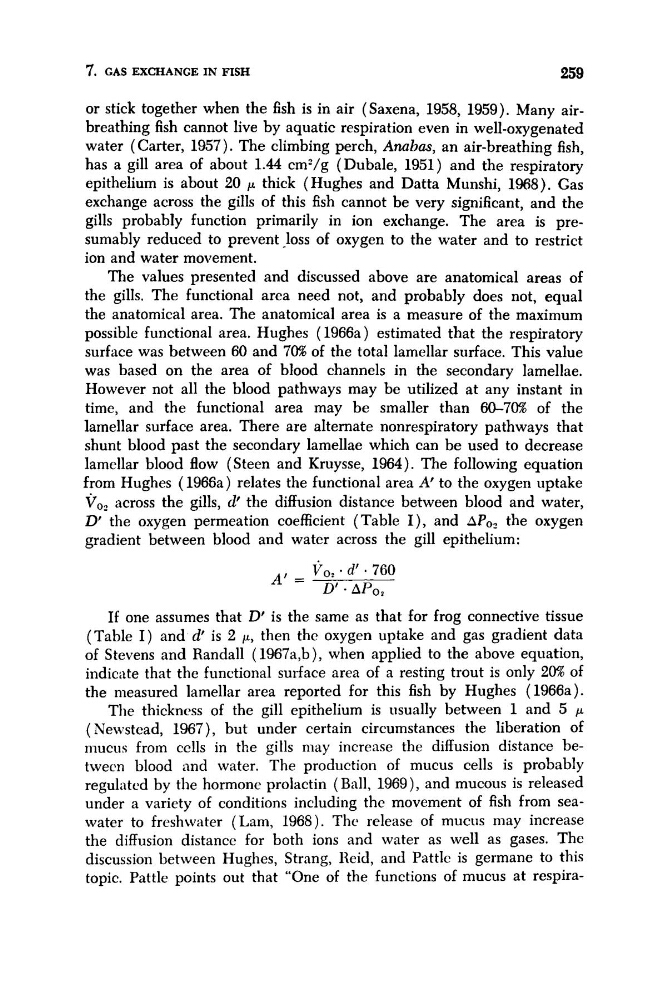
lamellar blood flow (Steen and Kruysse, 1964). The following equation
from Hughes (1966a) relates the functional area A’ to the oxygen uptake
Vo2 across the gills, d’ the diffusion distance between blood and water,
D’ the oxygen permeation coefficient (Table I ) , and APo2 the oxygen
gradient between blood and water across the gill epithelium:
V o 2 * d’ 760
D’ . APo2
A’ =
If one assumes that D‘ is the same as that for frog connective tissue
(Table I ) and d’ is 2 p, then the oxygen uptake and gas gradient data
of Stevens and Randall (1967a,b), when applied to the above equation,
indicate that the functional surface area of a resting trout is only 20% of
the measured lamellar area reported for this fish by Hughes (1966a).
The thickncss of the gill epithelium is usually between 1 and 5 p
( Newstead, 1967), but under certain circumstances the liberation of
mucus from cells in the gills may increase the diffusion distance between blood and water. The production of mucus cells is probably
regulatcd by the hormone prolactin (Ball, 1969), and mucous is released
under a variety of conditions including thc movement of fish from seawater to freshwater (Lam, 1968). The release of mucus may increase
the diffusion distance for both ions and water as well as gases. The
discussion between Hughes, Strang, Reid, and Pattlc is germane to this
topic. Pattle points out that “One of the functions of mucus at respira-
259
or stick together when the fish is in air (Saxena, 1958, 1959). Many airbreathing fish cannot live by aquatic respiration even in well-oxygenated
water (Carter, 1957). The climbing perch, Anubas, an air-breathing fish,
has a gill area of about 1.44 cm2/g (Dubale, 1951) and the respiratory
epithelium is about 20 p thick (Hughes and Datta Munshi, 1968). Gas
exchange across the gills of this fish cannot be very significant, and the
gills probably function primarily in ion exchange. The area is presumably reduced to prevent loss of oxygen to the water and to restrict
ion and water movement.
The values presented and discussed above are anatomical areas of
the gills. The functional area need not, and probably does not, equal
the anatomical area. The anatomical area is a measure of the maximum
possible functional area. Hughes ( 1966a ) estimated that the respiratory
surface was between 60 and 70% of the total lamellar surface. This value
was based on the area of blood channels in the secondary lamellae.
However not all the blood pathways may be utilized at any instant in
time, and the functional area may be smaller than 60-7048 of the
lamellar surface area. There are alternate nonrespiratory pathways that
shunt blood past the secondary lamellae which can be used to decrease
lamellar blood flow (Steen and Kruysse, 1964). The following equation
from Hughes (1966a) relates the functional area A’ to the oxygen uptake
Vo2 across the gills, d’ the diffusion distance between blood and water,
D’ the oxygen permeation coefficient (Table I ) , and APo2 the oxygen
gradient between blood and water across the gill epithelium:
V o 2 * d’ 760
D’ . APo2
A’ =
If one assumes that D‘ is the same as that for frog connective tissue
(Table I ) and d’ is 2 p, then the oxygen uptake and gas gradient data
of Stevens and Randall (1967a,b), when applied to the above equation,
indicate that the functional surface area of a resting trout is only 20% of
the measured lamellar area reported for this fish by Hughes (1966a).
The thickncss of the gill epithelium is usually between 1 and 5 p
( Newstead, 1967), but under certain circumstances the liberation of
mucus from cells in the gills may increase the diffusion distance between blood and water. The production of mucus cells is probably
regulatcd by the hormone prolactin (Ball, 1969), and mucous is released
under a variety of conditions including thc movement of fish from seawater to freshwater (Lam, 1968). The release of mucus may increase
the diffusion distance for both ions and water as well as gases. The
discussion between Hughes, Strang, Reid, and Pattlc is germane to this
topic. Pattle points out that “One of the functions of mucus at respira-