

7. GAS EXCHANGE IN FISH
Transverse section thrargh gill arches
I arch
/Water
flow
/
/
'Gill orch
.
Gill arch'
-Film
idary
nent -
lamellae
Sidc view of gill arch
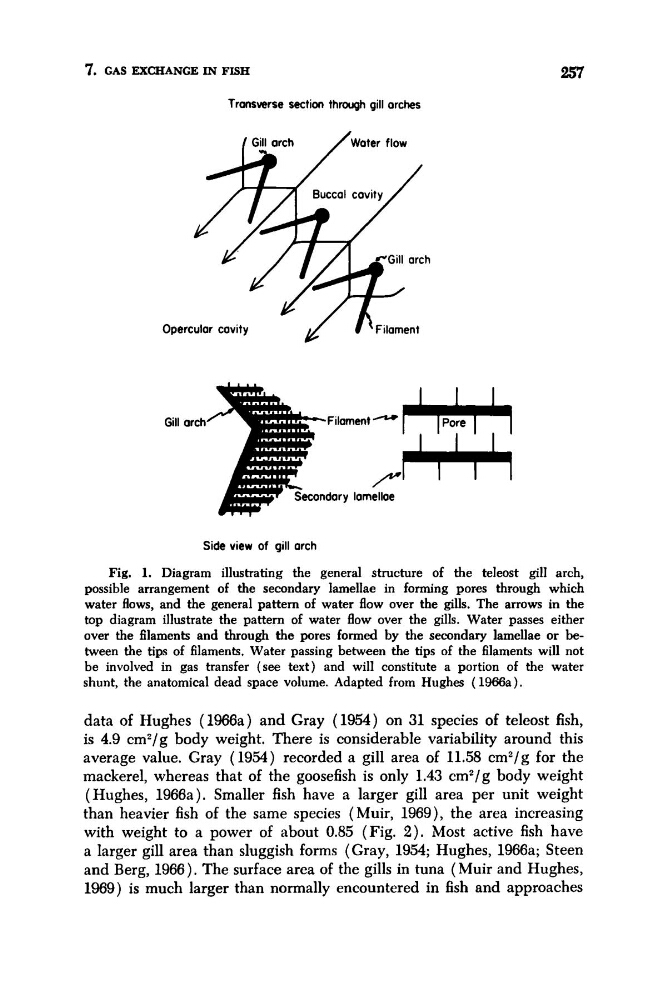
Fig. 1. Diagram illustrating the general structure of the teleost gill arch,
possible arrangement of the secondary lamellae in forming pores through which
water flows, and the general pattern of water flow over the gills. The arrows in the
top diagram illustrate the pattern of water flow over the gills. Water passes either
over the filaments and through the pores formed by the secondary lamellae or between the tips of filaments. Water passing between the tips of the filaments will not
be involved in gas transfer (see text) and will constitute a portion of the water
shunt, the anatomical dead space volume. Adapted from Hughes (19ssa).
data of Hughes (1966a) and Gray (1954) on 31 species of teleost fish,
is 4.9 cmZ/g body weight. There is considerable variability around this
average value. Gray (1954) recorded a gill area of 11.58 cmz/g for the
mackerel, whereas that of the goosefish is only 1.43 cmz/g body weight
(Hughes, 1966a). Smaller fish have a larger gill area per unit weight
than heavier fish of the same species (Muir, 1969), the area increasing
with weight to a power of about 0.85 (Fig. 2). Most active fish have
a larger gill area than sluggish forms (Gray, 1954; Hughes, 1966a; Steen
and Berg, 1966). The surface area of the gills in tuna (Muir and Hughes,
1969) is much larger than normally encountered in fish and approaches
Transverse section thrargh gill arches
I arch
/Water
flow
/
/
'Gill orch
.
Gill arch'
-Film
idary
nent -
lamellae
Sidc view of gill arch
Fig. 1. Diagram illustrating the general structure of the teleost gill arch,
possible arrangement of the secondary lamellae in forming pores through which
water flows, and the general pattern of water flow over the gills. The arrows in the
top diagram illustrate the pattern of water flow over the gills. Water passes either
over the filaments and through the pores formed by the secondary lamellae or between the tips of filaments. Water passing between the tips of the filaments will not
be involved in gas transfer (see text) and will constitute a portion of the water
shunt, the anatomical dead space volume. Adapted from Hughes (19ssa).
data of Hughes (1966a) and Gray (1954) on 31 species of teleost fish,
is 4.9 cmZ/g body weight. There is considerable variability around this
average value. Gray (1954) recorded a gill area of 11.58 cmz/g for the
mackerel, whereas that of the goosefish is only 1.43 cmz/g body weight
(Hughes, 1966a). Smaller fish have a larger gill area per unit weight
than heavier fish of the same species (Muir, 1969), the area increasing
with weight to a power of about 0.85 (Fig. 2). Most active fish have
a larger gill area than sluggish forms (Gray, 1954; Hughes, 1966a; Steen
and Berg, 1966). The surface area of the gills in tuna (Muir and Hughes,
1969) is much larger than normally encountered in fish and approaches