

5. ACID-BASE BALANCE
201
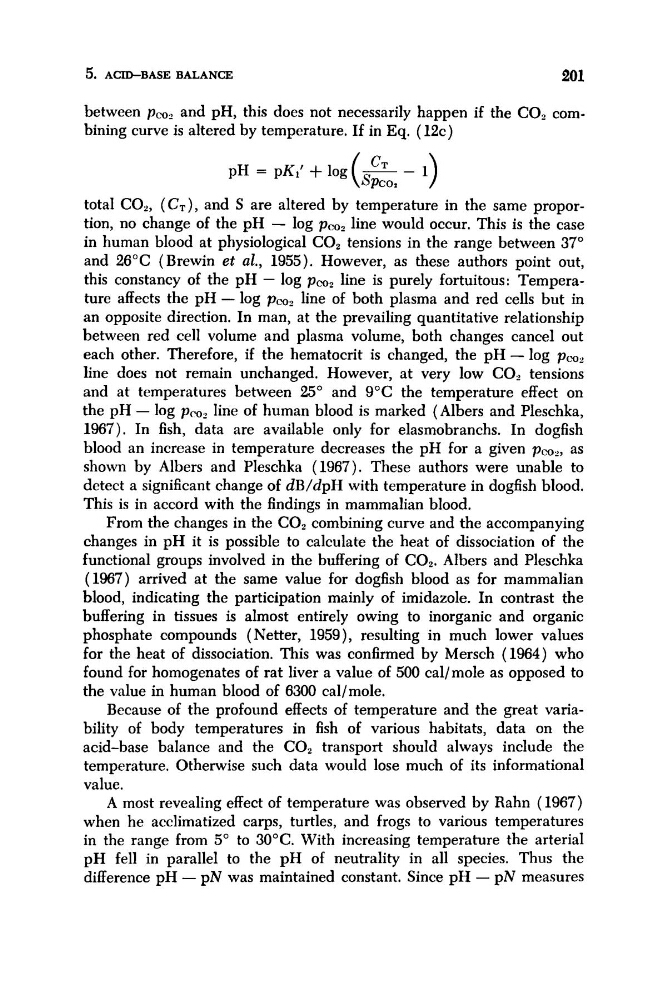
between pco2 and pH, this does not necessarily happen if the CO, combining curve is altered by temperature. If in Eq. (12c)
total COP, (C,), and S are altered by temperature in the same proportion, no change of the pH - log pco2 line would occur. This is the case
in human blood at physiological CO, tensions in the range between 37"
and 26°C (Brewin et al., 1955). However, as these authors point out,
this constancy of the pH - log pm, line is purely fortuitous: Temperature affects the pH - log pro? line of both plasma and red cells but in
an opposite direction. In man, at the prevailing quantitative relationship
between red cell volume and plasma volume, both changes cancel out
each other. Therefore, if the hematocrit is changed, the pH - log pm,
line does not remain unchanged. However, at very low CO, tensions
and at temperatures between 25" and 9°C the temperature effect on
the pH - log pco2 line of human blood is marked (Albers and Pleschka,
1967). In fish, data are available only for elasmobranchs. In dogfish
blood an increase in temperature decreases the pH for a given par, as
shown by Albers and Pleschka (1967). These authors were unable to
detect a significant change of dB/dpH with temperature in dogfish blood.
This is in accord with the findings in mammalian blood,
From the changes in the CO, combining curve and the accompanying
changes in pH it is possible to calculate the heat of dissociation of the
functional groups involved in the buffering of CO,. Albers and Pleschka
(1967) arrived at the same value for dogfish blood as for mammalian
blood, indicating the participation mainly of imidazole. In contrast the
buffering in tissues is almost entirely owing to inorganic and organic
phosphate compounds (Netter, 1959), resulting in much lower values
for the heat of dissociation. This was confirmed by Mersch (1964) who
found for homogenates of rat liver a value of 500 cal/mole as opposed to
the value in human blood of 6300 cal/mole.
Because of the profound effects of temperature and the great variability of body temperatures in fish of various habitats, data on the
acid-base balance and the CO, transport should always include the
temperature. Otherwise such data would lose much of its informational
value.
A most revealing effect of temperature was observed by Rahn (1967)
when he acclimatized carps, turtles, and frogs to various temperatures
in the range from 5" to 30°C. With increasing temperature the arterial
pH fell in parallel to the pH of neutrality in all species. Thus the
difference pH - pN was maintained constant. Since pH - pN measures
201
between pco2 and pH, this does not necessarily happen if the CO, combining curve is altered by temperature. If in Eq. (12c)
total COP, (C,), and S are altered by temperature in the same proportion, no change of the pH - log pco2 line would occur. This is the case
in human blood at physiological CO, tensions in the range between 37"
and 26°C (Brewin et al., 1955). However, as these authors point out,
this constancy of the pH - log pm, line is purely fortuitous: Temperature affects the pH - log pro? line of both plasma and red cells but in
an opposite direction. In man, at the prevailing quantitative relationship
between red cell volume and plasma volume, both changes cancel out
each other. Therefore, if the hematocrit is changed, the pH - log pm,
line does not remain unchanged. However, at very low CO, tensions
and at temperatures between 25" and 9°C the temperature effect on
the pH - log pco2 line of human blood is marked (Albers and Pleschka,
1967). In fish, data are available only for elasmobranchs. In dogfish
blood an increase in temperature decreases the pH for a given par, as
shown by Albers and Pleschka (1967). These authors were unable to
detect a significant change of dB/dpH with temperature in dogfish blood.
This is in accord with the findings in mammalian blood,
From the changes in the CO, combining curve and the accompanying
changes in pH it is possible to calculate the heat of dissociation of the
functional groups involved in the buffering of CO,. Albers and Pleschka
(1967) arrived at the same value for dogfish blood as for mammalian
blood, indicating the participation mainly of imidazole. In contrast the
buffering in tissues is almost entirely owing to inorganic and organic
phosphate compounds (Netter, 1959), resulting in much lower values
for the heat of dissociation. This was confirmed by Mersch (1964) who
found for homogenates of rat liver a value of 500 cal/mole as opposed to
the value in human blood of 6300 cal/mole.
Because of the profound effects of temperature and the great variability of body temperatures in fish of various habitats, data on the
acid-base balance and the CO, transport should always include the
temperature. Otherwise such data would lose much of its informational
value.
A most revealing effect of temperature was observed by Rahn (1967)
when he acclimatized carps, turtles, and frogs to various temperatures
in the range from 5" to 30°C. With increasing temperature the arterial
pH fell in parallel to the pH of neutrality in all species. Thus the
difference pH - pN was maintained constant. Since pH - pN measures