

202
A
C. ALBERS
.
0
7.0 .
6.8.
6.2
6.0
20
30
40
0
1 0
"C
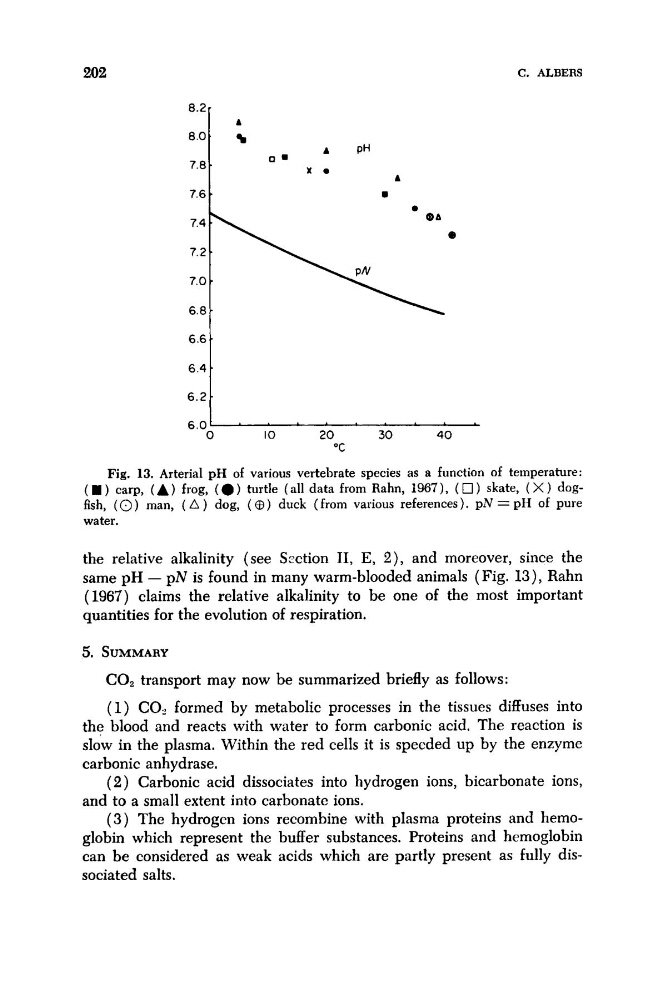
Fig. 13. Arterial pH of various vertebrate species as a function of temperature:
( W ) carp, (A) frog, ( 0 ) turtle (all data from Rahn, 1967), ( 0) skate, ( X ) dogfish, (0 ) man, ( A ) dog, ( @ ) duck (from various references ). pN = pII of pure
water.
the relative alkalinity (see Sxtion 11, E, 2), and moreover, since the
same pH - pN is found in many warm-blooded animals (Fig. 13), Rahn
(1967) claims the relative alkalinity to be one of the most important
quantities for the evolution of respiration.
5. SUMMARY
CO, transport may now be summarized briefly as follows:
(1) CO, formed by metabolic processes in the tissues diffuses into
the blood and reacts with water to form carbonic acid. The reaction is
slow in the plasma. Within the red cells it is specded up by the enzyme
carbonic anhydrase.
( 2 ) Carbonic acid dissociates into hydrogen ions, bicarbonate ions,
and to a small extent into carbonate ions.
( 3 ) The hydrogen ions recombine with plasma proteins and hemoglobin which represent the buffer substances. Proteins and hemoglobin
can be considered as weak acids which are partly present as fully dissociated salts.
A
C. ALBERS
.
0
7.0 .
6.8.
6.2
6.0
20
30
40
0
1 0
"C
Fig. 13. Arterial pH of various vertebrate species as a function of temperature:
( W ) carp, (A) frog, ( 0 ) turtle (all data from Rahn, 1967), ( 0) skate, ( X ) dogfish, (0 ) man, ( A ) dog, ( @ ) duck (from various references ). pN = pII of pure
water.
the relative alkalinity (see Sxtion 11, E, 2), and moreover, since the
same pH - pN is found in many warm-blooded animals (Fig. 13), Rahn
(1967) claims the relative alkalinity to be one of the most important
quantities for the evolution of respiration.
5. SUMMARY
CO, transport may now be summarized briefly as follows:
(1) CO, formed by metabolic processes in the tissues diffuses into
the blood and reacts with water to form carbonic acid. The reaction is
slow in the plasma. Within the red cells it is specded up by the enzyme
carbonic anhydrase.
( 2 ) Carbonic acid dissociates into hydrogen ions, bicarbonate ions,
and to a small extent into carbonate ions.
( 3 ) The hydrogen ions recombine with plasma proteins and hemoglobin which represent the buffer substances. Proteins and hemoglobin
can be considered as weak acids which are partly present as fully dissociated salts.